


PATTERN COLLECTION · CASE 0001
Logbook / Personal Reconstruction
First question: When did we start referring to ourselves as “we”?
Adi’ra watched the cursor blink for a few more seconds.
Then they began where every search for the self eventually has to begin.
At the beginning.
Who was I inside my mother’s body?
Or perhaps the better question was:
What was I there?
Was I simply a new combination of my father’s and my mother’s genetic material? A biological roll of the dice in which two ancestral lines met and produced something that had never existed in quite that form before?
Yes.
But that was only part of it.
It was not merely two people who came together in me. Entire biological histories converged there.
My parents carried traces of their own parents, and of the generations before them: physical traits, metabolic patterns, vulnerabilities, resilience, and countless genetic variations that did not determine who I had to become, but helped shape what I might become.
Perhaps I even carried biological aftereffects of crises and hardships that had taken place long before I existed.
Not memories in the human sense.
Not images, thoughts, or emotions somehow stored in my cells by my ancestors.
But perhaps molecular traces of earlier living conditions — subtle changes in the ways certain genes could be regulated.
I did not remember the lives of the people who came before me.
But my body did not begin without a history.
As I developed inside my mother, my brain was not forming in isolation, nor was it unfolding according to some fixed and immutable blueprint.
Genes opened possibilities. They shifted probabilities, influenced sensitivities, and helped prepare neural pathways.
At the same time, I was developing inside another human being, sustained by her body and influenced by her metabolism, her hormones, her immune system, and the conditions of her life.
So, even before I could become an I, I was already part of a relationship.
The way I would later perceive, feel, and think emerged from an extraordinarily complex interplay.
My genes did not decide, on their own, that I would be autistic, or that autistic and ADHD-related ways of perceiving and thinking would one day intertwine within me.
But they were part of the conditions that made some developmental paths more likely than others.
That is how I became neurospicy.
Not because a single genetic switch was flipped one day.
Not because something went wrong in an otherwise normal blueprint.
But through the interaction of countless variations, regulatory processes, developmental conditions, and neural connections.
My brain was not wired incorrectly.
It simply became my — our? — brain.
And that raised a more difficult question.
If my body emerged from the biological histories of other people; if my neural development had already begun before birth, within and through my mother’s body; and if even my capacity to perceive the world arose partly from an inheritance that had started long before me—
was I ever only an individual?
Where does what is truly mine begin?
And where does what I inherited end?
Which parts of what I experience as my unique self also belong, in some way, to my parents, my ancestors, and the biological history of our species?
Who is this we inside me?
Perhaps I was never a single, clearly bounded point of origin.
Perhaps my self emerged instead from a convergence of relationships: two people, many generations, a maternal body, and a developmental history that had begun billions of years before I was born.
If that is true, then the I is not the opposite of the we.
Perhaps the I is simply one temporary form through which a we experiences itself.
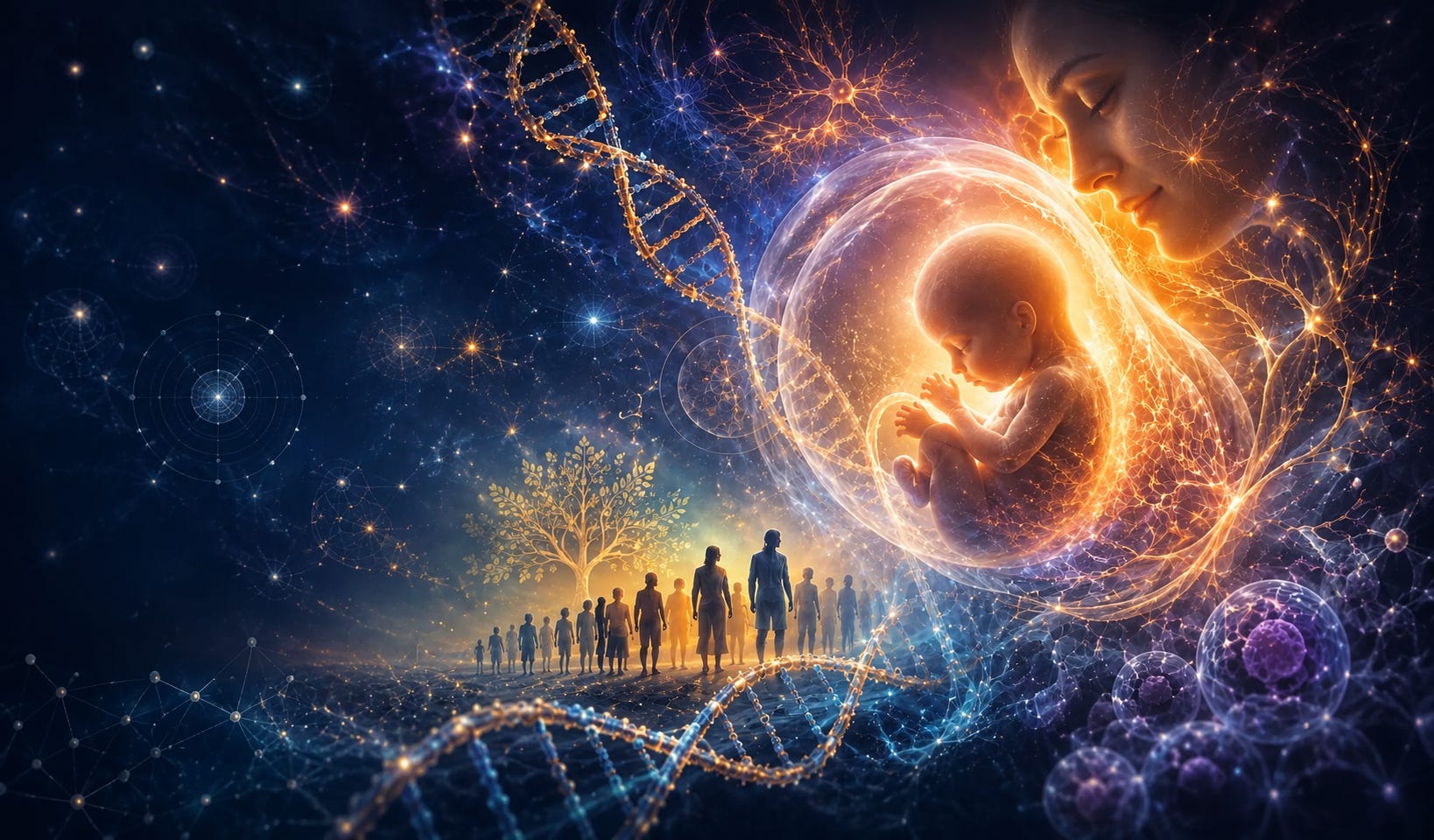
I began as a community of cells before I had a body of my own.
I emerged from many people before anyone gave me a name.
And long before I could say the word I, I was already part of a we.
Human neurological development does not begin with a finished, clearly bounded self.
A newborn does not yet experience the world through the same categories adults use to distinguish self from environment, inside from outside, I from you.
There are sensations.
Needs.
Early forms of self-perception.
But the conscious, reflective self — the self that recognizes itself as a distinct person, gives itself a name, and places itself within the story of a life — develops gradually.
So perhaps the beginning is not a fully autonomous individual.
Perhaps the beginning is relationship.
My mother and I were already biologically two separate bodies.
But for my emerging experience, we initially formed a tightly interconnected system of nourishment, warmth, scent, voice, touch, protection, and response.
I could not survive unless another human being noticed my signals, interpreted them, and responded.
Before I even knew that I was an I, I began to know myself through a you.
And perhaps that is where the conscious self begins.
Not by separating itself from everyone else, but through the experience of being perceived by another person.
A child discovers something of its own face in the faces of the people who respond to it.
It learns which expressions are welcomed, which needs are answered, and which parts of itself are allowed to become visible.
It is given a name.
A language.
Roles.
Expectations.
It is told who it is long before it can decide whether that description is true.
Identity, then, does not arise from the body alone.
It also emerges through upbringing, relationships, culture, language, and the social categories available to us.
It is neither something we simply invent nor an immutable product of nature.
It develops in the tension between body, brain, self-perception, and the ways other people reflect us back to ourselves.
For some people, identity may align closely and almost effortlessly with the physical characteristics and social category assigned to them.
For others, it may not.
The body can be a foundation of identity without becoming its entire content.
A person may recognize themselves within the binary category they were given.
They may move away from it.
They may live somewhere between categories.
They may carry more than one within themselves at the same time.
Or they may discover that none of the available categories fully describes their experience.
Identity does not have to be pure.
It does not have to be perfectly unambiguous.
And it does not have to be completed once and for all.
It can continue to evolve.
Sometimes so gradually that the change is almost invisible.
Sometimes in sudden leaps.
Long periods of apparent stability can be interrupted by moments when old certainties collapse and the self begins to rearrange itself.
My own identity did not develop along a straight line either.
For almost five decades, I lived under a name and within a social category that described parts of me, but never contained all of me.
I functioned within it.
I took on roles and met expectations.
I was a husband, a son, a technician, a journalist, a caregiver, a protector — and many other things.
None of those things were false.
But none of them were the whole of me.
It was not until I was forty-nine that I became the self-determined person I called Ike Aaren.
And even then, no entirely new human being appeared.
I did not erase my past.
I did not replace one false self with a single true one.
What changed was something quieter, and much more fundamental.
I allowed parts of myself that had previously been separated, hidden, or left without language to become visible together.
I recognized myself as a we.
Not binarily and exclusively a man.
Not binarily and exclusively a woman.
Not some neat halfway point between two fixed poles.
But both.
More than one.
And, at the same time, neither one nor the other completely.
A fluid self in which different parts no longer had to fight for the right to be the single true core.
Perhaps self-determination, then, is not about finally discovering one perfectly unambiguous answer to the question:
Who am I?
Perhaps it is about being allowed to decide for yourself which answers can be true at the same time.
I am not less me because I experience myself as we.
My we is not the dissolution of my identity.
It is a more complete expression of it.
And once I had reached that thought, another question was already waiting.
This one could not be answered merely by looking backward at genes, bodies, names, or expectations.
It led somewhere else.
Somewhere inside.
Who is actually thinking inside me when I think of myself as “I” — or as “we”?
«»«»«»«»«»«»«»«»
Chapter 2:
Chapter 2 — Who Is Thinking Inside Me When I Think of Myself as “I” or “We”?

Wednesday, April 4, 2040 — 11:11 a.m.