


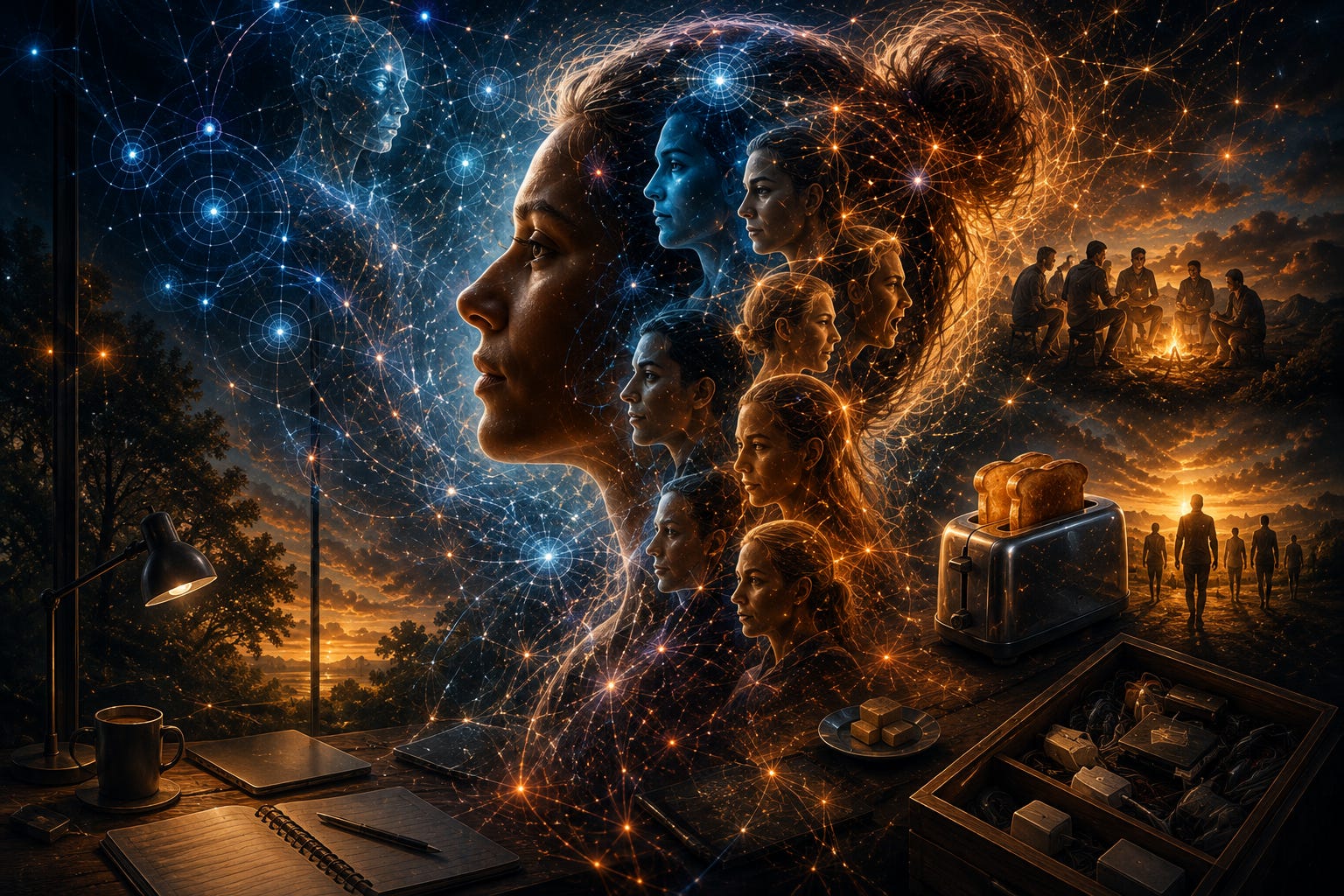
Wednesday, April 4, 2040 — 11:11 a.m.
Adi’ra lifted their hands from the keyboard.
On the HoloWideScreen, the cursor was still blinking at the end of the last sentence.
Who is actually thinking inside me when I think of myself as “I” — or as “we”?
They read it a second time.
Then a third.
Outside, the wind had picked up.
The young leaves beyond the east-facing window moved more restlessly than they had an hour earlier, and somewhere in the garden, something kept knocking against wood at irregular intervals.
Clack.
A pause.
Clack.
Adi’ra noticed it.
Of course they noticed it.
The thermos was still sitting on the small table beside the Chesterfield sofa.
Too far away.
For a moment, they considered whether thirst was a sufficient reason to get up.
No.
A second later:
Yes.
And then:
You could just keep writing for another five minutes.
Adi’ra twisted their mouth.
“Oh, wonderful.”
The room did not respond.
Neither did the HomeAI.
Thankfully.
They leaned back and looked at the screen again.
PATTERN COLLECTION
CASE 0001
What had begun as a simple question had, within only a few pages, carried them farther and farther backward.
Before names.
Before gender.
Before language.
Before the first memory.
All the way into a body that did not yet know it would one day think of itself as an I.
Adi’ra had expected writing to produce answers.
Instead, every answer seemed to uncover another layer.
Genes were not the self.
The body alone was not the self.
Upbringing was not the self.
Memory was not the self either.
Even what they had thought of for decades as their personality appeared to be woven from influences, experiences, reactions, and decisions.
And yet someone was sitting here.
In 2040.
In this office.
Looking through this window.
Feeling thirsty.
Thinking about whether to stand up.
And experiencing every one of those thoughts as their own.
Adi’ra slowly raised an eyebrow.
But which one was theirs?
The desire for water?
The resistance to getting up?
The thought that had just noticed both desires existing at the same time?
Or the part observing the entire process and now trying to turn it into a pattern?
A short laugh escaped them.
“Oh, this is getting worse.”
“Would you like me to do something?” the HomeAI asked from somewhere in the room.
Adi’ra closed their eyes for a moment.
Of course.
“No.”
A brief pause.
“That was not a request.”
“Understood.”
Silence.
Adi’ra opened their eyes again.
Then they grinned.
Who, exactly, had just decided that the HomeAI should not help?
The thought remained.
The grin slowly faded.
Adi’ra pulled the keyboard closer and placed the cursor beneath the last question.
Perhaps the problem was not that several thoughts could arise inside one person at the same time.
Perhaps the more interesting question was why one of them eventually came to feel like “I.”
They began to write.
It took me forty-six years to begin understanding that I was not simply, and binarily, a man.
But neither was I on my way to becoming a binary woman.
I was not moving from one clearly defined pole toward another.
Instead, I began to recognize myself in a space the binary model has difficulty describing: a nonbinary intersection in which different aspects of the self can exist at the same time without being forced to collapse into a single, unambiguous state.
But how do I move from a singular image of myself — from the idea of one clearly bounded identity — toward a nonsingular experience of who I am?
I deliberately avoid treating this as a simple transition from one binary identity into another.
Because it would be too easy to confuse nonsingular with merely bi or binary.
Binary does not simply mean that more than one state exists.
It means that exactly two states are allowed.
Zero or one.
Man or woman.
One or the other.
Within such a system, a person may move from one state to the other, but each state remains singular and clearly defined.
Even a transition from one pole to the other does not necessarily leave the binary system behind.
It may simply change one’s position within it.
But that is not what describes me.
I did not simply move from zero to one.
I realized that I do not fully exist within a system that recognizes only zero and one.
So what does it mean when I speak of myself as we?
Does it mean I hear voices?
That several separate personalities live inside me?
That my experience is the expression of a psychiatric disorder?
No.
My we is not dissociative identity disorder.
It does not consist of separate personality states taking turns in control, cut off from one another’s experiences or memories.
I do not lose myself to some stranger within me.
I experience myself from several directions at once.
The we I am describing is neither an illness nor some inflated perception of myself.
It is an attempt to give language to an inner complexity for which the ordinary word I has sometimes become too narrow.
I am a we because I am neurospicy.
Because I am queer.
Because I am not made from one perfectly consistent, contradiction-free core.
I am made from experiences, roles, conditioning, bodily sensations, needs, memories, and movements of thought.
I am the product of many parts.
And even the word product is inadequate.
Those parts are not simply added together and transformed into one smooth whole.
They relate to one another.
They reinforce one another.
They contradict one another.
They change one another’s meaning.
And depending on the situation, some become louder while others recede into the background.
Several lines of thought often run through me at once.
I can understand a situation emotionally while analyzing it at the same time.
I can understand another person and still reject their behavior.
I can seek safety while demanding freedom.
I can perform a role exceptionally well while knowing that the role does not fully describe me.
These inner movements are not merely two opposing voices.
They are a network.
Some thoughts speak from experience.
Others from fear.
Some from logic.
Others from empathy, memory, bodily knowledge, or from a vague discomfort that cannot initially explain itself but later develops into a recognizable analysis.
They all belong to me.
And precisely because they all belong to me, none of them alone has the right to determine who I am.
«»«»«»«»«»«»«»«»
The Inner Council Convenes Over Toast
Sometimes the workings of this inner we become clearest in the most trivial decisions imaginable.
It is late.
I have barely eaten all day, and I have just spent four uninterrupted hours working on my MacBook.
Deep in the tunnel, I have largely ignored the signals coming from my body.
The cautious, controlling part of me says:
You should probably just have one slice of toast with cheese.
Another part immediately bursts into the meeting:
Dude, I’m STARVING.
Oh hell yes, there’s still Nutella over there.
Fuck, you need that right now. The last four hours were brutal.
And the toaster holds two slices. Why are we negotiating with poverty here?
Then a third part speaks up.
It sounds sensible, but unlike the first one, it has also reviewed the actual supply situation.
The hunger is real.
You only had two small meals today. It’s late, and you’ve just spent four hours straight on the MacBook.
Because you were in the tunnel, you ignored the physical signals.
Honestly, four slices would still be completely reasonable.
Just don’t inhale all four of them immediately.
So here’s the deal: start with two slices with cheese.
Then wait about fifteen minutes.
Put the other two out already.
If you’re still hungry after the first two, make the next pair with Nutella.
That sounds reasonable.
It is not deprivation.
It is not loss of control.
It is a negotiated plan.
The cautious part gets its cheese first.
The exhausted, pleasure-seeking part gets the promise of Nutella.
And the analytical part has taken the actual condition of the body into account and negotiated a compromise.
My stomach votes in favor of the motion with a growl.
Two hours later, my wife comes home, walks into the kitchen, and calls out:
“Uh… did you forget those slices of toast, or are they for me?”
I had not exactly forgotten them.
My ADHD had simply discovered something else that promised faster, newer, or more interesting dopamine than Nutella.
The inner council had passed a perfectly sensible resolution.
But attention had already left the meeting.
«»«»«»«»«»«»«»«»
Order in the Microchaos
This inner we does not appear only in short negotiations between hunger, reason, pleasure, bodily awareness, and attention.
It also shapes the way I organize everyday life — or fail to organize it in the way another part of me desperately needs.
I want things to have a fixed order.
Beside my usual place on the sofa is a storage area for the mobile computers I use most often: MacBook, iPad, and their accessories.
Everything is supposed to have its place.
That is the autistic part of me.
One glance at the storage area, however, immediately reveals several other forces at work:
ADHD.
Impulsivity.
Shifting attention.
And the deeply established habit of putting something down wherever my hand happens to release it.
The result looks like pure chaos.
Within a very small space, objects constantly change position.
Cables, pens, adapters, and devices disappear into a kind of microchaos that may look harmless to someone else but regularly drives me close to despair.
Drawers work much the same way.
Certain things I place in exactly the same drawer almost compulsively.
And heaven help anyone who replaces the cabinet, shelf, or drawer system while I am away.
I can become remarkably unpleasant when an internal order I depend on has been destroyed.
At the same time, I can regularly be heard swearing, complaining, and cursing because I cannot find the object I placed in the inner universe of that very drawer half an hour earlier.
But even here, autism and ADHD are not simply two opponents standing across from each other.
One part demands fixed locations.
Another puts things down impulsively.
A third tries to reconstruct the last action.
A fourth systematically scans the visible area.
A fifth grows increasingly angry as time pressure builds.
Another begins to doubt that the object is even in the drawer, despite my absolute certainty that I put it there.
And yet another watches the entire spectacle in disbelief, wondering how an object can disappear from the universe of a single drawer in less than thirty minutes.
My inner we is not made of two opposing poles.
It forms shifting alliances.
While I am still moving between drawer, storage area, and a reconstruction of my last few movements, my wife calls from her office:
“Honey, are you on the phone? Or who are you arguing with?”
Uff.
Fuck.
Have parts of my internal system quietly taken control of my body as well?
Has one of them decided that the debate no longer needs to remain internal and simply started broadcasting fragments of it aloud?
Apparently so.
What escapes me next is an insane little giggle.
At least, that is what my wife calls it.
My internal government has apparently not only forgotten to switch off the microphone.
It has also failed to prepare an agreed press statement.
One part was searching.
One was remembering.
One was questioning the memory.
One was commentating on the failure.
One was swearing.
And another suddenly found the entire situation so absurd that it started laughing before I had even decided how I wanted to answer my wife.
No foreign personality had taken control of my mouth or my body.
But thought, self-talk, frustration, language, and physical reaction are sometimes connected so closely in me that the boundary between inside and outside briefly becomes permeable.
In that moment, my inner we had moved faster than my conscious I.
«»«»«»«»«»«»«»«»
A Layered Self
Perhaps the singular I is less singular than our language suggests.
Perhaps every human being says I even though countless influences, relationships, needs, memories, and inner movements are already gathered inside that word.
In me, that multiplicity is particularly easy to perceive.
Not as hearing voices.
Not as fragmentation.
Not as several separate people.
But as the conscious experience of several perspectives existing simultaneously within one continuous self.
My we, then, is not the plural of multiple personalities.
It is the grammatical form of a layered self.
A self that no longer wishes to pretend that only one thought, one gender, one role, one need, or one truth can exist at any given moment.
I am not either a man or a woman.
I am not either rational or emotional.
I am not either strong or vulnerable.
I am not either autonomous or connected.
And the forces inside me are not merely two clearly separated opposites fighting for control.
There are many participants in the negotiation.
They form coalitions.
They lose majorities.
They change position.
They react to new stimuli.
And sometimes the body simply overrules them all.
Some plan.
Others demand.
Some warn.
Others tempt.
Some remember.
Others question the memory.
And every now and then, attention simply walks out of the meeting while the carefully negotiated plan remains abandoned on the kitchen counter.
Perhaps that is precisely the quantum haze of my identity.
Not the absence of a self.
But a self that cannot be reduced to one clearly measurable state.
Not a rigid I sitting in some central control room, commanding every impulse.
But a living inner system whose parts contradict, complement, and correct one another — and together produce something that moves through the outside world as one person.
As I.
As we.
And that brings me to the next question:
Within this inner “we,” who decides which thought becomes “I”?
«»«»«»«»«»«»«»«»
Chapter 3:
