


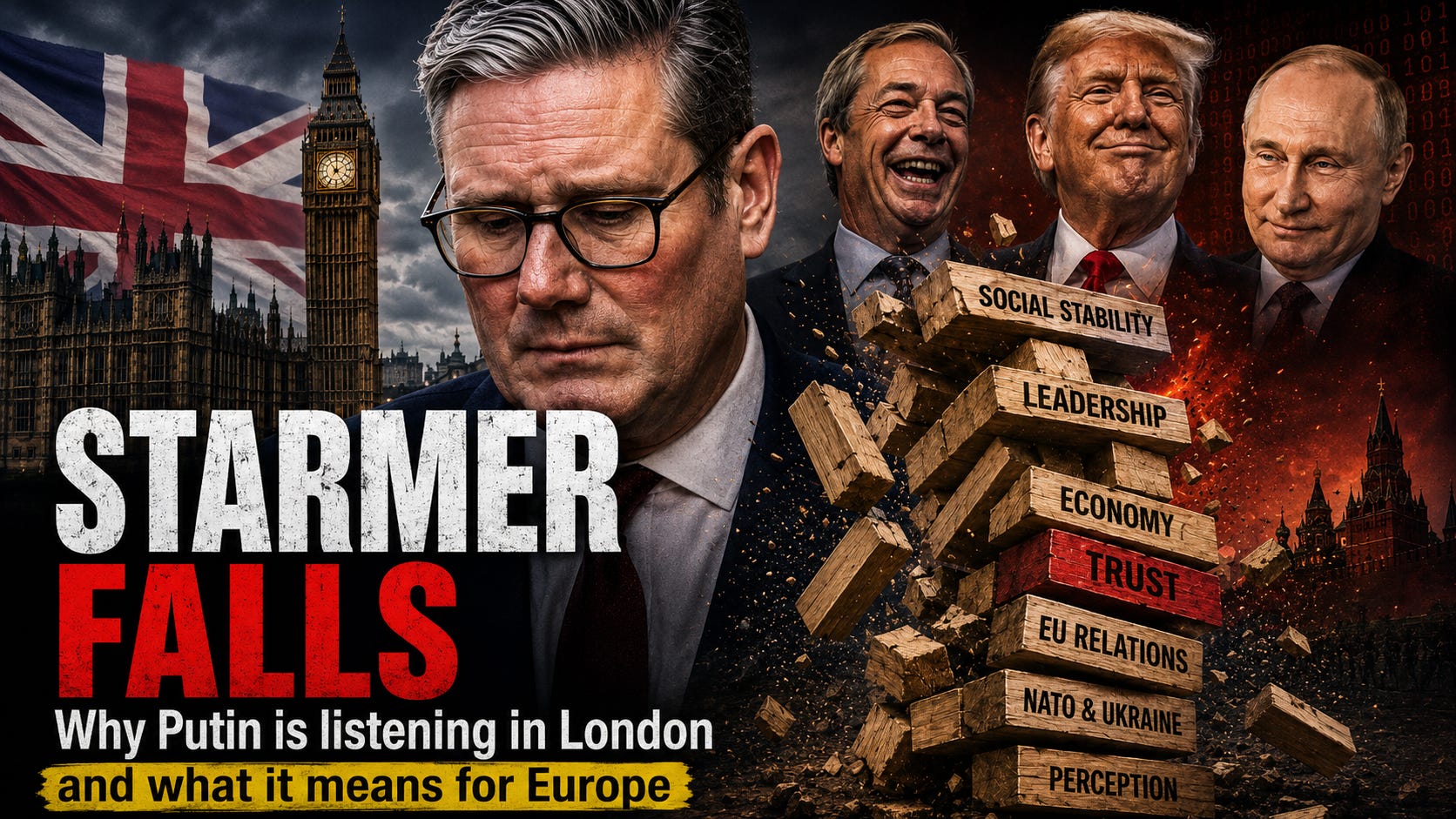
Why read this text when everyone is already writing about Starmer’s resignation?
Because this is not just about London. Not just about Keir Starmer. Not just about Labour, Nigel Farage, or the next power shift in Downing Street.
It is about why Western centrist governments, despite majorities, institutions, and foreign-policy rationality, can suddenly become politically brittle — and why exactly this brittleness can be exploited by Trump, Farage, and Putin.
This text does not try to retell the next headline.
It asks what is moving underneath it.
Keir Starmer was not the man who wanted to shake British democracy. Quite the opposite. He was the man meant to calm it down after the garish years of Brexit, Boris Johnson, Liz Truss, and Conservative exhaustion.
The lawyer.
The technocrat.
The repairman.
A man who did not shout, but sorted. Who did not set fire to the stage, but tried to clean up after the performance. Who was supposed to bring something like seriousness back into Downing Street after years of political foam and spectacle.
Now he is going.
And that is precisely the force of this resignation: it is not a populist who has failed reality; not a gambler who has collapsed under his own arrogance; not a political arsonist burned by the flames he himself had lit.
What has failed is a man of the center, who came into office with a historic majority, who appeared reliable in foreign policy, who supported Ukraine, who wanted to repair relations with Europe, and who sought to return Britain to the world stage as a grown-up actor after years of post-Brexit self-harm.
But politics rarely fails because of the one brick visibly falling out of the wall.
It fails when too many load-bearing stones lose strength at the same time.
For Starmer, those stones were the cost of living that did not disappear; public services that did not improve quickly enough; a Labour parliamentary party growing nervous; Reform UK, with Nigel Farage reopening the old Brexit wound from the hard right; and Andy Burnham, who was suddenly no longer just the popular mayor of Greater Manchester on the sidelines, but a real alternative after entering Parliament.
In the classic political narrative, this sounds simple: Starmer lost support, Burnham gained momentum, Labour pulled the emergency brake.
But that explanation is too small.
Because Starmer’s fall is not an isolated Westminster drama. It is a European symptom. It shows how dangerously unstable centrist governments can become when they are expected to promise social relief, shoulder massive defense spending, support Ukraine, contain Trump, deter Putin — and at the same time prevent right-wing protest parties from turning public unease into anger.
Western democracies are not living through one crisis.
They are living through several crises that keep shifting weight onto one another.
That is what makes the British case so significant.
Britain Is Not Just Another European State
Britain is a nuclear power, a NATO heavyweight, an intelligence power, a key supporter of Ukraine, a bridge to the United States — and, after Brexit, a country that has surgically removed itself from the European Union without ever finding a stable new political identity.
Whoever governs in London is therefore not only managing struggling hospitals, rising rents, energy prices, and rail infrastructure.
They also stand on a security pillar watched from Washington to Kyiv, from Brussels to Moscow.
Starmer had tried to stabilize that pillar.
In foreign policy, that was visible enough. The long-term partnership with Ukraine, the rapprochement with the EU, the clear NATO line toward Russia: none of this was background noise. It was part of a British attempt not to slide further into strategic irrelevance after Brexit.
London wanted to be reliable again without crawling back to Brussels.
To act European without saying “Europe” too loudly at home.
To remain close to the United States without fully surrendering itself to Donald Trump.
The problem was this: foreign-policy rationality does not win constituencies when people at home feel their daily lives getting tighter.
Foreign Policy Does Not Pay the Rent
This is where the real tragedy of the center begins.
It can be right and still lose.
It can correctly analyze that Putin must be stopped, that Ukraine must not be abandoned, that NATO states need to spend more on defense, and that an erratic US president forces Europe to build more strategic autonomy.
But if that same center cannot explain why this security burden must not be played off against the grocery bill, the heating bill, the dentist appointment, the rent, and the future of one’s own children, then a gap opens.
And into that gap step Farage, Trump, and Putin — each in his own way.
Farage says: Look, they care about everything except you.
Trump says: Look, they are weak, they need me.
Putin says: Look, the West is getting tired.
The insidious part is that this narrative does not have to be entirely true to become politically effective.
Britain does not collapse just because Starmer leaves. NATO does not break just because Labour changes its leader. Support for Ukraine does not automatically end just because a new prime minister moves into Downing Street.
Institutions, treaties, military staffs, intelligence agencies, budget lines, and diplomatic channels remain in place.
But perception is itself a political force.
When the liberal center looks weak, it is treated as weak. When it wobbles, it gets pushed. When it offers defensive explanations while populists tell simple stories of blame, it does not lose the facts first.
It loses the rhythm.
Burnham’s Impossible Task
Andy Burnham, should he indeed lead Labour into its next phase, will not inherit a neatly ordered machinery of government.
He will inherit an overloaded stability tower.
He has to achieve very quickly what Starmer no longer could: he has to put the social and security-policy parts of politics back into one sentence.
He has to explain that aid for Ukraine is not a moral luxury expense, but European self-defense.
That higher defense spending must not mean hollowing out the welfare state, but precisely for that reason requires a new industrial, regional, and social strategy.
That an EU reset does not have to mean reversing Brexit, but can be framed as an attempt to give British households, British companies, and British security more room to breathe.
And that dealing with Trump can be neither slavish flattery nor symbolic outrage, but must be cool, transactional, and self-confident defense of British interests.
That is easier to write than to govern.
Because Burnham will be tested from every side.
Farage will brand him as a prime minister without a direct mandate and build a democratic grievance story around it, even though such a change is constitutionally normal in the British system.
Trump will check whether the new man in London can withstand pressure: on defense spending, China, energy, Iran, Ukraine, or trade.
Brussels will want to know how far the British EU reset can really go.
Kyiv will look for immediate reassurance.
And Moscow, as always, will treat every transition as an invitation to test the seams.
Putin does not have to believe Britain is weak.
It is enough if he believes Britain is distracted.
The West Is Not Collapsing. But It Is Becoming More Vulnerable.
That is the difference between collapse and vulnerability.
The West has not collapsed. But it has become more vulnerable because its societies no longer experience the burdens of security policy, inflation, migration, infrastructure decay, climate crisis, and geopolitical reordering as separate issues.
For citizens, all of it eventually lands in the same account: money, time, trust, and what still feels bearable.
And that is where the most dangerous tipping point lies.
Not only on the Ukrainian front line.
Not in NATO headquarters.
Not in the Oval Office.
But in the question of whether democratic governments can still plausibly show their populations that external security and internal justice belong together.
If that connection breaks, security policy is perceived as an elite project, Ukraine aid as someone else’s invoice, defense spending as an attack on the welfare state, and European cooperation as a betrayal of national control.
That is the moment when right-wing movements no longer merely collect protest.
They begin to change strategic stability.
The Warning for Berlin
For Europe, Starmer’s resignation is therefore a warning with flashing blue lights.
Because the British crisis is not British enough to let us feel safe.
Germany knows the ingredients too: an exhausted center, rising security costs, an aggressive right, a population expecting relief, an industry under pressure, a Ukraine policy that has to be explained, and a transatlantic relationship that, under Trump, no longer functions as a stable backstop.
Here too, a government can be formally capable of acting while politically losing elasticity.
Here too, a chancellery can believe that communicating constraints is enough, while outside an emotional counter-reality is already forming.
Here too, the right thing can fail if it is poorly narrated, unfairly distributed, and socially undersecured.
The lesson from London is therefore not that the center must become more populist. It is that the center must become tangible again.
It has to show that security does not only mean tanks, missiles, intelligence agencies, and NATO summits, but also affordable energy, functioning hospitals, resilient infrastructure, decent work, regional dignity, and the feeling that one is not merely a number in a geopolitical PowerPoint slide.
Anyone who wants to deter Putin must not only procure ammunition.
They must also stabilize the democratic consent that makes that ammunition politically possible.
Reason Alone Is No Longer Enough
Starmer did not embody this connection strongly enough.
Perhaps he understood it. Perhaps he even tried to build politics around it.
But in the end, he too often looked like a prime minister who had read the right file while someone else outside had already written the headline.
Andy Burnham now gets the chance to correct that mistake.
He has to relieve households without encouraging Putin.
He has to treat Trump politely without allowing himself to be humiliated.
He has to move closer to Europe without handing Farage the perfect Brexit betrayal campaign.
He has to give Labour a new tone without throwing the state into chaos.
And he has to show Ukraine that British support was never tied to one exhausted prime minister, but to Britain’s strategic interest.
This is not just a change of government.
It is a stress test.
For London. For Europe. For NATO. For Kyiv. And for that political center which still believes that reason is enough if it is explained long enough.
But reason that produces no warmth freezes politically.
And a democracy whose center goes cold will be heated by those who like to play with fire.
Starmer is leaving because too many burdens rested on his political tower at once. Burnham may be able to stabilize it.
But the real question reaches far beyond Westminster:
Whether Europe understands that its security architecture can only hold if the social ground underneath it does not keep breaking.
This text follows my PJenga analysis approach: politics is not treated as a linear chain of events, but as a system of connected stability towers in which social, military, economic, and narrative burdens shift weight onto one another.