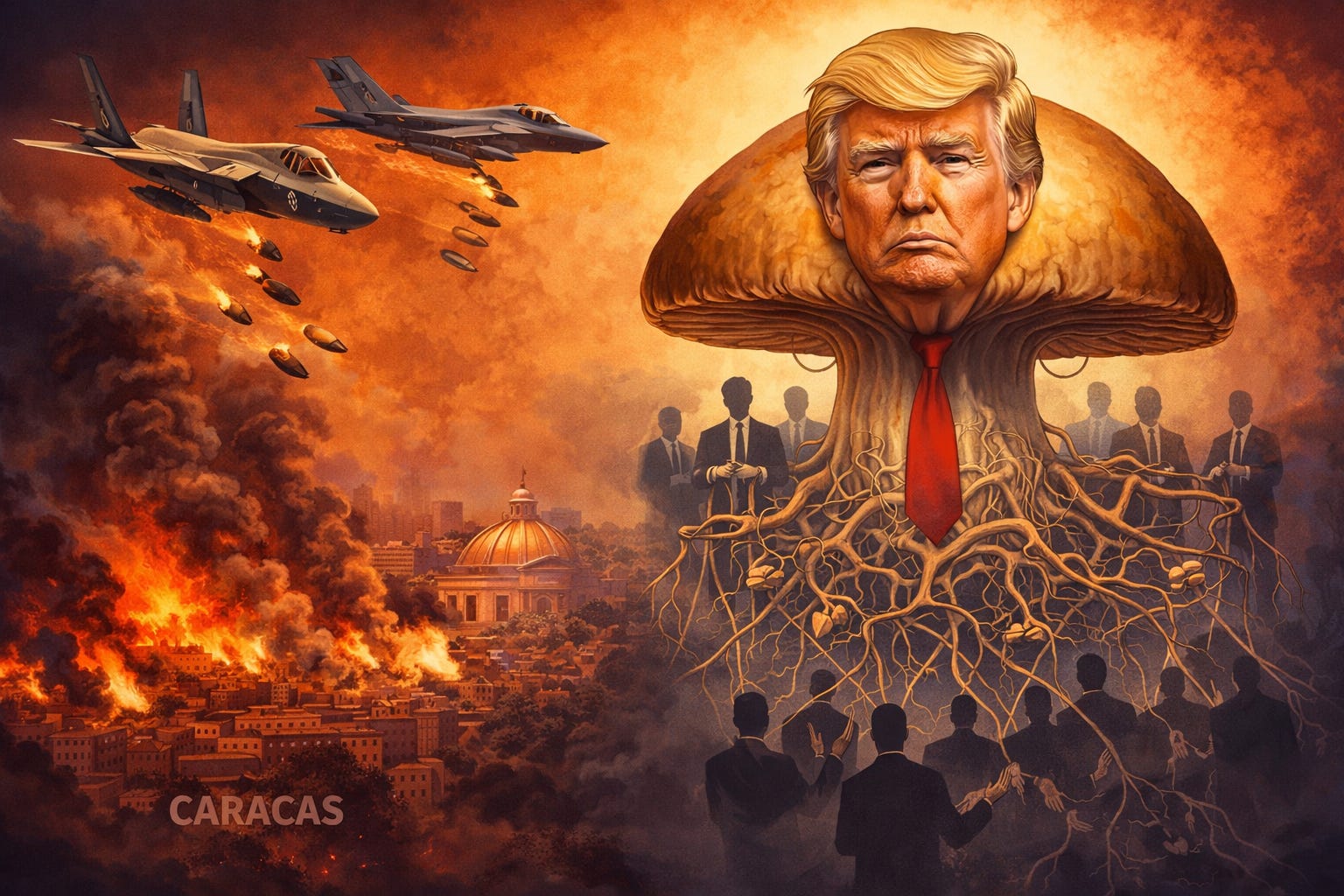
Part 0 — When Power Stops Pretending
At first glance, the situation appears familiar.
A US military operation in Venezuela.
Condemnations from Europe.
Statements invoking international law, sovereignty, and the rules-based order.
Calls for restraint. Demands for clarification. Expressions of concern.
This is the language we know.
It is the language of reaction, of process, of institutions still speaking as if the grammar of global order has not fundamentally changed.
And this is precisely the problem.
What we are witnessing is not primarily a legal dispute, nor a regional military escalation, nor even a crisis of diplomacy. Those are surface phenomena. They absorb attention, generate debate, and keep observers busy arguing details.
But beneath that surface, something else is happening.
Power is no longer pretending.
For decades, global politics operated on a shared fiction: that power submits to rules, that force requires justification, that interests must be cloaked in norms. Even when those rules were violated, they were violated discreetly. Language mattered. Appearances mattered.
That era is ending.
The Venezuela operation is not remarkable because it breaks international law. Many actors have done so before. It is remarkable because it does so without apology, without rhetorical camouflage, and without meaningful concern for institutional validation.
This is not an accident. It is a signal.
The United States, under Trump, is no longer primarily engaging in norm-management. It is engaging in fact-creation. Military, economic, communicative facts. Once created, these facts force others to respond on terrain not of their choosing.
Europe, by contrast, continues to respond as if the old script still applies.
Declarations of illegality.
References to European interests.
Appeals to shared values.
None of this is wrong.
But it is insufficient.
The raised finger only works when rules are enforceable—or at least feared. When enforcement collapses, moral clarity becomes commentary, not power.
This is why the contrast feels so stark.
While European leaders deliberate, Trump acts.
While Europe interprets, Trump sets.
While institutions speak, realities harden.
And this dynamic does not begin with Venezuela.
It stretches backward: to Trump’s erratic but revealing relationship with Putin, to his explicit confrontation with China, to his long-standing contempt for multilateral constraint. It also stretches forward, into spaces where others are watching closely—Moscow, Beijing, Tehran—calculating what this new openness of force enables or forecloses.
The critical shift is not geopolitical alignment.
It is ontological.
What counts as order?
What counts as legitimacy?
What counts as deterrence?
When power ceases to disguise itself, the rules do not disappear overnight—but they hollow out. Institutions remain, but their gravity weakens. Legal frameworks persist, but without the ability to shape outcomes.
This is why focusing exclusively on legality misses the point.
The deeper question is this:
What happens when a central actor begins to treat international order not as a binding structure, but as optional background noise?
And perhaps more importantly:
Who benefits, who loses, and who suddenly finds their own strategies exposed?
This series does not argue that this shift is good.
Nor does it argue that it is irreversible.
But it insists on something more uncomfortable:
that pretending the old order still governs behavior is now analytically dishonest.
To understand what is unfolding, we must stop narrating events as isolated incidents and start tracing the structural logic beneath them—the economic incentives, the energy flows, the shadow logistics, the power networks that quietly reconfigure the map while attention remains fixed on statements and summits.
Part 0 is the threshold.
What follows in Parts 1–4 dissects this transformation step by step:
how the Venezuela operation fits into a wider strategic pattern,
how it constrains some actors while empowering others,
how it reshapes deterrence, dependency, and decision-space far beyond Latin America.
This is not a story about one operation.
It is a story about what happens when power stops pretending—and forces everyone else to decide whether they will continue to speak the language of a world that no longer exists.
Read the main analysis (Parts 1–4):
Venezuela Operation: A Regional Strike — or the Signal of a New Logic of Power?