

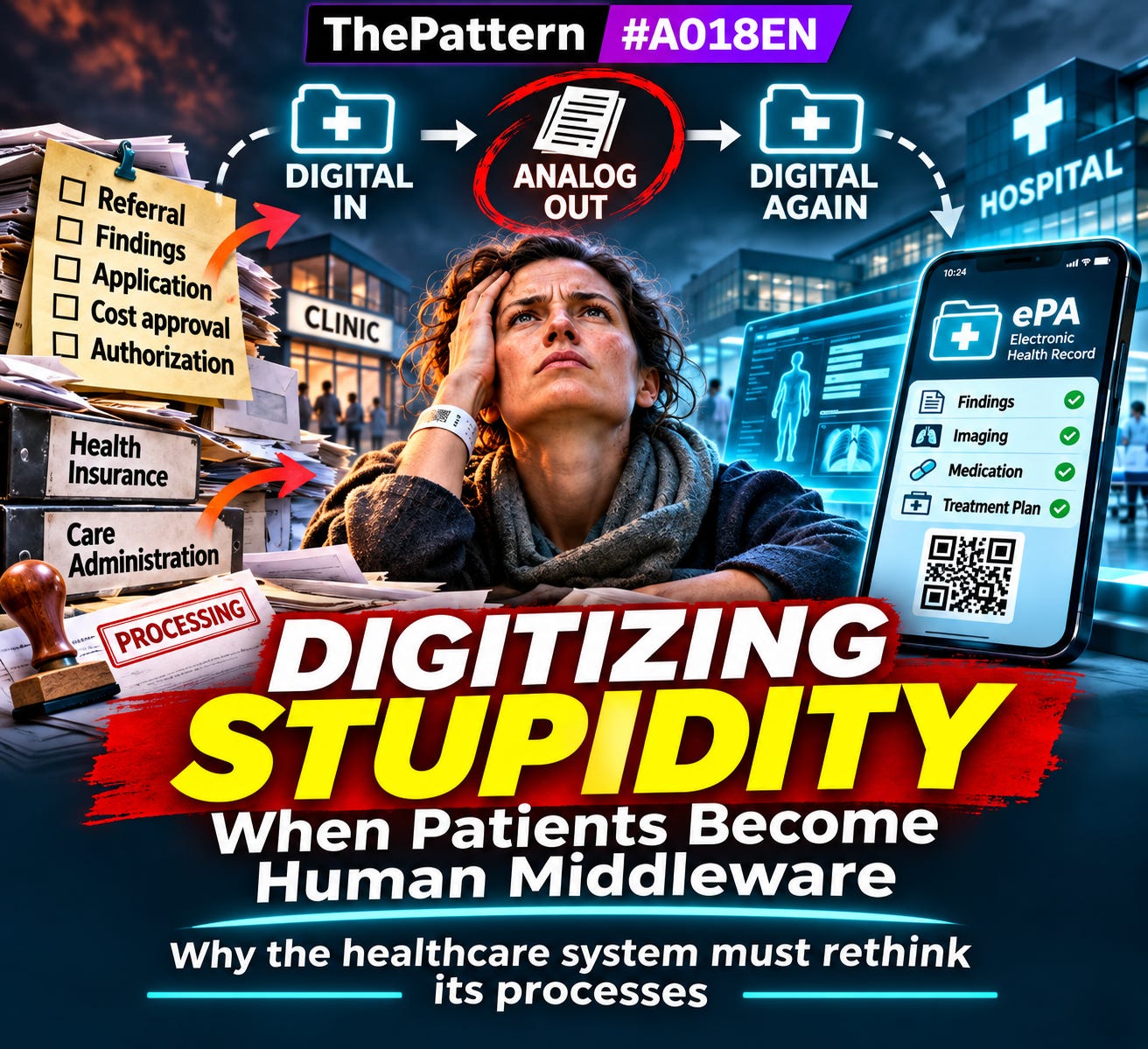
On electronic patient records (ePA - electronic patient archive), institutional path dependence, and a patient who involuntarily became the interface manager of the German healthcare system.
We have the technology. What’s missing is process thinking.
Over the past few weeks, my journalistic work has focused on various administrative and communication problems within the German healthcare system. The starting point was neither theoretical considerations nor scientific studies or political debates, but my own experiences as a patient.
The delayed or entirely absent provision of medical documents in my electronic patient record, the communication between the University Medical Center Hamburg-Eppendorf (UKE) and another hospital that might be able to offer me surgery sooner, and the downright absurd communication between my long-term care insurance fund and the Medical Service responsible for assessing my care needs.
Three different cases, different institutions, different responsibilities. And yet, I increasingly recognize the same pattern.
We are digitizing our healthcare system without consistently abandoning the workflows of a pre-digital world.
As someone whose professional background includes enterprise IT, infrastructure architecture, and process automation, I find it increasingly difficult to explain some of these problems by pointing to a lack of technological capabilities.
Because more often than not, the technology already exists.
A QR code. Nothing more.
Due to my serious spinal condition, I am currently trying to obtain a neurosurgical assessment from BG Klinikum Hamburg in Boberg to determine whether surgery could potentially be performed there sooner.
To make that assessment, the hospital needs access to my radiological data, particularly the MRI and CT scans already held by UKE.
These data were generated digitally, processed digitally, evaluated digitally, and are stored digitally.
And yet, through several emails, I had to explain why, as a patient with significantly impaired mobility, I cannot simply travel to one hospital, collect my medical data, and then deliver them to another hospital.
I had already requested the documents. I had not received them. And I had already granted Boberg access to my electronic patient record, known in Germany as the elektronische Patientenakte, or ePA - electronic patient archive.
According to its own website, UKE already operates a system that makes radiological images and their corresponding reports accessible online through a QR code.
Which brings me to an extraordinarily simple question:
Why isn’t this QR code routinely included in the discharge report?
Accompanied, of course, by the corresponding URL in a readable, clickable, and machine-readable format. After all, expecting someone to scan a QR code with the very smartphone displaying it makes remarkably little sense.
Once finalized, that report should immediately be uploaded to the electronic patient record, provided the patient has not objected to the corresponding provision of data.
The original radiological images could remain within the hospital’s imaging archive. Access would, of course, need to be appropriately secured and made available to authorized healthcare providers.
Coming up with this idea required neither considerable time nor any particularly impressive computational effort on the part of my brain.
It is not a technological innovation, a revolutionary concept, or some grand vision for healthcare in the year 2050.
It is simply the logical integration of technological capabilities that already exist.
Authorization to authorize?
During my communication with Boberg, I was also required to provide a written authorization releasing the institutions from their duty of medical confidentiality, allowing the two hospitals to exchange information and involving my wife in the process.
Why, exactly, is this additional effort necessary?
I have an electronic patient record. Through its associated app, I can grant a healthcare institution access to my medical documents, even before attending an appointment in person. I can determine the duration of that authorization and revoke it.
The ePA also allows me to appoint a digital representative, meaning that my wife could manage my electronic patient record on my behalf.
Authentication, authorization, delegation, and access logging are therefore not technological concepts that still need to be invented.
They are already part of the system.
If UKE makes the relevant documents available in my ePA and I authorize Boberg to access them, the necessary exchange of documents is already enabled through that infrastructure.
Of course, granting access to an electronic patient record does not constitute a general waiver of medical confidentiality for every conversation or transfer of information outside that record.
But that is precisely my point!
Why must I establish an additional communication channel through separate written authorizations when the necessary exchange of documents could take place through an existing digital infrastructure specifically designed for that purpose, and which I have already authorized?
It is not data protection that is obstructing me here.
It is the failure to consistently use an infrastructure that was created, among other things, to facilitate precisely this kind of exchange in a manner compliant with data protection requirements.
Digital in, analog out, digital back in …
Things become even more absurd when applying for an official assessment of my long-term care needs.
In Germany, this assessment determines a person’s Pflegegrad, or care grade, which establishes their eligibility for various benefits under the statutory long-term care insurance system.
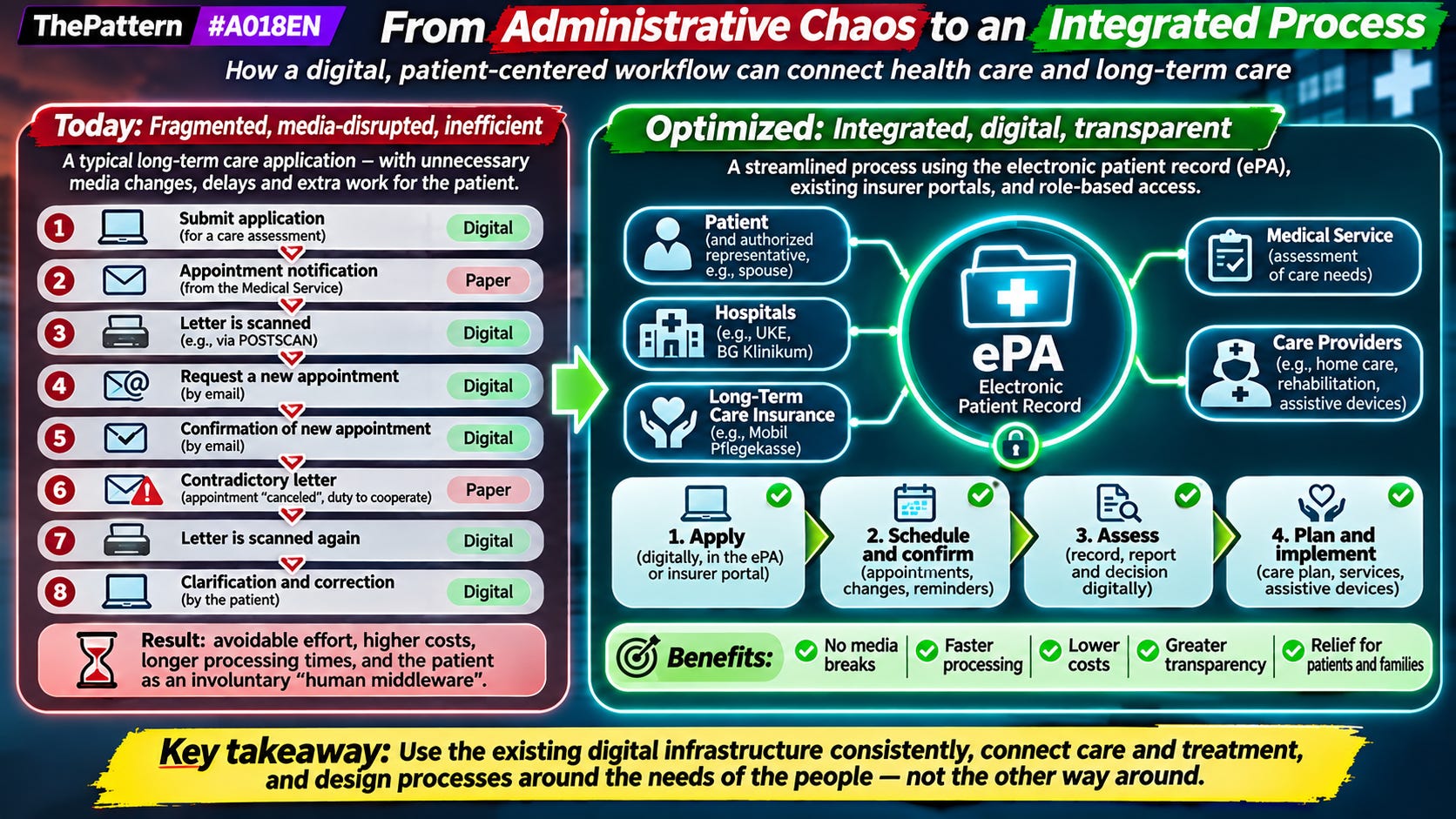
I submitted my application digitally to my insurer, Mobil Pflegekasse.
In response, I received a physical letter from Medizinischer Dienst Nord, the regional Medical Service responsible for conducting the assessment, informing me of an appointment that had been assigned to me.
Because I use Deutsche Post’s POSTSCAN service, the letter was scanned and made available to me digitally.
Unfortunately, the appointment conflicted with an important specialist appointment at UKE. I therefore contacted the Medical Service by email and requested a different appointment, which they subsequently confirmed by email.
My long-term care insurance fund then sent me another physical letter, informing me that the assessment appointment could not take place and reminding me of my obligation to cooperate.
Mind you, this letter was issued eight days before the originally scheduled appointment.
Deutsche Post scanned that letter for me as well, allowing me to respond digitally once again.
Am I really the only person who notices how utterly ridiculous this process is?
Digital application
Physical letter
Digitization of the letter
Digital communication
Digital confirmation
Contradictory processing of the case
Another physical letter
Another digitization
Digital correction of the administrative error by the applicant
I am literally paying a service provider to digitize information that the institutions involved had previously taken out of their digital environments and printed onto paper.
Take a moment to consider that, particularly against the backdrop of discussions about rising social insurance contributions, administrative costs, and staffing shortages.
We employ people and technological systems to convert information back and forth between different media, even though that information was digital in the first place.
And then we employ even more people to resolve the communication problems that arise in the process.
Digitization is not the introduction of software
An excellent neurosurgeon does not need to be a process engineer. A qualified nurse does not need to design enterprise architecture, and I certainly do not expect an insurance clerk to develop the cross-organizational IT infrastructure of the German healthcare system.
But who does?
Who within these institutions is examining the new possibilities created by digital systems, identifying which existing workflows have become obsolete, and redesigning processes accordingly?
Who regularly checks whether employees are even aware of these possibilities?
Who organizes recurring training sessions that go beyond teaching people how to operate a piece of software and explain how the introduction of that software can fundamentally change the way they work?
And above all, who is responsible for actually retiring obsolete processes?
Medical expertise and technical process expertise are not mutually exclusive. Quite the contrary, they need to complement each other.
Introducing software merely provides a tool. If I subsequently retain all my existing workflows and simply use that new tool alongside them, I may not have eliminated any work whatsoever.
I may simply have created another system that needs to be operated, maintained, and financed.
In organizational science, one of the concepts used to describe this phenomenon is path dependence: the persistence of historically established structures and procedures, even though the circumstances under which they originally developed have changed.
That is increasingly the impression I get from the German healthcare system.
Bada bing, bada boom. Done!
And while we are considering what could be accomplished with the electronic patient record, why not go one small step further?
Why not establish a dedicated, appropriately protected section within the ePA, simply called Long-Term Care?
It could contain:
Applications for care assessments and their processing status
Appointment proposals and confirmations
Correspondence with the long-term care insurance fund and the Medical Service
Assessment reports and official decisions
Care planning and documentation
Information regarding medical and assistive equipment
Purpose-specific access permissions and representative authorizations
People requiring long-term care frequently require medical treatment as well. Healthcare and nursing care often go hand in hand.
Why, then, should we artificially separate at the level of digital information architecture what is inherently connected in the lives of the people concerned?
Interestingly, Section 341(2), No. 10 of Germany’s Social Code, Book V (SGB V), already expressly provides for the inclusion of nursing care data in the electronic patient record.
Care providers can also access the ePA and upload care-related documents within the scope of their statutory permissions.
What is currently missing is an integrated administrative and communication environment for applying for and organizing long-term care services.
The existing access architecture would need to be extended to include clearly defined, purpose-specific roles. Neither the insurance fund nor the Medical Service should thereby receive unrestricted access to all of an insured person’s medical data.
But why should we repeatedly develop separate portals, apps, user accounts, and authentication procedures for every additional administrative area when a patient-controlled digital infrastructure already exists?
Proposed workflow: A digitally integrated long-term care application process, using the electronic patient record, existing insurance portals and apps, and an analog alternative for those who cannot or do not wish to use digital services.
The patient as human middleware
In information technology, middleware refers to software that facilitates communication and data exchange between different applications and systems.
Within the German healthcare system, it appears that the patient is increasingly expected to perform this function.
The patient obtains information, transfers documents, translates between different organizational responsibilities, identifies inconsistencies, corrects errors, monitors unresolved issues, and escalates them when necessary.
And all of this is expected during a period in which the patient’s ability to perform these tasks may be significantly impaired.
My professional background enables me to recognize many of these problems for what they are in the first place. I can reconstruct workflows, digitize documents, manage access permissions, and confront the institutions involved with their contradictory statements.
But what about an 80-year-old living alone who possesses neither my technical knowledge nor my technical equipment?
What about people living with cognitive impairments, depression, chronic pain, or neurological conditions?
How many people simply give up at some point?
And do these people even appear in the statistics that the responsible institutions use to evaluate the quality of their administrative processes?
Process quality is measurable
Anyone serious about digitizing healthcare should not merely count the number of electronic patient records created or the number of institutions technically connected to Germany’s healthcare telematics infrastructure.
I would be interested in entirely different performance indicators.
How many medical documents are successfully made available immediately after completion? How often does the transfer fail? How many additional contacts must a patient initiate to obtain missing information? How many transitions between digital and analog media occur within a single administrative procedure? How many working hours are consumed by the subsequent correction of avoidable errors?
And perhaps the most important question of all:
How much work must a sick person perform just to get their own medical treatment and nursing care organized?
Those are the kinds of performance indicators that would actually allow us to determine whether digitization is fulfilling its intended purpose.
Who bears responsibility?
I have submitted a series of journalistic questions to the executive board of UKE concerning electronic patient records, patient safety, and organizational responsibility.
At the time of writing, I have received nothing more than an acknowledgment from the hospital’s complaints management department, but no substantive response.
I have also submitted a series of journalistic questions to Mobil Pflegekasse and Medizinischer Dienst Nord regarding their cross-organizational administrative processes.
Their responses are still pending.
My intention is explicitly not to hold individual employees of these institutions personally responsible for the problems I have encountered.
This is about the responsibility of those whose job it is to develop functional organizational structures, verify that those structures actually work, and adapt them to changing technological capabilities.
Executives, IT departments, quality managers, and management consultants are employed and paid to perform these very tasks.
And when we discuss the financial future of our healthcare system, perhaps we should also discuss how many resources we spend artificially keeping obsolete processes alive.
I am not expecting science fiction.
Nor am I expecting medical care at the technological level of the USS Enterprise.
I merely expect institutions to use the technology they already possess, and for whose development and provision we all pay, according to its actual capabilities.
Digitization does not mean preserving the past with modern technology. It means finally being able to move beyond it.
Sources and further reading
gematik – Electronic patient records: FAQs for healthcare providers and institutions
Section 352 SGB V – Authorized individuals and healthcare providers
ThePattern#A017DE – Applying for Long-Term Care: The Bureaucratic Escape Room, Part II (German)
Transparency notice: This article is based on the author’s personal experiences, documented administrative procedures, and journalistic analysis. Artificial intelligence was used to assist with research, structuring, translation, and linguistic editing.