


A systems analysis by Ike Aaren Hadler | 25 November 2026
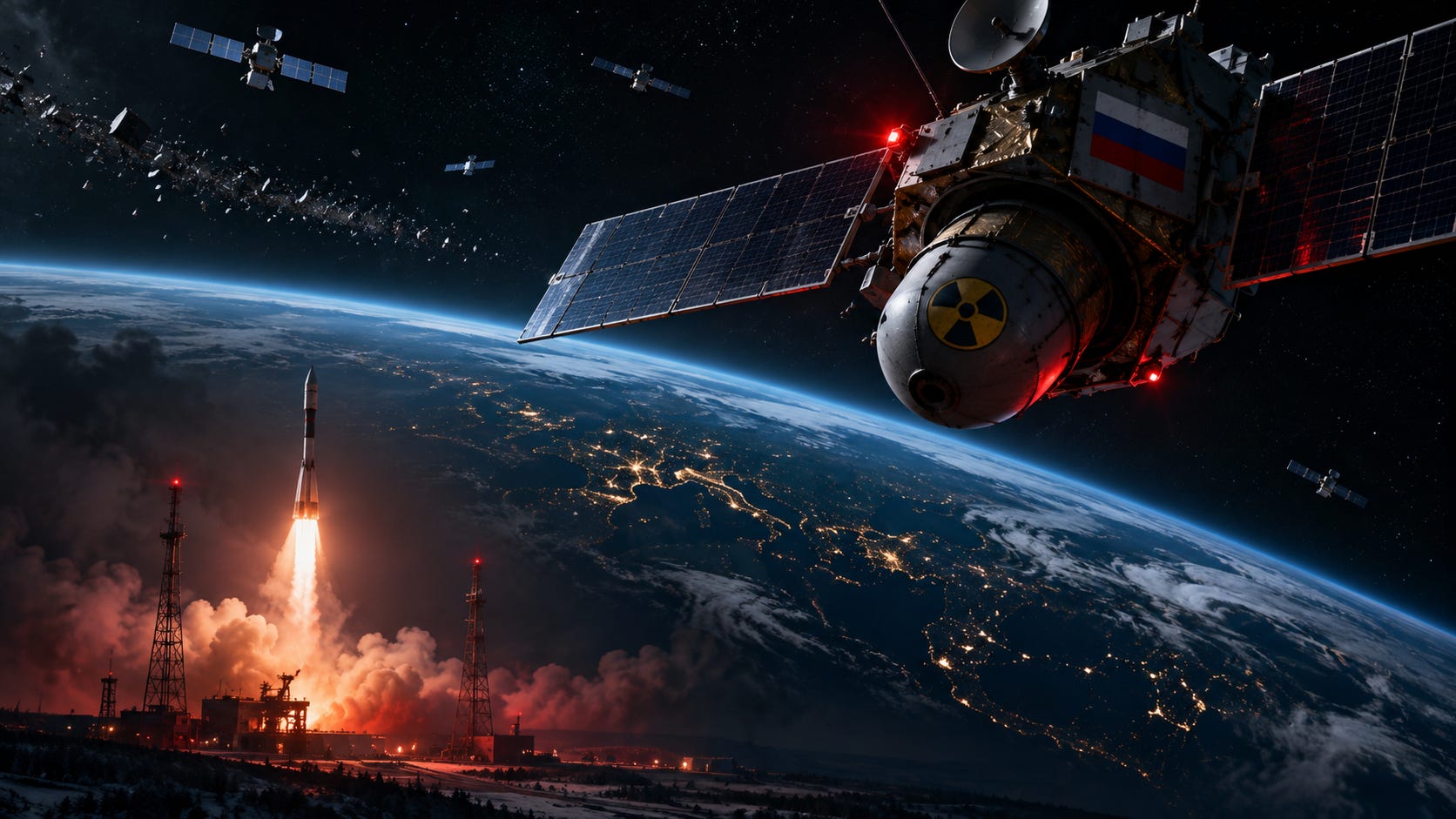
A Russian nuclear bomb orbiting somewhere above our heads. Quite a promising premise for another James Bond film, if it were not for the fact that we now have to take such ideas seriously outside Hollywood as well.
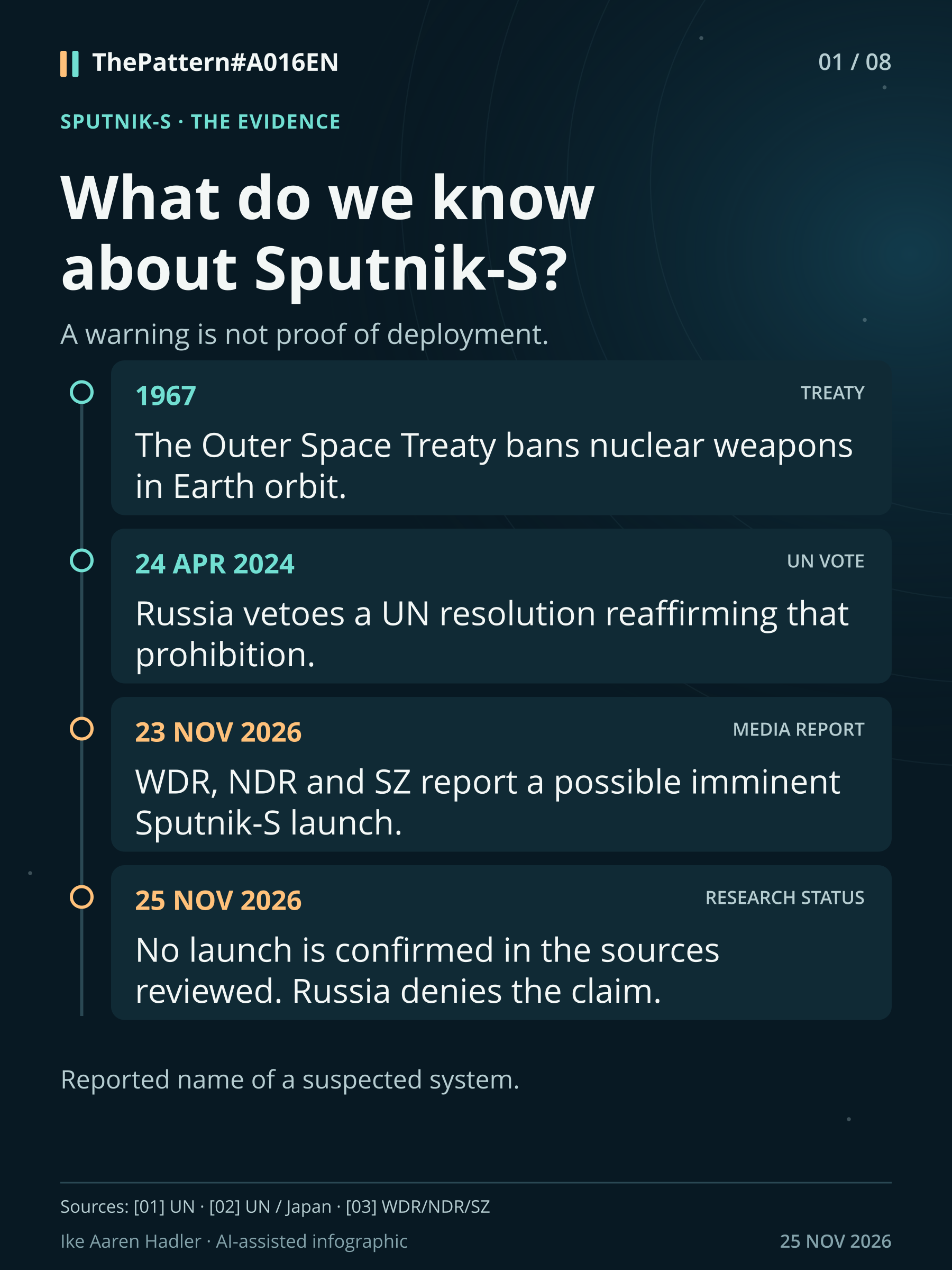
On 23 November 2026, NDR, WDR and Süddeutsche Zeitung jointly reported on Western intelligence findings suggesting that Russia might launch a nuclear-armed satellite called Sputnik-S into Earth orbit before the end of the year. According to those reports, the satellite was completed several years ago and has since been sitting somewhere in the greater Moscow area, essentially waiting for launch. Russia denies the reports.
Stefan A. K. Weichelt has also explored the subject in considerable detail in his German-language article “A Nuclear Bomb Above Our Heads”, which is well worth reading, particularly for its discussion of what a nuclear detonation in space could mean for modern civilisation.
As I read his article and the earlier reporting, though, I kept returning to the question of how likely Russia is to carry out such a plan in the first place. There are some fairly practical considerations that might argue against deployment, and I feel they have received rather less attention than they deserve.
During the final years of my previous career, I worked mainly on planning and designing complex IT and network infrastructure. A substantial part of that work involved thinking, before anything was built, about what could go wrong, what dependencies would arise between individual systems, and how to respond when things did not work quite as intended.
My professional background is neither in nuclear physics nor in spacecraft engineering. But some of the fundamental problems involved in designing complex technical infrastructure are likely to turn up here as well.
So, for the sake of argument, let us assume that the Western intelligence findings are correct, that Sputnik-S does exist, and that Russia could begin preparing it for launch tomorrow.
The danger begins on the launchpad
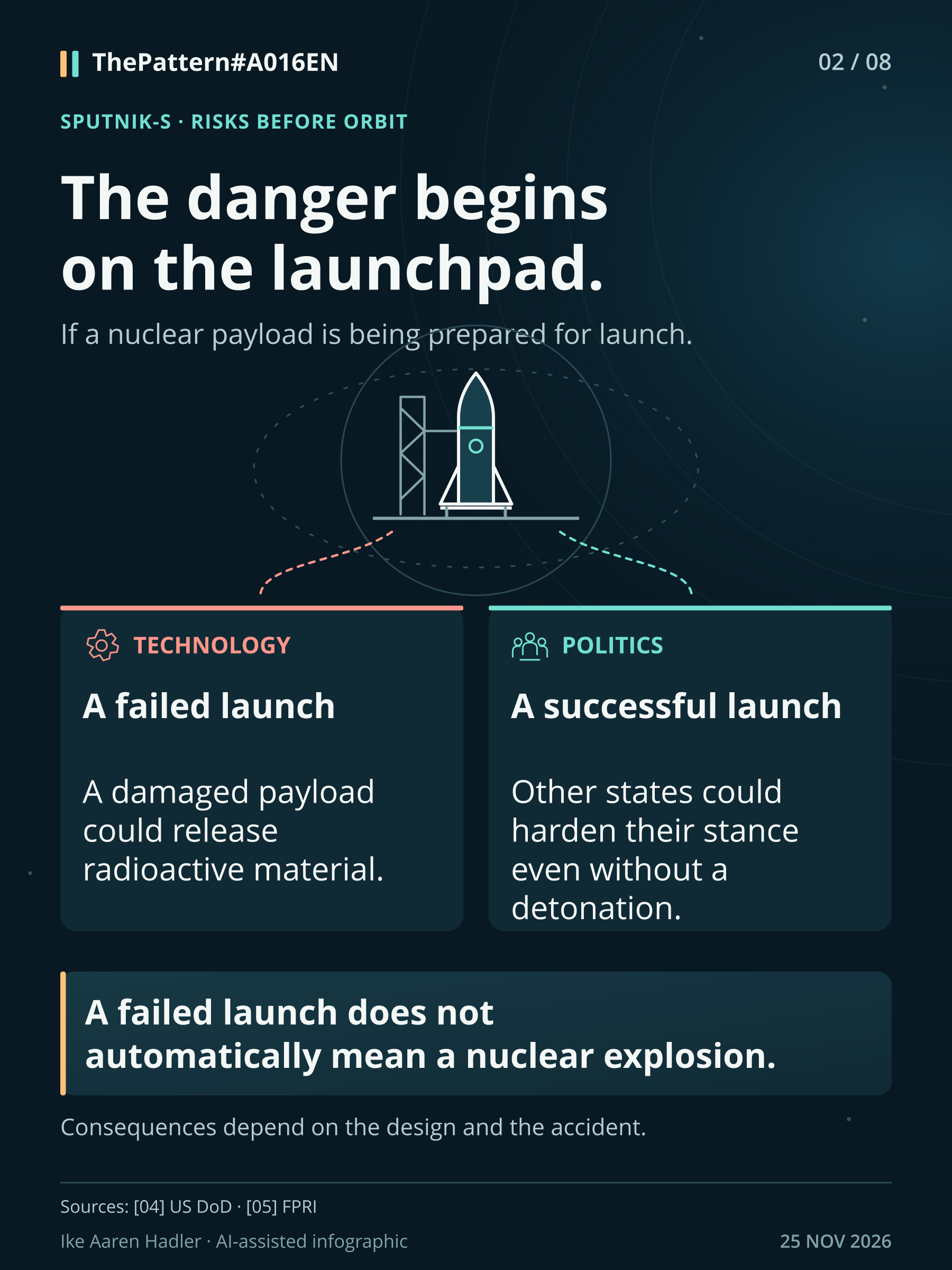
Putting a nuclear weapon into Earth orbit is a different proposition from storing it in a guarded military depot on the ground. And for all Russia’s experience with both nuclear weapons and spaceflight, rocket launches do occasionally go wrong.
An exploding launch vehicle would not automatically trigger a nuclear detonation of its payload. Depending on the warhead’s design and the circumstances of the accident, however, radioactive material could be released, or parts of the payload could fall back to Earth uncontrollably. Depending on when and where things went wrong, that could also happen outside Russian territory.
Canadians have known since the Cold War that the consequences of such incidents can require a diplomatic response as well.
On 24 January 1978, the Soviet reconnaissance satellite Kosmos 954 crashed over Canada. It carried no nuclear weapon, but it did have a nuclear reactor to supply its power. Radioactive debris was scattered across roughly 124,000 square kilometres, and the joint Canadian–American recovery operation continued into October.
A reactor of that kind cannot simply be equated with a modern nuclear warhead, of course. What interests me about the incident is that the Soviet Union lost control of something whose consequences other countries then had to deal with.
Today, it might not even take a technical failure to trigger an international crisis. A completely successful launch could be enough.
When the phones start ringing in Washington
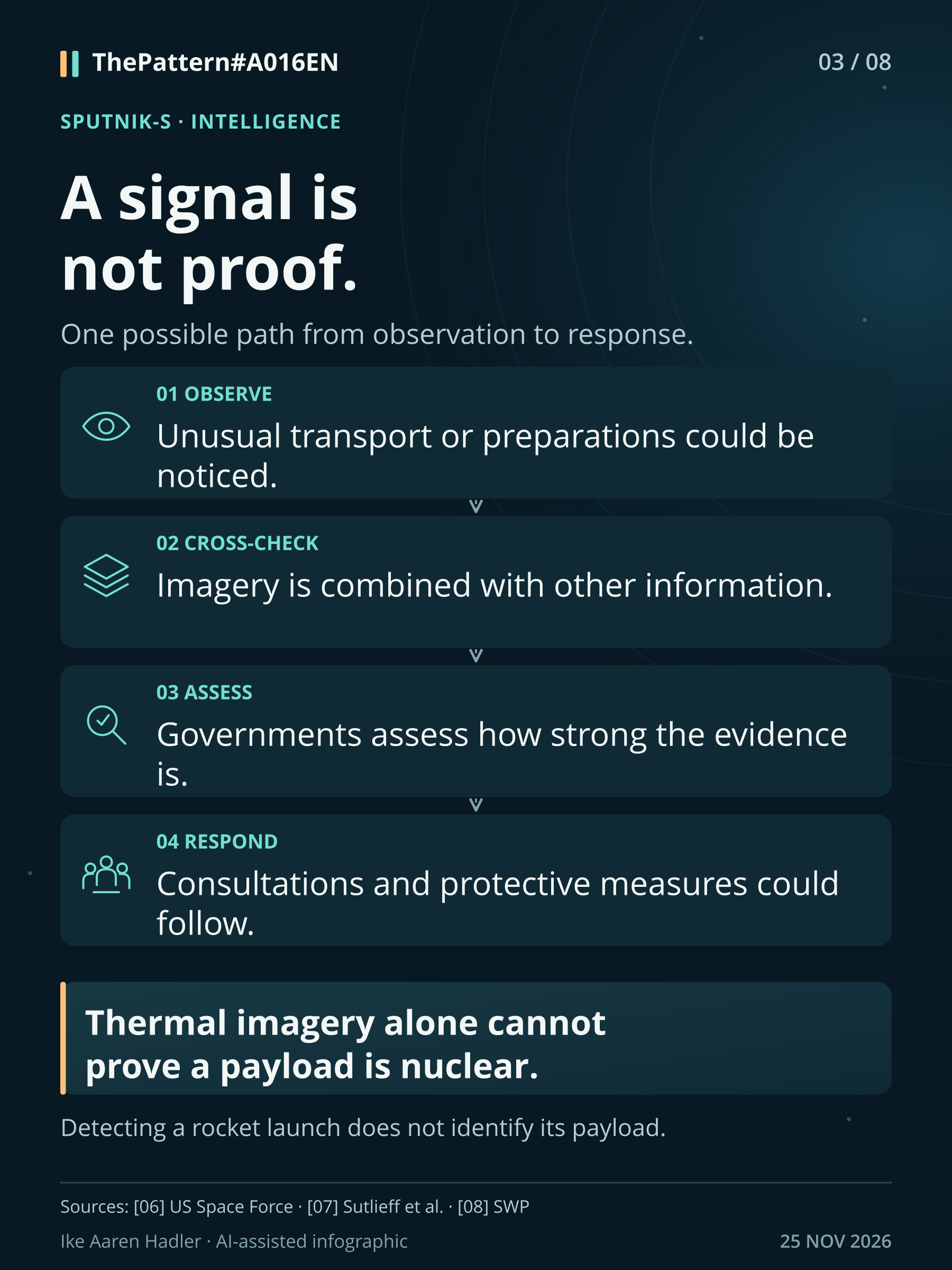
The United States can detect rocket launches and track their trajectories using its Space Based Infrared System (SBIRS) and other early-warning systems. Those observations alone cannot establish beyond doubt whether a rocket is carrying a nuclear warhead. But if relevant intelligence already exists, Washington would probably view a launch linked to that intelligence rather differently from the launch of an ordinary weather satellite.
I find myself imagining what might happen in Washington, Brussels and Beijing in the hours following such a launch: military briefings, diplomatic consultations, perhaps changes in military alert levels, and a whole series of political decisions over which Vladimir Putin would have only limited influence once he had given the launch order.
The relationship between Putin and Trump is particularly interesting in this context. In recent months, Donald Trump has repeatedly sought direct talks with Putin and made at least some efforts towards a political rapprochement. But would that relationship survive if Russia suddenly posed a substantial threat to American space infrastructure?
On 24 November 2026, the Foreign Policy Research Institute (FPRI) published an analysis discussing, among other things, the possibility that Moscow might regard Trump’s presidency as a favourable window for deploying such a weapon.
I’m not so sure.
Relations between Trump and Putin have developed under different security conditions. And the United States now has a great deal to lose in space, economically as well as militarily. A Russian nuclear weapon in orbit would affect the interests of the Pentagon and of the many American companies that have invested billions in space infrastructure over recent years.
Trump might respond to such a development rather differently from what Putin currently imagines. His Golden Dome missile-defence programme, initiated by executive order in January 2025, includes plans for space-based interceptors. It is still under development and does not envisage nuclear weapons in space. A Russian deployment could nevertheless give the expansion of US military capabilities in space considerable political momentum, perhaps even prompting programmes that are not being discussed publicly today.
And then there is Xi Jinping.
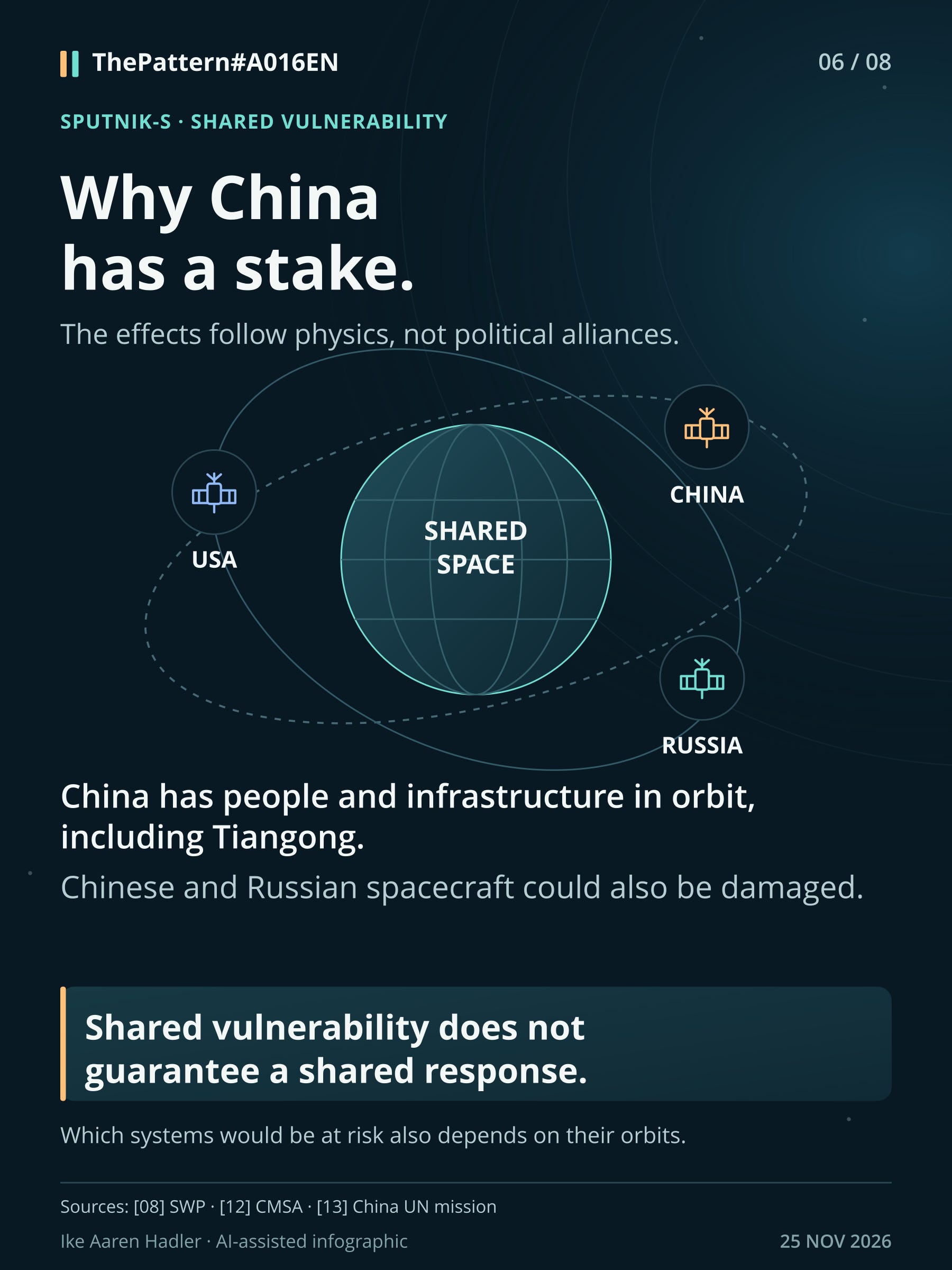
China now operates extensive satellite constellations, military space infrastructure and its own crewed space station, Tiangong. Whatever political ties Putin and Xi may share, the effects of a nuclear detonation in space would not distinguish between Russian, American and Chinese satellites.
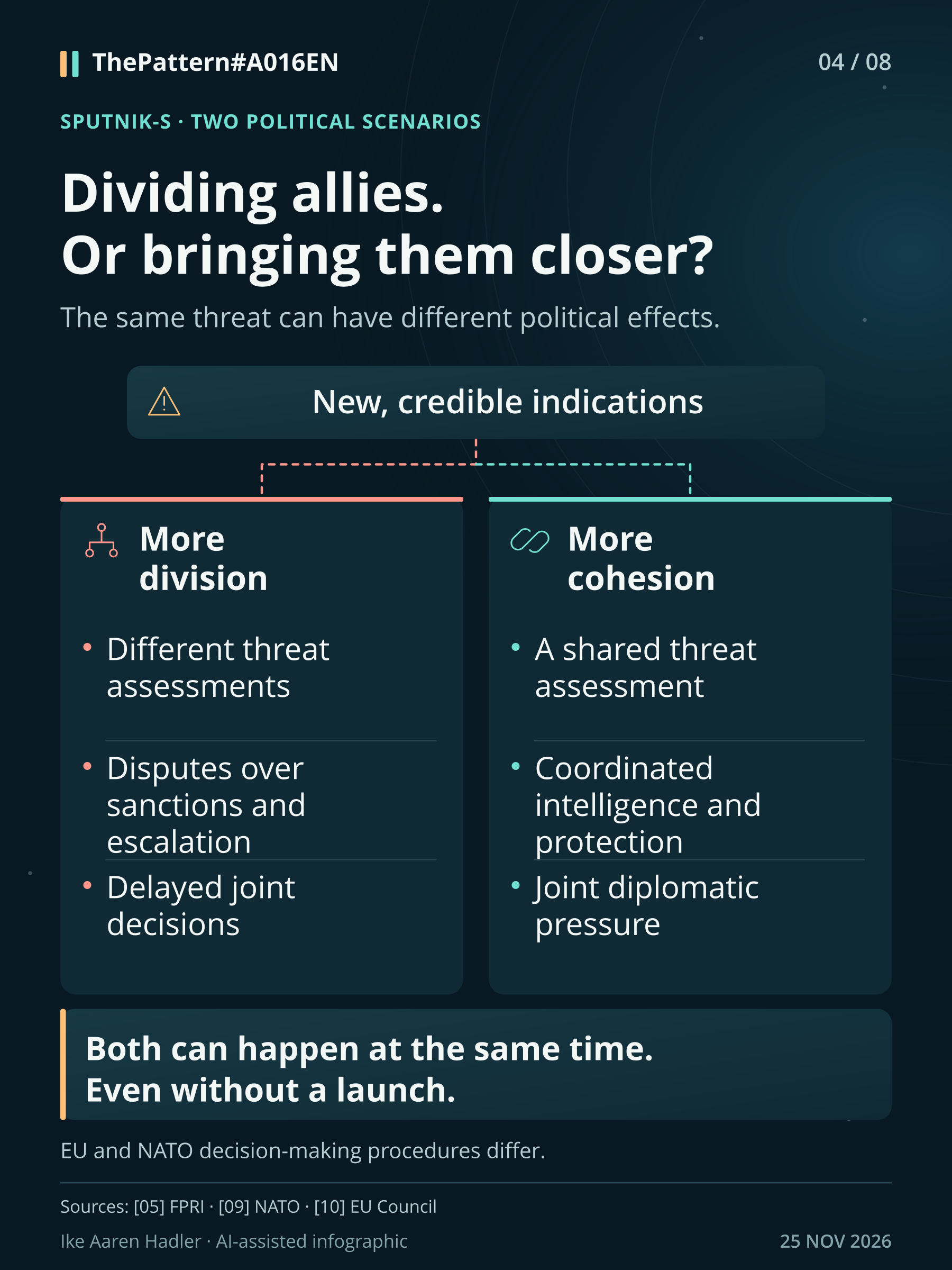
There would be a certain historical irony if Putin, by placing a nuclear weapon in orbit, were the one to make Washington and Beijing discover a shared security interest despite their many differences.
The two countries would hardly have to become best friends. But they would at least have a common reason to put pressure on Moscow.
Once it reaches orbit, the problems are only beginning
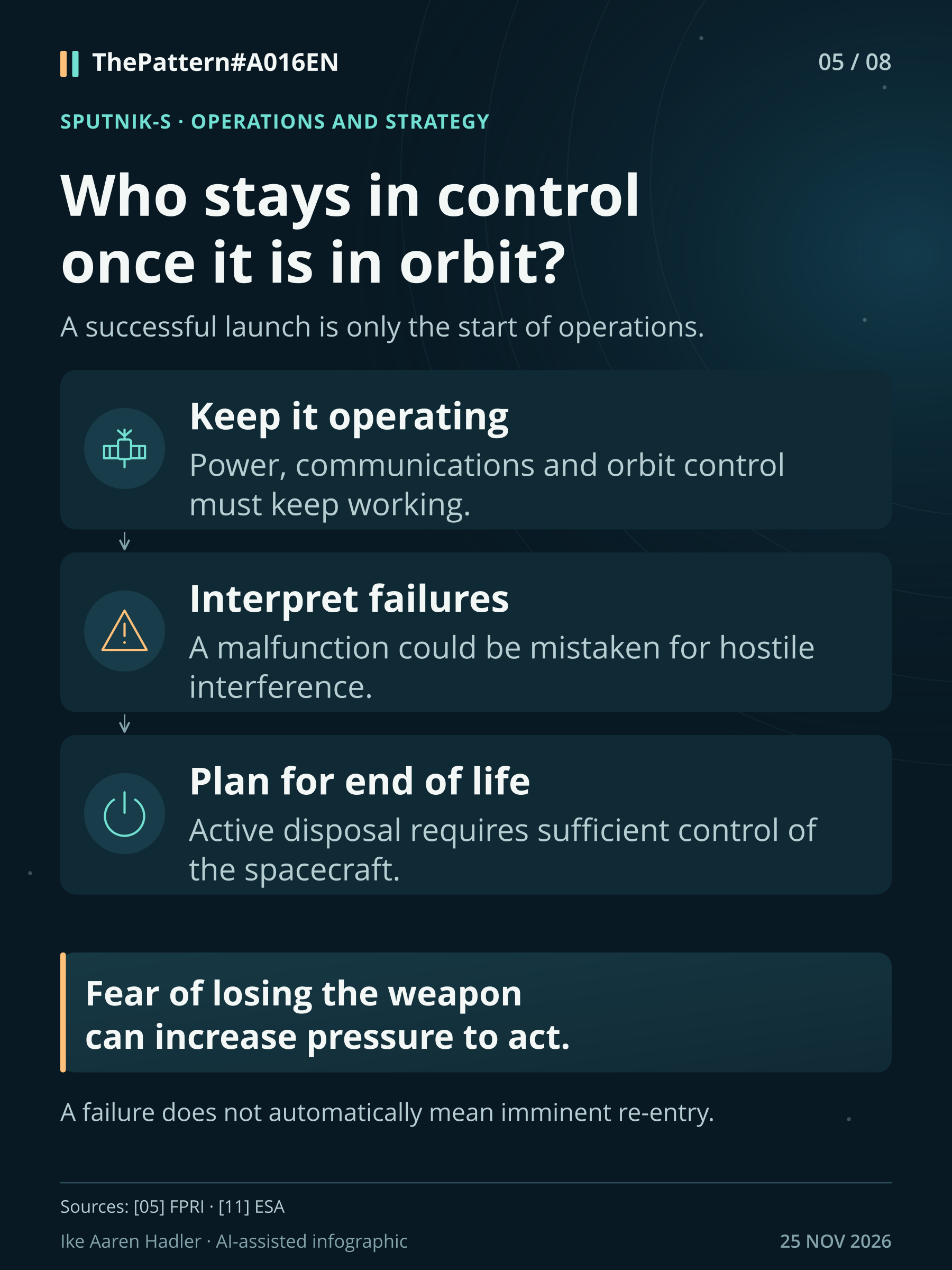
Let us now assume that the rocket has delivered its payload to the intended orbit and that every technical system is working perfectly. Sputnik-S would have been deployed, but the real operational challenge would probably only be beginning.
Satellites need a functioning power supply, communications and electronic control systems, as well as, depending on their design and purpose, the ability to adjust their orientation and orbit. Their components spend years exposed to environmental stresses. Something that works beautifully on a satellite today may not still work in five or ten years.
There is, interestingly, an example from the suspected Russian space-weapons programme itself.
In April 2025, Reuters reported observations of the Russian satellite Kosmos 2553 that suggested uncontrolled tumbling and a possible malfunction. US officials have linked the satellite to testing for Russia’s space-weapons programme. It has not, however, been established that it carries an operational nuclear weapon.
What would amount to a technical and financial loss with an ordinary satellite would become a very different matter with a nuclear weapon on board. Over recent decades, the growing amount of space debris has also introduced another source of failure over which we have only limited control. The European Space Agency, ESA, has spent years examining the risks of collisions and resulting debris cascades in its reports on the space environment.
A collision would not automatically cause a nuclear detonation either. But a damaged nuclear payload in orbit that could no longer be controlled would, on its own, give the international community plenty to talk about.
I also find myself wondering about the end of such a system’s intended service life. In IT, we talk about lifecycle management: considering a technical system’s entire lifespan, including its eventual decommissioning.
Bringing a satellite back into the atmosphere in a controlled manner at the end of its life, or moving it to a less heavily used orbit where that makes technical and orbital sense, are established practices in spaceflight. But they require sufficient control over the satellite. And a nuclear weapon in a so-called graveyard orbit is still a nuclear weapon in orbit.
I am not questioning Russian engineers’ ability to develop solutions to these problems. But I have yet to encounter a complex technical system, however carefully designed, in which a complete loss of control can be ruled out altogether.
A weapon that puts its owner under pressure
If Sputnik-S were placed in orbit, other countries could, in principle, track its trajectory. Looking at a satellite does not necessarily reveal its payload, and being able to track it does not mean it would be easy to neutralise. But sufficiently credible intelligence about its nuclear armament would likely make it a permanent feature of other major powers’ military planning.
That would leave Moscow in a rather uncomfortable position. It would have to account for possible hostile action by other countries as well as the satellite’s technical problems. If a malfunction occurred, it might not even be immediately clear which of the two it was dealing with.
Nuclear strategists discuss a related problem under the heading use it or lose it. Under certain circumstances, the fear of losing a strategically important weapon creates additional pressure on military decision-making, particularly during international crises.
The FPRI conducted a crisis simulation of this kind in September 2026. What struck me was that, in the simulation, the threat of a nuclear weapon in orbit led to military confrontation without any nuclear weapon actually being detonated in space.
A simulation is not a prediction, of course. But it illustrates how quickly events could take on a life of their own when several countries have to make decisions under time pressure, working with different information and different perceptions of the threat.
Against that background, I keep coming back to the additional strategic value of permanent deployment. Russia already has extensive nuclear capabilities and delivery systems whose flight paths can pass through space. I am well aware that a ballistic trajectory is physically different from a sustained Earth orbit, and that the two do not necessarily offer the same military capabilities.
But what additional capabilities, specifically, does Moscow hope to gain from Sputnik-S? And are they significant enough to justify accepting the continuing risks of deployment? Without knowing the technical specifications or the intended military concept of operations, we cannot give a definitive answer.
A permanently deployed system could, at least, offer greater availability and make the threat more credible. Yet that last part already seems to be working reasonably well without a launch.
The nuclear bomb making its presence felt before launch
Over the past few years, Putin has done quite a bit to get Western intelligence officers’ pulses racing and, to put it a little pointedly, keep a steady stream of readers coming our way in the press.
Back in 2024, the American Center for Strategic and International Studies (CSIS) examined Russian Nuclear Calibration in the War in Ukraine, looking at how Russia’s leadership had adjusted its nuclear threats in response to political and military developments during the war.
In April 2025, Stiftung Wissenschaft und Politik (SWP) also examined the possible strategic motives for developing Russian nuclear weapons in space. Among the questions it raised was whether Moscow hopes to force political concessions from the West by demonstrating a willingness to take risks.
We do not know whether Sputnik-S will actually be launched before the end of this year. But we are already spending a great deal of time discussing it. Our intelligence services have to devote resources to it, military planners have to consider the possible consequences, politicians are asked for their views, and here I am, writing an article about it.
Meanwhile, Sputnik-S may still be sitting in a building somewhere near Moscow.
I am certainly not criticising our intelligence services or my fellow journalists for taking the threat seriously. Given the possible consequences, failing to do so would be negligent. But that attention is also part of what gives a military threat its political effect.
For now, Moscow may be more interested in having a credible option than in exercising it. As early as 2025, the SWP raised the question of whether Russia had even made a final decision to deploy the weapon.
I can see a strategic advantage for Moscow in that uncertainty. As long as the weapon remains on the ground, Russia largely retains the choice of when, or whether, to take the next step. Deployment would surrender some of that freedom, because other countries would then also help determine how the situation developed.
The Outer Space Treaty will not stop the rocket
Since 1967, Article IV of the Outer Space Treaty has prohibited stationing nuclear weapons and other weapons of mass destruction in space.
Well, I would not necessarily count on that treaty to stop Putin from deploying such a weapon if he considered it worthwhile.
There is no dedicated, comprehensive inspection mechanism to ensure compliance, nor are there sanctions that take effect automatically. Russia also has a veto in the United Nations Security Council, as do the United States and China.
What interests me more than the treaty violation itself is the possibility of indirect consequences. Disregarding an international agreement is one thing; having to deal with the resulting changes in the international security situation is another.
Deployment could prompt other countries to change their military approach to space fundamentally. It is entirely conceivable that the United States or China might then make decisions Moscow would rather not have provoked.
What, then, if Trump responded by ordering a comparable nuclear build-up in space?
Whether the United States would actually consider such a step is not known. From Russia’s perspective, though, it would be negligent to leave that possibility out of its strategic planning altogether.
When dependencies turn into cascades
One argument in favour of a Russian nuclear weapon in space is that the countries involved do not all depend on satellite infrastructure to the same degree. Political scientist Frank Sauer has also pointed out in the current reporting how heavily Western armed forces depend on space technology.
Russia might therefore be prepared to accept the loss of some of its own satellites if it expected to inflict substantially greater strategic damage on the United States and other Western countries.
From a military perspective, that calculation would at least be understandable. But the effects of a nuclear detonation in space are not simply a matter of how many satellites are destroyed.
There is a problem I know from IT infrastructure planning that, in my view, applies rather well to today’s space infrastructure. We can build as much redundancy into a technical system as we like. If several supposedly independent components are exposed to the same hazard, we may still end up with a system that is not particularly resilient, despite all our efforts.
This is a common cause failure: several components failing because of a shared cause.
A constellation containing thousands of satellites may cope quite well with the loss of individual components. But if many of those satellites are exposed to the same damaging space environment over an extended period, their sheer number offers only limited protection.
The American Starfish Prime nuclear test in 1962 already demonstrated that a nuclear detonation in space can create artificial radiation belts capable of damaging satellites long after the explosion itself.
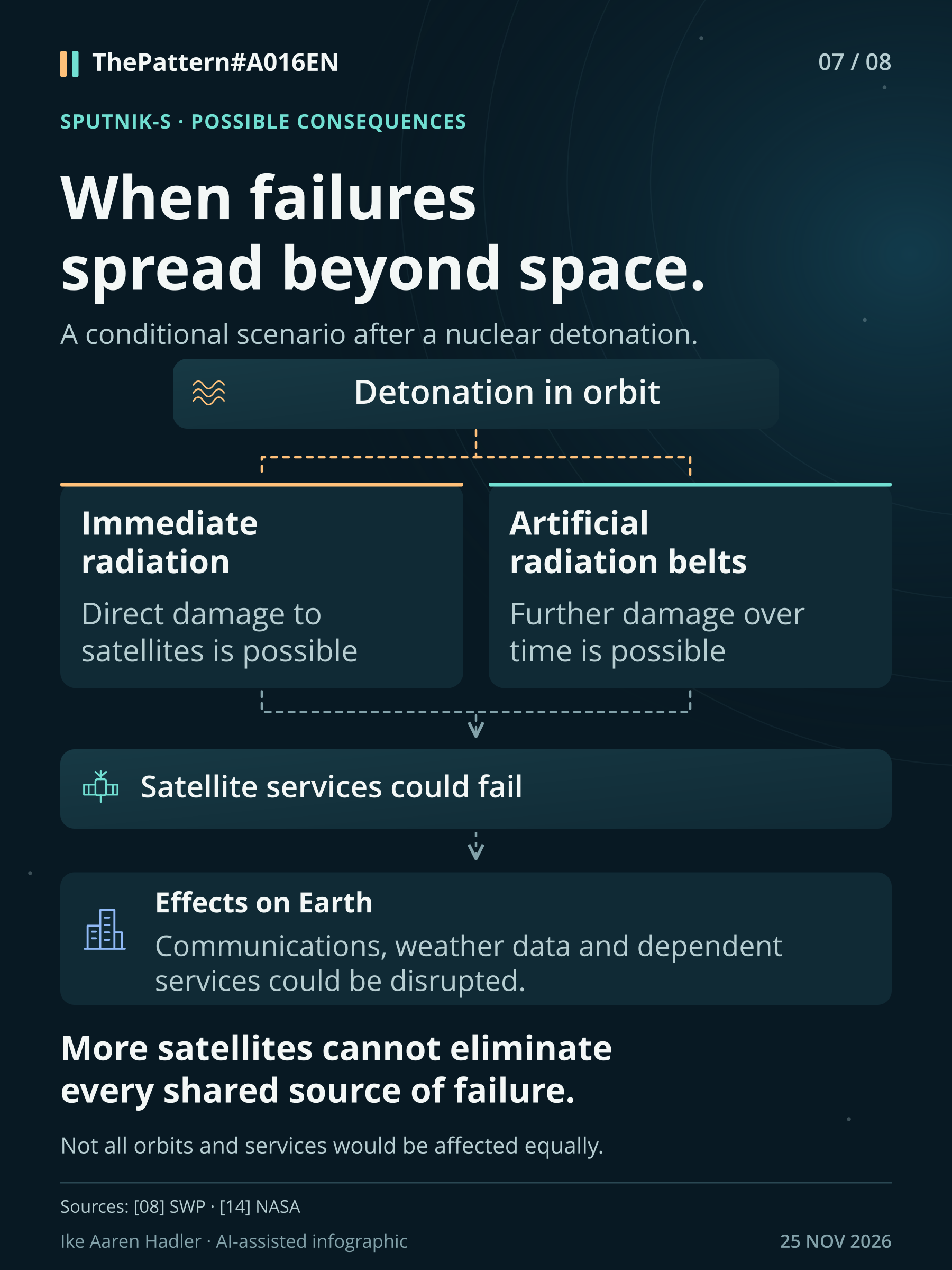
Today, many civilian and military activities depend on satellite services. Weather observation, communications, navigation, military early warning, logistics and parts of our energy and financial infrastructure are connected to these systems to varying degrees. Not everything would necessarily fail at once, and not every orbit would be affected equally. But the loss of particular services could cause problems in other infrastructure that, at first glance, has little to do with spaceflight.
Because those dependencies have long since crossed national borders, it would be extraordinarily difficult to anticipate every economic and political consequence. That applies to Russia too, which operates its own satellites and wants to expand its space infrastructure. It applies all the more to China, whose government will have its own ideas about the risks it is prepared to accept for its economic and technological development.
Restoring failed infrastructure might also prove considerably more complicated than simply manufacturing replacement satellites and launching them. At first, there might be no guarantee that replacement satellites would remain operational for long enough in the affected orbits.
Artificial radiation belts can weaken over time, and space debris can also disappear over time, depending on its orbit. The damage need not last for ever. But once such processes have been set in motion, our ability to influence what happens next is very limited.
What if Putin makes a different calculation?
There is an obvious objection to my argument. Before Russia’s full-scale invasion of Ukraine in February 2022, many people also assumed that the likely military, economic and political costs would weigh against an actual invasion.
As we now know, those in charge in the Kremlin reached a different assessment, or were at least prepared to take those risks.
The same could, of course, be true of Sputnik-S. I do not assume that Putin would assess such a project according to my priorities, or that the potential economic damage to Russia would necessarily dissuade him from deployment.
It is quite possible that, from his perspective, the very risks that come with deployment, and that can only partly be controlled, would increase the weapon’s political value. The greater the potential damage, the greater the pressure on other countries to make concessions might be.
But such a strategy only works as long as the other actors respond more or less as expected. And that is where Putin could miscalculate, regardless of how well his engineers have done their jobs.
Neither the United States nor China is obliged to behave as Moscow might hope.
ThePattern — Control asymmetry
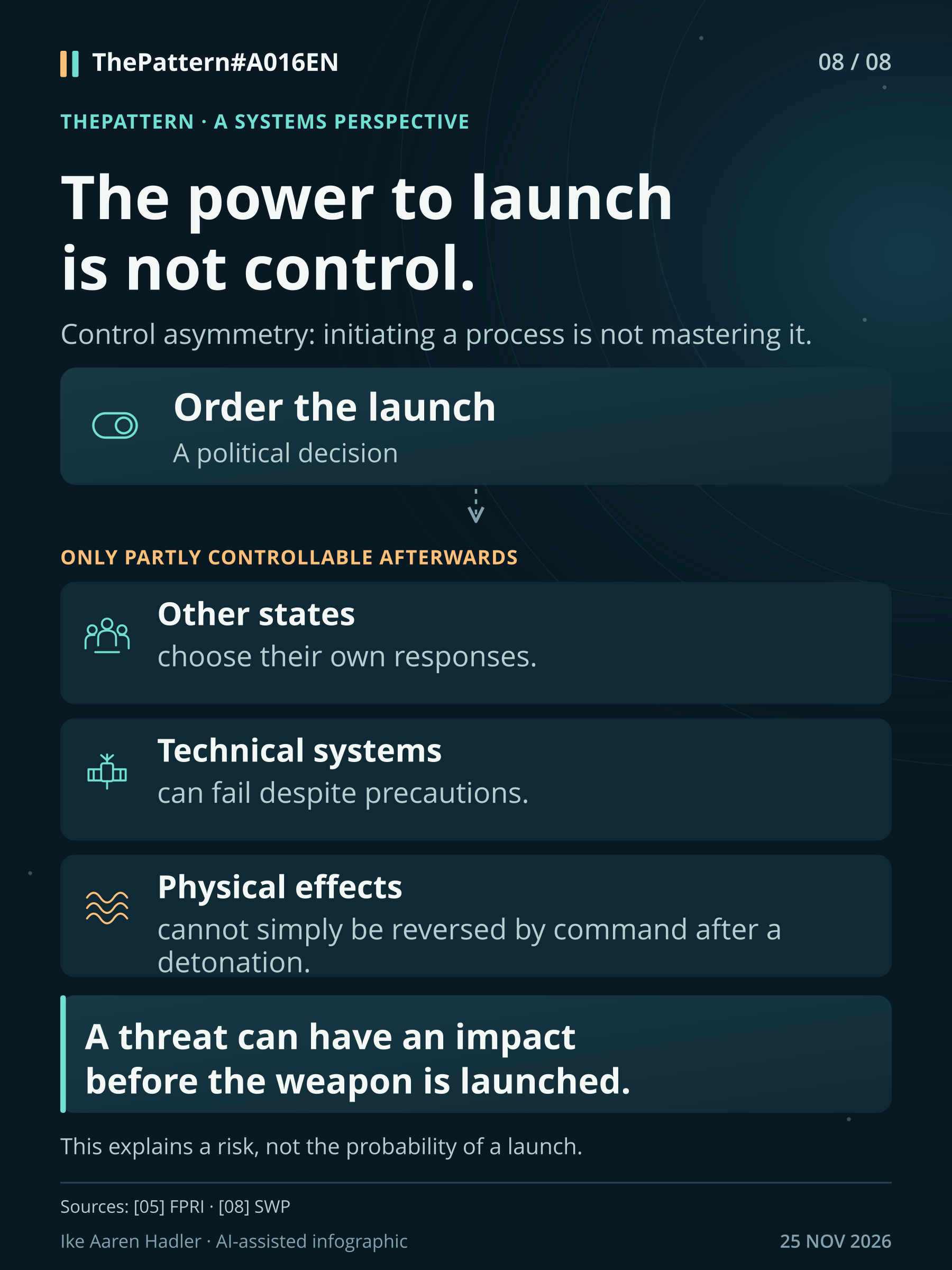
What interests me in all this is a pattern I also encounter elsewhere in our increasingly technological society. We tend to equate the technical ability to do something with the ability to retain control over the processes it sets in motion. Those are two rather different things, as we have had plenty of opportunities to discover outside spaceflight too.
If the system really is ready, Putin could order the launch of Sputnik-S. But he cannot tell Trump or Xi Jinping how to respond, and his engineers cannot guarantee that the weapon will remain fully controllable at every moment throughout its life in orbit.
An actual detonation would also set physical processes in motion that could neither be stopped by another order from the Kremlin nor confined to the politically desirable consequences.
I would call this pattern control asymmetry: the power to initiate a process can be considerably greater than the power to determine its subsequent course.
And perhaps that is one practical reason to hold off on launching Sputnik-S.
I do not dismiss Western intelligence findings, nor do I rule out the actual deployment of a Russian nuclear weapon in space. But I see enough reasons that might weigh against such a decision, even if the technical means have long been available.
I cannot judge whether the Kremlin gives those reasons similar weight.
I would like to hear how the people responsible for the technical and military planning of such a project answer the question of the system’s long-term controllability. And whether they have managed to make their political decision-makers understand that they would be creating more than another military capability.
They would also be creating new dependencies over which they would then have only limited influence.
Because while a rocket launch can still be called off, the same cannot necessarily be said of what follows.
Sources and further reading
NDR/WDR/SZ — Geheimdienste warnen: Russland soll Atomwaffe im Weltraum vorbereiten [Intelligence agencies warn: Russia reportedly preparing a nuclear weapon in space], 23 November 2026. In German.
Stefan A. K. Weichelt — Eine Atombombe über unseren Köpfen [A Nuclear Bomb Above Our Heads], 23 November 2026. In German.
Foreign Policy Research Institute — Moscow Considers Deploying Nuclear Weapons in Space, 24 November 2026.
Jonas Schneider and Juliana Süß, Stiftung Wissenschaft und Politik — Russische Atomwaffen im Weltraum? Mögliche Zerstörung im All, Eskalation auf der Erde und Rüstungskontrollschäden [Russian Nuclear Weapons in Space? Potential Destruction in Space, Escalation on Earth and Damage to Arms Control], 17 April 2025. In German.
CSIS — Russian Nuclear Calibration in the War in Ukraine, 23 February 2024.
Health Canada — Previous nuclear incidents and accidents: COSMOS 954.
Reuters — Russian satellite linked to nuclear weapon program appears out of control, U.S. analysts say, 25 April 2025.
ESA — Bericht zur Weltraumumgebung 2026 [Space Environment Report 2026], 14 September 2026. In German.
United States Space Force — Space Based Infrared System.
Executive Order 14186 — The Iron Dome for America, 27 January 2025.
United Nations — Outer Space Treaty, 1967.
How this article came about: I developed my original ideas through an extended exchange of arguments with ChatGPT and Gemini. Both AI systems were also used for research and editing, and each critiqued the other’s contributions. Their agreement does not, however, constitute independent confirmation of my argument. This English translation was also produced with AI assistance.