


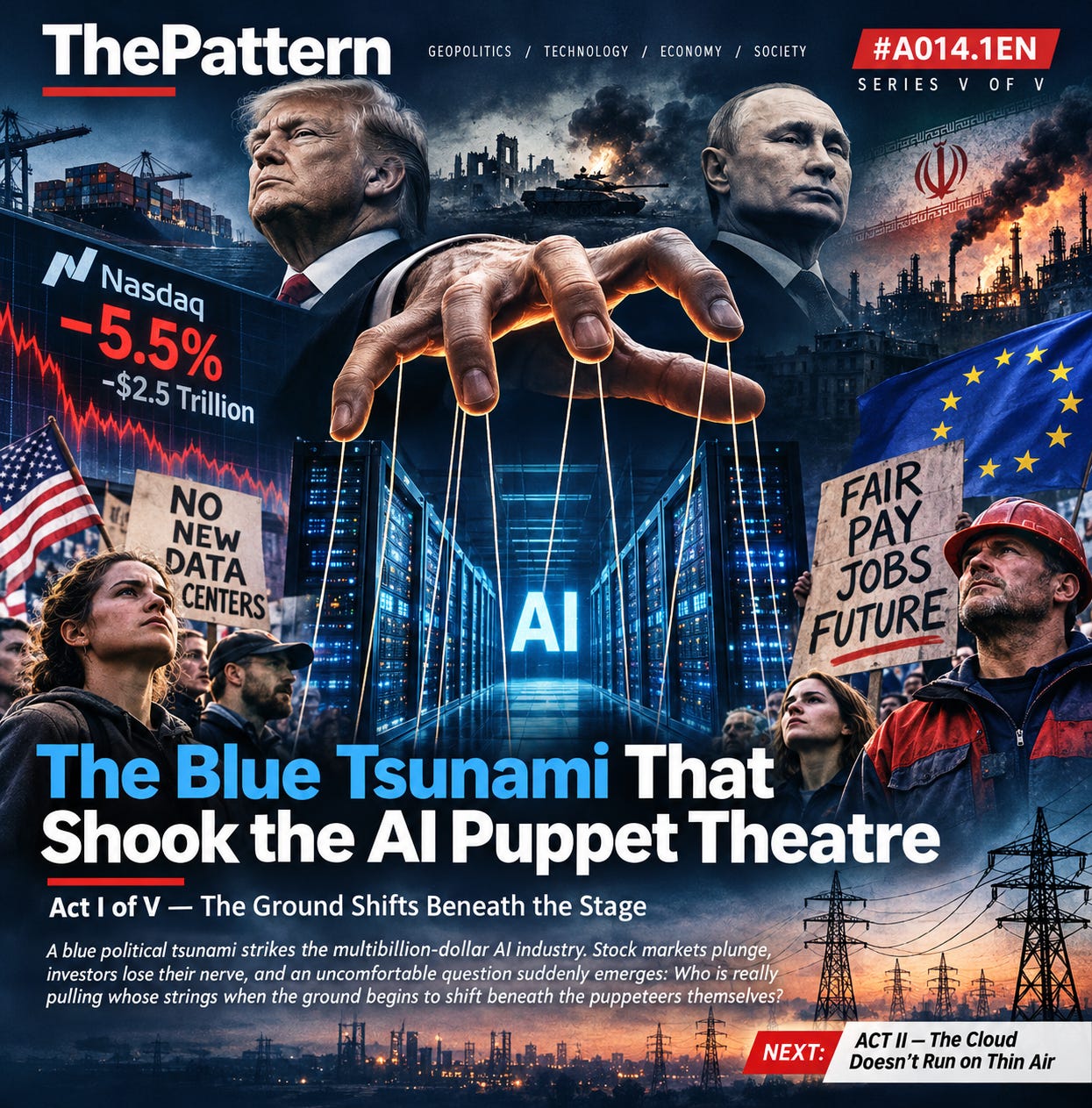
A blue political tsunami strikes the multibillion-dollar AI industry. Stock markets plunge, investors lose their nerve, and an exceptionally uncomfortable question suddenly emerges: Who is really pulling whose strings when the ground begins to shift beneath the puppeteers themselves?
The Day the Future Suddenly Became Less Valuable
On November 5, 2026, something remarkable happened on the American technology stock market.
The Nasdaq Composite lost 5.5 percent in a single trading session. The Nasdaq 100 shed approximately $2.5 trillion in market capitalisation. The Philadelphia Semiconductor Index fell by around twelve percent, Nvidia dropped roughly nine percent, and AMD plunged by seventeen percent.
It was one of those days when enough value disappears from Wall Street in a matter of hours to make an ordinary calculator seriously reconsider its career choices.
Of course, $2.5 trillion had not literally gone up in flames. This was a decline in market valuation, not an equivalent amount of cash leaving corporate bank accounts.
The data centers were still operating. Processors continued processing. AI models kept answering questions, developing software, and analysing data. No technological breakthrough had suddenly been disproven overnight.
What had changed was the expectation of how much money this technology might generate in the future.
Two days earlier, Americans had voted in the midterm elections. Democrats made substantial gains. At the same time, voters in numerous communities were asked to decide whether new data centers should be permitted.
The results were unusually decisive.
In 40 out of 41 local ballot measures, voters supported restrictions on data center development or rejected proposals that would have made such development easier.
Five measures resulted in outright bans, twelve in partial bans. Other communities introduced temporary moratoriums, additional permitting requirements, or stronger local decision-making powers.
Not every measure was legally binding. Not every proposal concerned artificial intelligence specifically. And 41 local votes cannot establish the opinions of more than 300 million Americans.
Nevertheless, the results carried a message that may not have received sufficient attention during the industry’s years of enthusiastic growth projections.
People wanted a say.
And they were asking questions that should arguably have been answered before the first multibillion-dollar facility was approved.
Who pays for the additional electricity? Who finances new power lines and substations? How will water consumption affect surrounding communities? Who carries the financial risks? And how many permanent jobs will these enormous facilities actually create?
These were hardly revolutionary questions.
They were questions about costs, responsibility, and democratic participation.
Apparently, that was revolutionary enough.
The Blue Tsunami Meets an Unwelcome Reality
The term Blue Tsunami describes the Democrats’ decisive electoral gains.
But opposition to new data centers cannot simply be reduced to a partisan backlash.
Republican politicians had also begun questioning the largely unrestricted expansion of this infrastructure before the midterms.
In Texas, Republican Governor Greg Abbott introduced a temporary permitting pause in September while questions concerning grid capacity and resource consumption were examined.
The newly elected Democratic governor, Gina Hinojosa, intends to go further, suspending approvals until new statutory safeguards are established.
In Michigan, newly elected Governor Jocelyn Benson is demanding binding conditions. Data centers should pay for their additional energy requirements, protect natural resources, undergo transparent approval procedures, and create jobs covered by union agreements.
Ohio’s newly elected governor, Amy Acton, is pursuing a similar approach. Her proposals include making operators responsible for additional utility costs, strengthening transparency and environmental safeguards, and requiring unionised employment.
These political programmes are not automatically enforceable law. Their implementation will depend on legislatures, regulatory authorities, and potentially the courts.
But financial markets do not necessarily wait until an invoice arrives.
They react when someone credibly announces that an invoice might eventually be issued.
Remarkably, even Donald Trump’s administration had already acknowledged the underlying problem of rising energy costs.
In March 2026, the White House introduced a voluntary Ratepayer Protection Pledge. Major technology companies committed to covering their additional energy requirements and the infrastructure investments necessary to support them, rather than passing those costs on to residential electricity customers.
Yet Trump had already made accelerated permitting for major data centers an explicit objective of his administration through a July 2025 executive order.
On one side, faster construction and fewer regulatory obstacles.
On the other, a promise that ordinary households would not bear the financial consequences.
The crucial question is how enforceable such promises actually are, and who independently verifies compliance.
Because there is a meaningful difference between a voluntary statement published on a government website and a legally enforceable obligation.
A difference that may become particularly noticeable when the next electricity bill arrives.
Why Social Stability Can Destabilise Financial Markets
This is where the real paradox begins.
If binding regulations ensure that companies pay for their infrastructure, treat employees fairly, comply with environmental standards, and allow affected communities to participate in decisions, should that not contribute to greater long-term economic stability?
Why, then, would financial markets respond with a sell-off?
Because stock markets do not directly measure the social value of an economic development.
They primarily assess expected future earnings and the risks associated with generating them.
A substantial proportion of the valuation of a rapidly growing company may depend on profits it is not expected to earn for many years.
The present value of those profits depends not only on their projected size, but also on when they materialise and how uncertain they are.
When an AI company invests billions in new data centers, its financial projections assume timely completion, adequate electricity supplies, sustained customer demand, and commercially attractive operating costs.
If a facility opens two years later than expected, the associated revenue also arrives two years later. Financing expenses, construction obligations, and other costs do not simply disappear in the meantime.
If energy, grid connections, or employment become more expensive, projected profit margins change as well.
This is not a political conspiracy.
It is financial mathematics.
The problem arises when initial valuations assume exceptionally favourable conditions and leave little room for delays or disappointing outcomes.
Under those circumstances, relatively small changes in expectations about the future can produce substantial changes in a company’s present market value.
Reuters reported that concerns about stricter AI regulation and possible delays in data center construction contributed significantly to the November 5 sell-off.
However, the election was not the sole cause.
State Street noted the following day that global semiconductor stocks had already fallen approximately twenty percent from their previous highs before the midterms. High capital expenditure, financing concerns, and uncertainty over the actual monetisation of artificial intelligence had been weighing on the sector for some time.
The UBS analysis also argued that regulatory restrictions could slow development, raise costs, or shift construction to other locations without necessarily destroying the underlying demand for computing capacity.
That distinction matters.
An industry can remain technologically successful while its share prices fall dramatically.
New regulations can make economic sense while reducing the expected profits of individual companies.
And a market crash can reveal that investors had previously placed valuations on a future whose underlying assumptions were considerably less secure than they appeared.
Perhaps democratic resistance did not create the instability at all. Perhaps it merely provided an additional stress test that an already strained system struggled to absorb.
But why had the system become so sensitive in the first place?
To understand that, we need to look behind the curtain.
Behind the Curtain
Imagine the AI industry as an enormous puppet theatre.
On stage, increasingly capable systems perform astonishing tasks. They analyse information, write, translate, develop software, and take on work that would have required considerable human effort only a few years ago.
The audience is impressed.
Behind the stage stand the apparent puppeteers: technology corporations, developers, platform operators, and financial investors.
They determine which systems are developed, how they are financed, and under what conditions people can access them.
The roles seem straightforward.
Some pull the strings.
Others move.
But behind the curtain awaits an uncomfortable surprise.
The puppeteers themselves are attached to strings.
They depend on capital providers, debt financing, long-term supply contracts, available energy, and paying customers. Their market valuations depend on expectations that are themselves influenced by the economic decisions of other companies.
These connections extend considerably further than the simple image of an investor placing money into a successful technology company.
On October 1, 2026, the Bank for International Settlements, or BIS, published research examining circular financing relationships within the AI industry.
One finding deserves particular attention.
Of the investments captured by the study that flowed into AI companies between 2021 and 2025, 55.2 percent by investment value came from other AI companies.
For 46.4 percent of the value of the investments examined between AI companies, the investor and the recipient also maintained a commercial supplier or customer relationship.
These figures have different denominators. They describe the investment structures captured by the research, not every financial transaction taking place across the entire AI economy.
Nor do they establish that these arrangements are fraudulent or fictitious.
But they demonstrate just how closely interconnected the industry’s financial relationships have become.
Consider a major technology corporation investing in an AI developer.
That developer requires enormous computing capacity and purchases it from a cloud provider that may itself be involved in financing the developer.
The cloud provider records revenue.
That revenue can support expectations of continued growth.
Those expectations can, in turn, make it easier to attract further investment, which finances the construction of additional data centers.
An economic feedback loop emerges.
There is nothing inherently unusual or improper about this. Such arrangements can finance emerging technologies, secure long-term capacity, and distribute commercial risks among partners.
But they also create mutual dependencies.
If one participant cannot meet its obligations, the consequences may affect companies that are simultaneously its investors, suppliers, and customers.
A disappointing revenue stream can therefore do more than alter a single earnings forecast. Its effects may spread through several financial and commercial relationships.
The BIS explicitly warns that such arrangements can amplify financial risks and reduce transparency about where those risks ultimately reside.
The seemingly straightforward puppet theatre has become something considerably more complicated.
There is no longer a single string explaining every movement.
There is a network of mutual dependencies in which each participant fully controls only part of the system.
The most dangerous puppet may be the one convinced it is the puppeteer.
When Growth Becomes More Important Than Economic Sense
Another BIS study, published on July 14, 2026, examined the AI investment boom as a competition for a limited number of dominant market positions.
The underlying problem is surprisingly simple.
Companies do not necessarily invest solely because projected earnings justify the expenditure.
Sometimes they invest because their competitors are investing.
Move too slowly, and you risk falling behind. Build too little capacity, and you may lose future market share. Fail to match a competitor’s technological progress, and you could eventually become dependent on that competitor.
The prospect of a highly profitable market can therefore encourage companies to invest more collectively than would be economically or socially efficient.
In the conservative baseline scenario of the BIS model, investment was approximately fifty percent above the socially efficient level.
That is a modelling result, not an empirical finding that fifty percent of all current AI spending is being wasted.
But the research illustrates a mechanism familiar from earlier technology booms.
When companies compete for future dominance, individually rational investment decisions can collectively produce a misallocation of capital.
Every individual board of directors may have perfectly reasonable arguments for continuing to invest.
And yet, collectively, they may still build far more capacity than the market ultimately requires.
An impressive economic arrangement in which rational decisions by individual participants provide no guarantee that the overall outcome will be rational.
Similar patterns appeared during nineteenth-century railway expansion and the dot-com boom.
The internet did not disappear when the dot-com bubble burst.
Its long-term economic significance actually increased.
That did not mean every company that inserted the word internet into its business strategy had suddenly become a sensible investment.
Artificial intelligence may prove equally transformative.
But that does not mean every planned server farm, every multibillion-dollar financing agreement, or every stock market valuation is economically justified.
Technological progress and financial discipline are two different capabilities. Possessing the first does not guarantee the second.
An Industrial Revolution in a Geopolitical Construction Site
Even under stable global economic conditions, all of this would represent an enormous challenge.
But the AI revolution is not taking place in a stable world.
Since Russia’s full-scale invasion of Ukraine in February 2022, Europe has had to fundamentally restructure its energy supply.
The move away from Russian pipeline gas has increased the importance of internationally traded energy resources and altered Europe’s exposure to global price volatility.
In February 2026, the United States and Israel launched attacks on Iran, triggering a prolonged regional conflict. Severe disruptions to shipping through the Strait of Hormuz affected international oil and liquefied natural gas markets.
The International Energy Agency described the consequences for global energy markets as exceptionally serious. The temporary near-interruption of LNG shipments through Hormuz affected a route that had previously carried almost one-fifth of global LNG supply.
For Europe, this meant additional uncertainty in energy markets already strained by earlier geopolitical developments.
At the same time, Trump’s tariff policies have complicated international trade relationships and investment decisions.
According to an ifo Institute survey from July 2026, more than sixty percent of the German industrial companies surveyed reported negative effects from American tariffs.
Among automotive companies, the figure reached 74 percent.
Approximately one in three surveyed companies postponed planned investments.
And it is precisely in this environment that one of the most capital- and energy-intensive infrastructure expansions of our time is supposed to proceed at unprecedented speed.
According to the International Energy Agency, the largest data center operators are expected to invest more than $700 billion worldwide in 2026, predominantly in new data center infrastructure.
These investments require electricity, transformers, grid connections, cooling systems, highly specialised semiconductors, and long-term financing.
Data centers therefore compete, at least in some locations and markets, with manufacturing, housing, public infrastructure, and other investment projects for scarce resources and capacity.
Energy price shocks can also increase inflationary pressure. If central banks respond with higher interest rates or delay monetary easing, financing becomes more expensive, particularly for large projects that depend heavily on borrowed capital.
The European Central Bank had already raised interest rates during 2026 in response to inflationary pressure associated with the Middle East conflict. At the end of October, it again warned of the inflation and growth risks associated with higher energy prices.
The International Monetary Fund captured the simultaneous pressures in the title of its July 2026 World Economic Outlook update:
Global Economy in Crosscurrents of War and Technology.
The IMF described forces pulling in different directions: war-related disruption and energy costs weighing on many economies, while AI-driven demand provides additional growth in regions with strong technology sectors.
This does not mean that the wars directly caused the November 5 stock market decline.
But they help shape the economic conditions under which the AI industry must eventually deliver its promised returns.
Financial markets are therefore valuing a technological future whose infrastructure must be paid for in a present shaped by wars, trade conflicts, and substantial economic uncertainty.
The problem is not that sensible investments become impossible under such conditions.
The problem begins when expectations of future growth rise faster than the ability to finance the foundations required to deliver it.
The Correction Is Not the End of the Technology
For all these concerns, one important point must not be overlooked.
The major technology corporations are not uniformly speculative enterprises without economic substance.
Many possess profitable business divisions, substantial financial reserves, and millions of paying customers.
Nor does stricter regulation necessarily undermine the long-term economic development of artificial intelligence.
UBS argues that additional regulatory obstacles may prolong construction schedules or shift data center development geographically without causing an equivalent reduction in underlying demand.
That is a credible counterargument to the idea of an imminent industry-wide collapse.
Regulation can itself improve long-term stability by establishing predictable rules, limiting excessive risks, and strengthening public confidence.
However, it can also create unintended consequences.
Large corporations are often better equipped than smaller competitors to absorb additional permitting costs and complex regulatory obligations.
Regulation intended to protect society can therefore paradoxically increase market concentration if it is not accompanied by fair competitive conditions.
The November 5 sell-off was neither proof that the AI boom is over nor proof that the entire industry rests on an empty financial bubble.
It was a warning signal.
An indication that capital markets were beginning to reassess the financial resilience of assumptions that had previously supported extraordinarily ambitious valuations.
And perhaps that is the more important development.
Artificial intelligence did not lose 5.5 percent of its technological capabilities in a single day. Investors lost some of their confidence in the economic expectations they had attached to those capabilities.
Those are fundamentally different things.
Who Still Controls the Entire System?
Now the question of power becomes particularly interesting.
Technology companies exercise considerable influence over AI models, platforms, and access conditions.
Major capital providers influence which businesses can expand through their investment decisions.
Governments establish regulatory frameworks, while local communities can influence land use, infrastructure, and permitting.
Employees can organise, negotiate collective agreements, and demand participation in economic decision-making.
Power is certainly not distributed equally.
But neither is it entirely one-sided.
The financial relationships within the AI industry demonstrate that companies, investors, and infrastructure providers depend on one another in multiple ways.
Precisely because of these dependencies, economic shocks can have consequences extending far beyond what individual participants initially anticipate.
This reveals an important distinction between power and control.
A corporation may possess substantial power over its products without being able to control every consequence of its commercial decisions.
An investor may influence financing without fully understanding the technological development involved.
And a political leader may accelerate infrastructure construction without being able to predict the eventual economic costs for everyone affected.
A complex industry cannot be understood simply by identifying one supposed master puppeteer.
We must examine the dependencies that shape the behaviour of all participants.
Perhaps this is one of the greatest challenges of the current AI boom.
We are developing systems that are expected to take on increasingly important economic and social functions.
At the same time, their providers are becoming increasingly dependent on an investment architecture whose long-term viability remains unproven in significant respects.
As businesses, public institutions, and individuals integrate AI more deeply into everyday life, questions about availability, financing, transparency, and democratic oversight become more important.
Not because artificial intelligence must necessarily be dangerous.
But because the more people depend on an infrastructure, the more reliable that infrastructure needs to be.
What the Stock Market Crash Actually Revealed
Perhaps we have been looking at November 5 from the wrong direction.
We ask why the prospect of stricter regulation could shake financial markets.
We could just as reasonably ask why certain market valuations are so sensitive to the prospect of companies assuming greater responsibility for the costs of their own infrastructure.
After all, social responsibility is not an unpredictable natural disaster.
Labour rights, environmental standards, reliable public utilities, and democratic permitting procedures are among the basic conditions of a modern economy.
A sustainable long-term business model should be capable of accounting for such requirements.
Of course, these obligations affect costs and investment decisions. Regulation can also become excessive, contradictory, or economically counterproductive.
But expecting businesses not to transfer additional social costs onto other people is hardly an extremist demand.
If reassessing those costs places substantial pressure on stock valuations, perhaps that tells us less about the supposed irrationality of the public and more about the assumptions underlying certain investments.
The most troubling aspect is not necessarily the decline in share prices itself.
It is the question of how resilient the earnings expectations were that had supported increasingly ambitious valuations over the preceding years.
The AI revolution does not have to fail because of this.
It may even become economically more resilient through realistic expectations, more equitable cost allocation, and effective regulation.
But that requires acknowledging that technological capability alone does not guarantee a commercially sustainable business model.
And this is where our puppet theatre acquires a different perspective.
The audience is no longer watching only the fascinating figures performing on stage.
People are beginning to question the mechanisms behind the performance.
The financing.
The dependencies.
The costs.
And who ultimately pays the bill.
Perhaps the most important consequence of that American election week was not the destruction of stock market value, but the recognition that a multibillion-dollar future industry remains dependent on the consent of the society whose future it intends to shape.
People have not thereby regained complete control.
But they have demonstrated that they do not necessarily have to remain passive spectators of decisions made by others.
In the long run, that could matter considerably more than the next Nasdaq recovery.
As Wall Street Trembled, Europe’s Factories Went on Strike
While American technology companies lost trillions in stock market value on November 5, hundreds of thousands of people took to the streets in France that very same day.
According to the French Interior Ministry, 575,000 people participated in demonstrations and protests.
The CGT trade union put the figure considerably higher, at approximately 1.57 million.
Their demands included better wages, greater purchasing power, improved public services, and adequate funding for education.
Meanwhile, in Germany, more than 413,000 employees in the metalworking and electrical industries participated in over 2,800 warning strikes, demonstrations, and protest actions during the first week of November, according to IG Metall.
The union demanded a five percent pay increase, stronger guarantees to protect jobs and industrial sites, and profit-sharing arrangements for employees at economically successful companies.
The employers’ initial offer, by contrast, provided for eight months without a pay increase, a one-off payment that could be withheld under certain conditions, and a 1.3 percent wage increase beginning only in July 2028.
It does not take long to appreciate the contrast.
While trillions in market value can disappear from Wall Street within hours, workers in European factories are negotiating how much of the wealth they help generate should actually appear in their pay packets.
One side worries about disappointing future returns.
The other worries about its current purchasing power.
Naturally, both sides invoke economic responsibility.
But these conflicts extend far beyond France and Germany.
An Al Jazeera analysis published on November 8, based on data from the Armed Conflict Location & Event Data project, or ACLED, documented more than 1,700 protest and unrest events involving at least 100 participants across 31 European countries between September 15 and October 30, 2026.
France accounted for more than 1,200 recorded events. In Spain, Italy, Germany, Portugal, and numerous other countries, people demonstrated against rising living costs, underfunded education, housing shortages, inadequate wages, and cuts to public services.
Not every demonstration remained peaceful. Not all participants pursued the same objectives, and by no means were all of them opposed to the AI industry.
Nor was this a single coordinated European movement working alongside American communities to oppose data centers.
But these conflicts are not unfolding in isolated economic environments either.
Trump’s trade policies have demonstrably affected European businesses. His AI strategy adds political pressure to the international technology competition, while the American-Iranian conflict and Putin’s war against Ukraine have altered global energy and security conditions.
European governments must simultaneously strengthen their defence capabilities, modernise their industries, remain technologically competitive, and finance public services.
These challenges were not created exclusively by Trump.
But his decisions have intensified several of them or altered the economic conditions under which governments must respond.
And amid these pressures stand people increasingly demanding accountability for how political and economic priorities are determined.
In the United States, the confrontation centres on electricity networks, water resources, and permits for data centers.
In Germany, industrial workers are fighting over wage growth, job security, and their share of economic value creation.
In France, Spain, Italy, and numerous other European countries, young people, employees, and other sections of society are demanding better living conditions and a greater say in political decisions.
It would be misleading to portray these different struggles as a single unified protest movement.
But it would be equally premature to overlook the questions about distribution and responsibility that many of them share.
Private investment capital and public education budgets are not interchangeable pools of money.
Nevertheless, governments influence how resources are allocated and who bears the costs of economic development through taxation, infrastructure policy, public spending, and legislation.
Perhaps, then, we are witnessing more than a correction of inflated technological expectations.
Perhaps we are also witnessing a broader societal confrontation over how much technological progress should cost, who should pay for it, and who should receive its economic benefits.
While investors worry about the future value of artificial intelligence, people on both sides of the Atlantic are demanding that their work, education, and living conditions not become the neglected remainder of that future.
These protests have not yet formed a unified political movement.
And not every social conflict can be traced back to the AI industry.
But the relationship between technological development, economic power, and social benefit is becoming increasingly urgent.
Perhaps the future of artificial intelligence will therefore be determined not only by what machines we are capable of building.
But also by the kind of society we are willing to finance in order to build them.
And that brings us to the next uncomfortable question.
Before debating the economic miracles artificial intelligence might deliver one day, perhaps we should examine the real resources this supposedly virtual revolution already requires.
Behind the digital promises stand power stations, substations, transmission lines, and cooling systems.
Companies compete for grid connections, energy supplies, and capital.
And somewhere within that physical infrastructure lies a bill that cannot be paid with rising stock prices or particularly convincing investor presentations.
The cloud may appear virtual. Its electricity bill is not.
To be continued — Act II: The Cloud Doesn’t Run on Thin Air.
Sources and Further Reading
Financial Markets and Political Decisions
State Street, November 6, 2026: Midterms add to an AI correction already underway
Texas Tribune, November 4, 2026: Gina Hinojosa and the Future of Data Centers
AI Investment and the Geopolitical Economy
Bank for International Settlements, October 1, 2026: Circular relationships among AI firms
International Monetary Fund, July 2026: Global Economy in Crosscurrents of War and Technology
International Energy Agency: Powering Artificial Intelligence
International Energy Agency: Global Gas Security Review 2026
European Central Bank, October 29, 2026: Monetary Policy Decisions
ifo Institute, July 22, 2026: US Trade Policy Hampering Investment Activity in German Industry
Industrial Action and European Protest Movements
IG Metall, November 6, 2026: More than 400,000 Workers Participate in Protest Actions
Le Monde, November 5, 2026: French Protests and Participation Figures
Al Jazeera, November 8, 2026: Mapping How France’s Protest Wave Spread Across Europe
German Federal Agency for Civic Education, November 5, 2026: Gen Z regelt — Nationwide Protests
Editorial transparency: This investigative essay was researched, structured, translated, and edited with the assistance of generative AI. The selection of topics, analytical perspective, and final editorial responsibility remain with the publishing author.
Please reply with just one letter like „!“ if you worked your way through the article.
A helpful analysis … it made me think of the Patti Smith song “People have the power to redeem the earth from fools”