


November 4, 2026 | U.S. Midterms, Presidential Power, and the Global Economy
American voters have dealt Donald Trump a significant political defeat in the 2026 midterm elections. According to the latest projections, Democrats have gained control of both chambers of Congress. They have already secured 54 Senate seats and crossed the threshold needed for a majority in the House of Representatives.
But anyone expecting Trump to become a harmless lame duck for his remaining two years in the White House may be in for an unpleasant surprise. A weakened presidency is not the same as a powerless one.
Domestic Politics: Governing Against Congress
Beginning January 3, 2027, Democrats will be able to block legislation, subpoena administration officials, conduct congressional investigations, and exert considerable pressure through the federal budget process. Trump’s ability to secure Senate confirmation for judges and senior administration officials will also face significant constraints.
Yet Trump will retain his veto power, control over the executive branch, and substantial presidential authority. Even before the election, Reuters reported that his administration had spent months preparing ways to pursue its political agenda with as little congressional approval as possible.
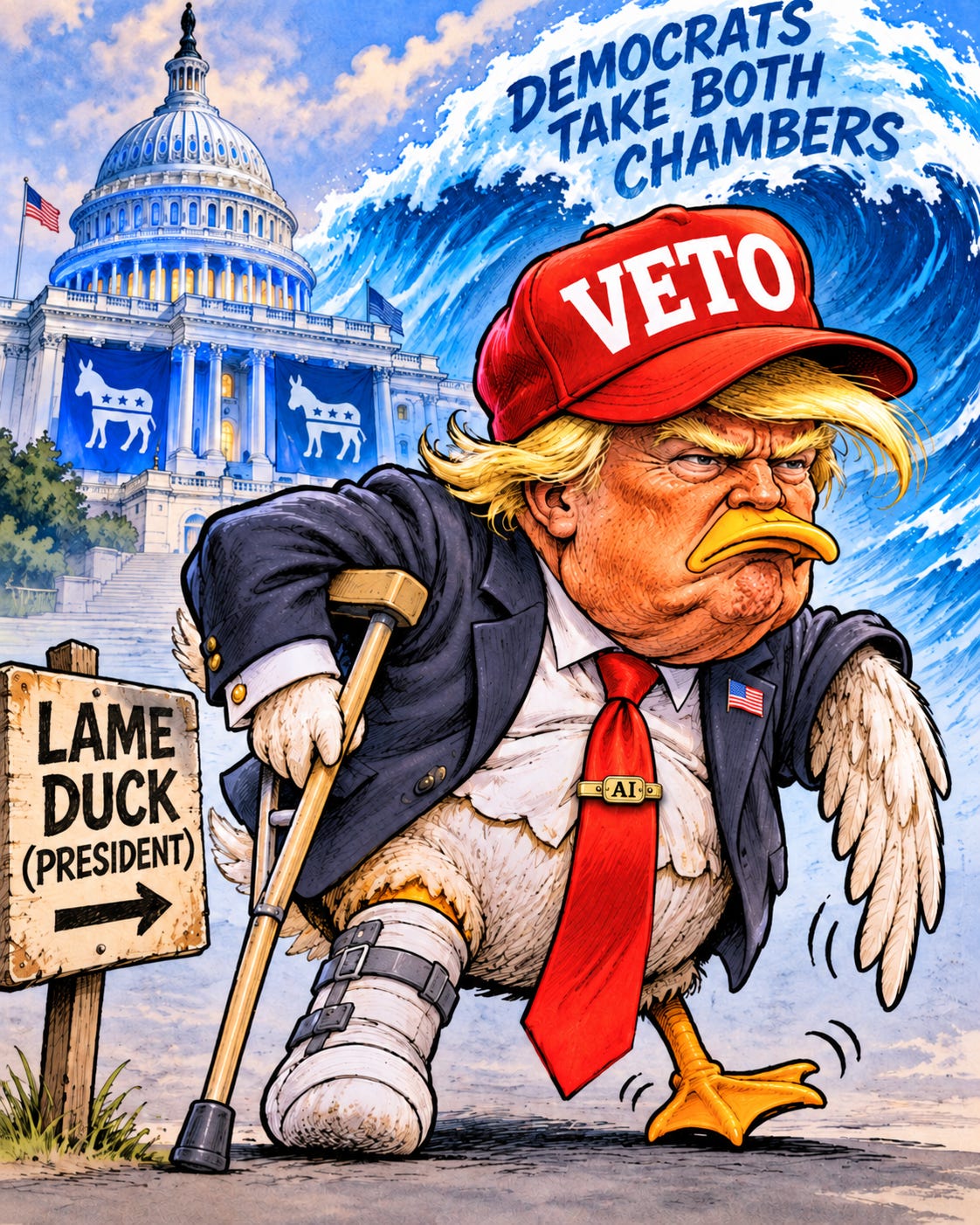
His prominently displayed red “VETO” cap offers a revealing glimpse of the political confrontation he appears prepared to embrace.
The danger lies in prolonged institutional gridlock: executive orders, legal battles, budget standoffs, and competing efforts to shift political responsibility onto the opposing party. Such confrontations could prevent urgently needed reforms at a time when the country’s economic and social challenges demand meaningful solutions.
Foreign Policy: The President Still Commands the Military
Foreign policy presents an even more serious concern. Trump remains commander in chief of the U.S. armed forces. Congress can impose political and financial constraints on military operations, but it cannot reliably prevent every military strike before it happens.
The war against Iran has already demonstrated how consequential military decisions can become when known risks are disregarded. Further escalation could cost additional lives and threaten the security of the entire Persian Gulf region.
The same uncertainty extends to Ukraine, Russia, China, and America’s European NATO allies. When foreign policy commitments depend on rapidly shifting decisions in the White House, long-term security planning becomes increasingly difficult.
The Global Economy: Everyone Else Pays a Price, Too
The next two years could also bring further turbulence to the global economy. New tariffs, trade disputes, investment uncertainty, and continued disruptions to energy supplies represent a dangerous combination.
The Strait of Hormuz demonstrates how quickly a regional conflict can produce global consequences. Rising transportation and energy costs affect businesses, households, and government budgets far beyond the Middle East.
Europe remains particularly vulnerable. Its strategic dependencies on foreign energy, technology, defense capabilities, and critical raw materials cannot be eliminated within a few years. Even a future American president committed to restoring international cooperation would struggle to rebuild lost trust or reverse investment decisions disrupted by years of instability.
Some economic damage can be repaired relatively quickly. Other consequences may last well beyond the administration responsible for them.
Electoral Defeat Is Not the Same as Losing Power
It would be a mistake to suggest that further escalation is inevitable. Political compromise remains possible, and a Democratic-controlled Congress can impose meaningful limits on Trump’s ability to govern.
Nevertheless, the United States now faces a remarkable contradiction: A president whose party has just lost control of both chambers of Congress will continue to wield enormous executive and military power.
The defining question of the next two years is therefore not whether Trump still has power, but how he will respond as that power faces increasing constraints.
American democracy has activated an important constitutional check through these midterm elections. Whether that check proves sufficient to contain further foreign policy escalation, domestic power struggles, and economic damage remains to be seen.
The duck may be limping. But his veto pen still works.
Illustration: AI-generated political caricature.
Election results reflect projections available on the morning of November 4, 2026.