


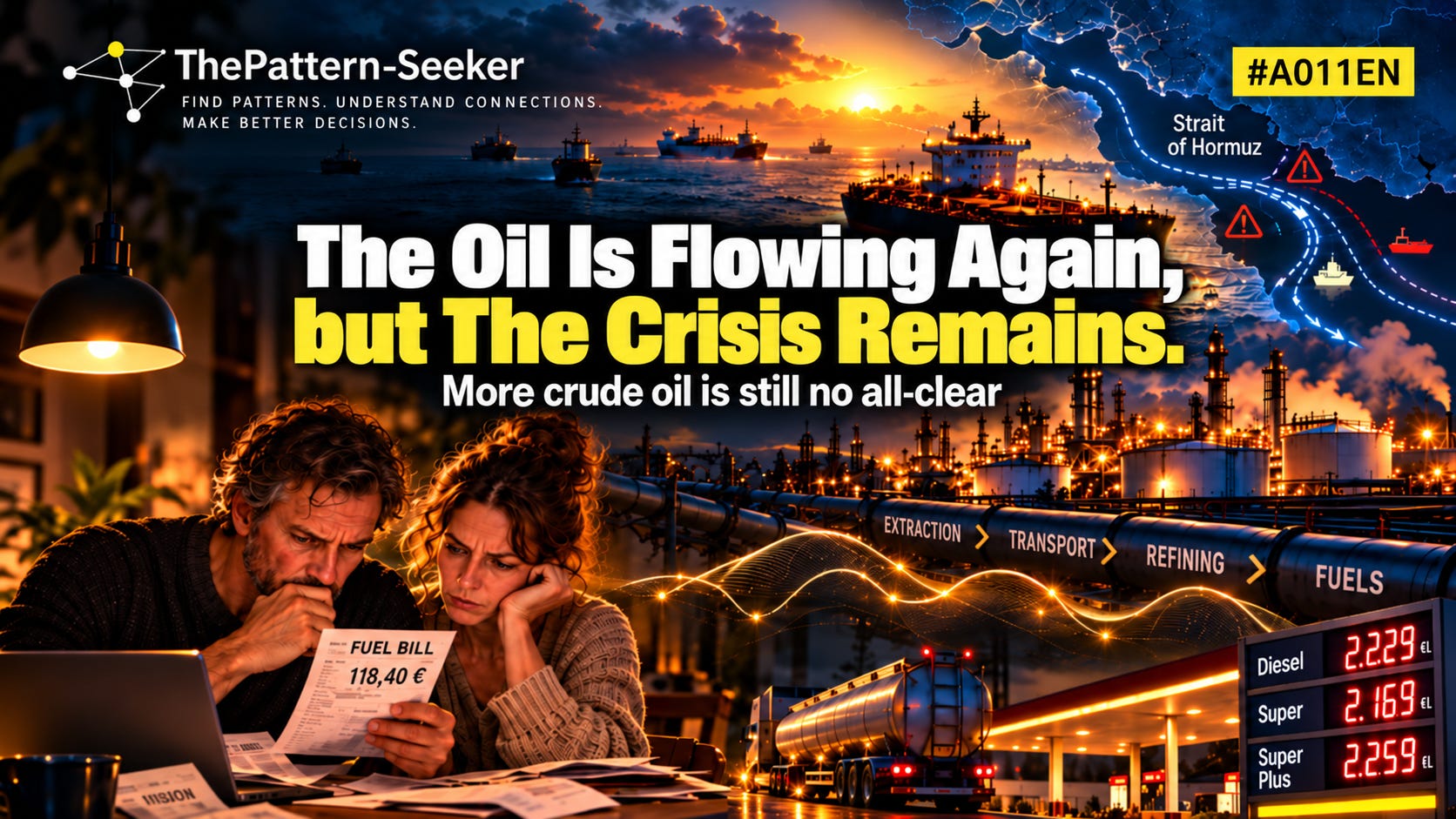
Why recovering crude-oil volumes do not amount to an all-clear — and why some consequences arrive only after the original trigger has long disappeared from the headlines
More tankers, more crude oil, and at times a falling market price: it sounds like a crisis that is slowly being overcome. Yet while supply improves in one part of the system, damage, detours, political decisions and military risks continue to work their way through others. The decisive question is therefore not only how much oil is flowing again today, but which consequences from yesterday are still on their way.
The news might finally bring some relief to the kitchen table of the family from A007DE, the one that cancelled its winter holiday to Fuerteventura. Perhaps running costs will become predictable again; perhaps, at some point, they may even be able to talk about replacing the old family car without simultaneously removing every other planned purchase from the table.
There is, in fact, reason for cautious optimism. Kpler recorded at least 16.5 million barrels per day of crude-oil exports from the Gulf region between 1 and 28 September. Excluding Iran, that is roughly back to pre-war levels.[1] So this is not merely a market hoping for better supply. A substantial part of the crude volume that had disappeared is actually moving again.
What this does not mean, however, is that the system behind those volumes is functioning as it did before the war.
That is where the central problem of this crisis begins: one number can return to normal while the conditions required to produce that number remain anything but normal.
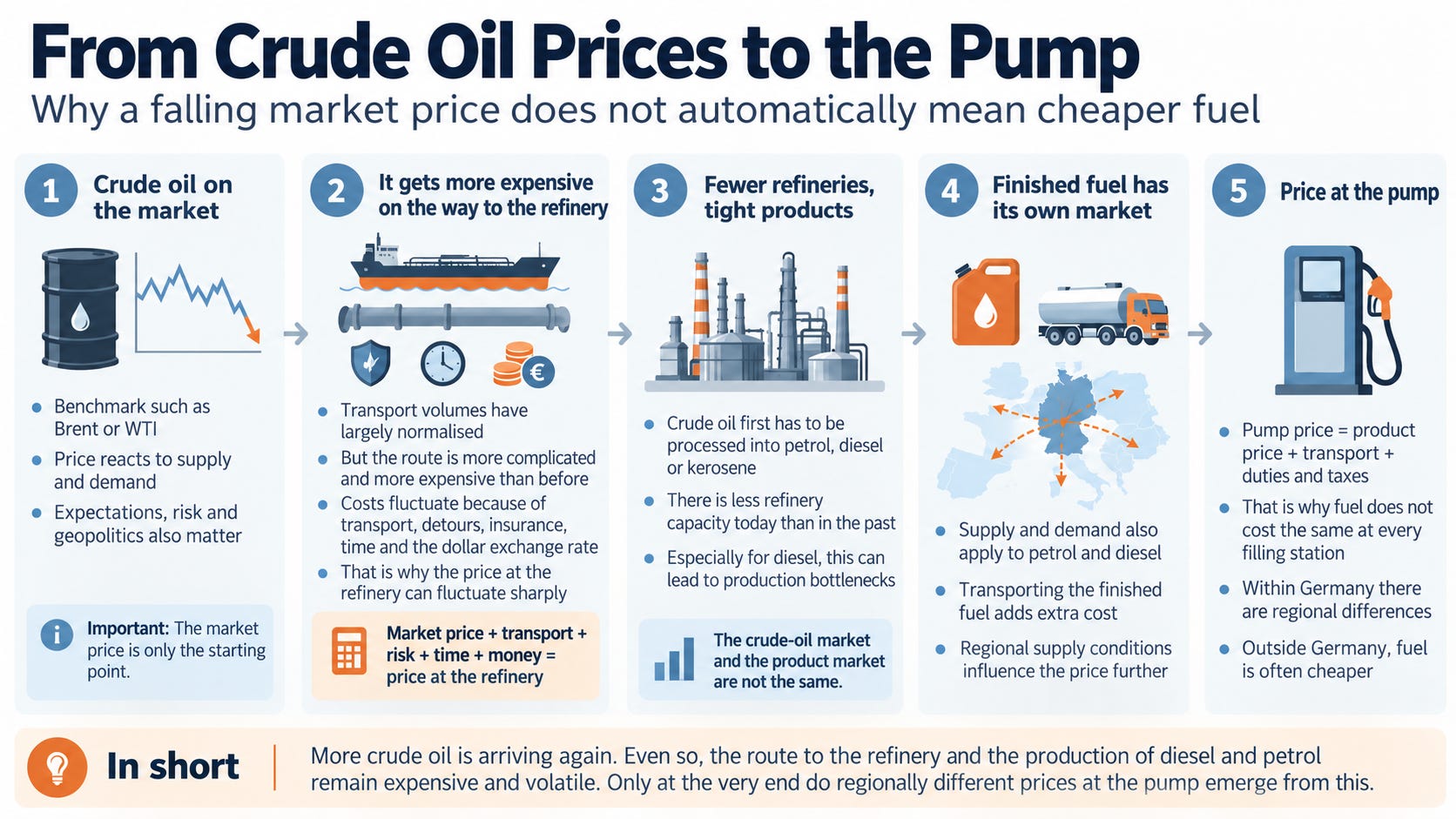
The oil is arriving again — but not in the same way
Before the war, a large share of the region’s crude exports passed through the Strait of Hormuz. Today, significantly more oil is being routed through alternatives, including Saudi Arabia’s East-West Pipeline to the Red Sea and the UAE route to Fujairah. At the same time, some cargoes that still pass through Hormuz are transferred to other tankers once they are outside the strait.[1]
On paper, export volumes can therefore begin to resemble the old normal. Behind those figures, however, sits a different logistics system.
Crude oil does not necessarily reach buyers on the same ships, along the same routes or within the same time frame. Tankers take detours, cargoes are transferred, insurers repeatedly reassess risk, and ports and pipelines suddenly have to handle volumes they were not previously expected to carry at this scale.
Think of a motorway bridge that has been closed. After a few days, traffic may once again reach almost the same total volume by being pushed through several diversions. That is certainly better than complete paralysis, but the bridge has not been repaired, and journeys have not become as short, reliable or cheap as they were before.
The same distinction matters in oil markets. Physical supply can recover without freight, insurance and risk costs returning to their previous levels. Kpler therefore distinguishes explicitly between the normalisation of crude-oil volumes and the normalisation of the costs involved in moving them.[2]
The exchange price is only one part of that story. A refinery also has to care about which crude grade actually arrives, how long it has been travelling, which route it had to take, what that transport cost and what additional risks had to be paid for along the way.
The visible crude-oil price is the beginning of the bill, not the end of it.
A refinery cannot process an “all-clear”
The journey of crude oil may end at the refinery, but the supply problem does not.
Crude first has to be turned into petrol, diesel, jet fuel and other products. The quantities that can be produced depend on the crude grade, the technical configuration of the plant and, above all, how much refining capacity is actually available.
More crude therefore does not automatically mean proportionally more diesel.
This is currently one of the most persistent bottlenecks. Kpler estimated Middle Eastern refinery throughput in August at around 7.3 million barrels per day, compared with about 9.9 million before the war. Damaged facilities were able to process less, while other refineries had to restrict production because finished products could not be moved out efficiently. In that scenario, Kpler did not expect a complete return to previous refinery throughput before the second quarter of 2027.[3]
That is why two apparently contradictory headlines can both be true at the same time: crude supply improves, while diesel remains scarce and expensive.
The International Energy Agency likewise noted in early October that crude exports had recovered substantially, while flows of refined products remained severely constrained. Diesel, in particular, remained tight.[4]
Finished fuel therefore has its own market. Supply and demand meet again at that stage, after which storage, regional distribution, retail margins and taxes are added.
The pump price is not simply the Brent price converted from dollars per barrel into euros per litre.
Relief at the beginning of the chain can meet another bottleneck further down and lose much of its effect before it reaches the consumer.
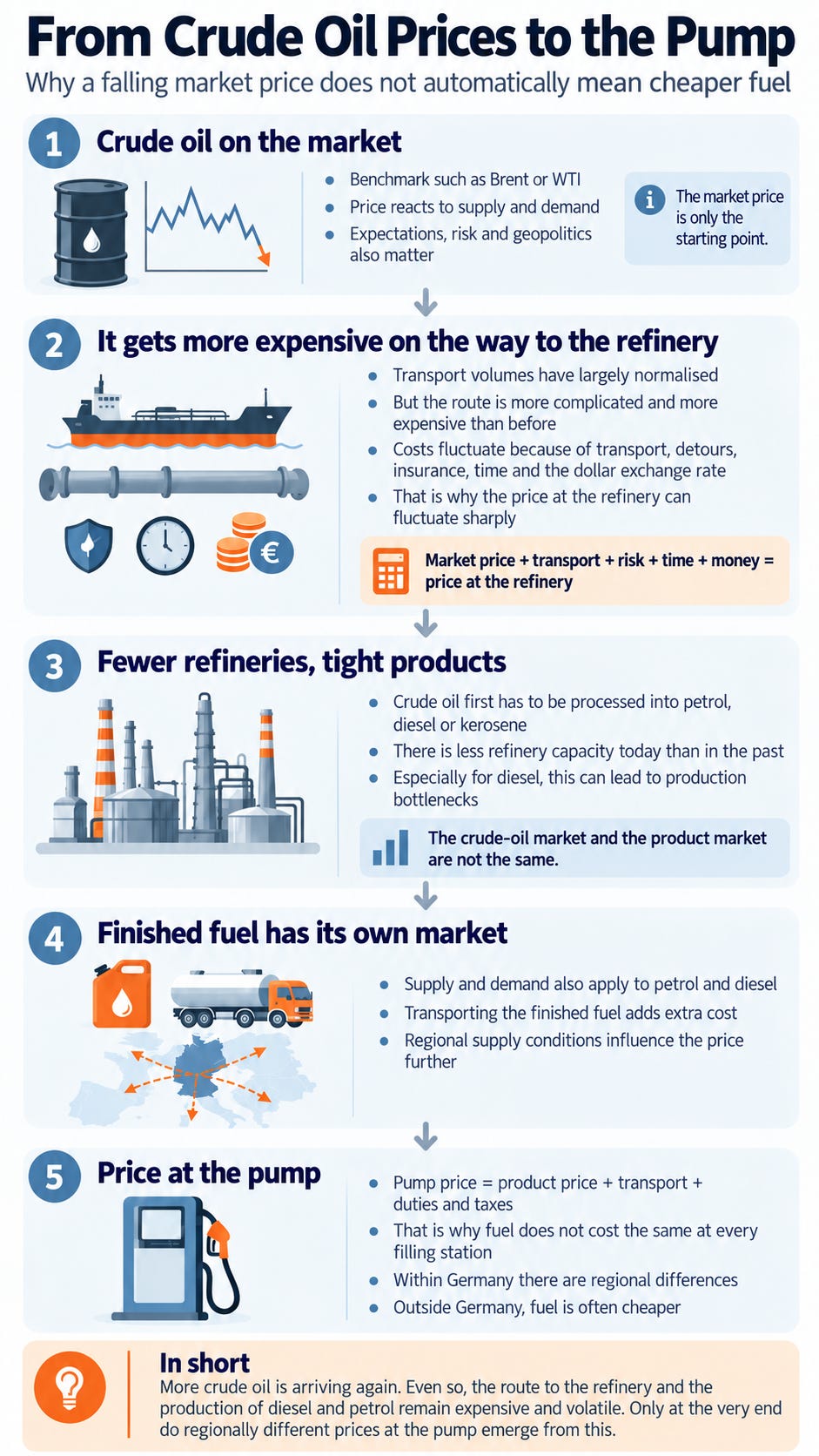
From the crude benchmark to the pump, several distinct markets and cost layers interact. Relief in crude oil does not necessarily reach consumers unchanged. AI-generated illustration.
The oil price is only the surface of the water
Perhaps this crisis is easier to understand if we stop imagining the oil market as a chain and instead picture it as a large lake.
In calmer times, a stone occasionally falls into the water. A pipeline fails, a producer cuts output, or a refinery unexpectedly goes offline. The impact creates waves, those waves spread, and eventually the surface settles again.
Of course, oil markets were never truly that simple. But for many limited events, this linear view was useful enough to connect cause and effect.
Today, many stones are falling at once.
They are different sizes, travelling at different speeds and hitting different parts of the water. Some have only just landed, while the waves from others are still moving through the lake even though the original event has already disappeared from the news.
And beneath the visible surface there are currents.
Tankers, insurers, pipelines, inventories, refinery capacity, exchange rates, political decisions, military risks, state interventions and the prices of refined products are all moving below that surface. They do not act neatly one after another. They act simultaneously and on one another.
A new wave therefore no longer hits still water. It hits a system that is already moving.
Some effects reinforce each other, while others temporarily cancel each other out. The surface can even look calmer for a few days while, below it, the conditions for the next price movement are already developing.
I use the term chronodynamics for precisely this movement of a crisis through time: pressures emerge, change in strength, collide with other pressures and leave behind a new state upon which the next event then acts.
That was already the central idea in A007DE. The question was not whether a single crisis would bring down the global economy. The point was that every new shock strikes a system whose reserves, households, businesses and governments have already been altered by earlier pressures.
Time is therefore not merely another axis below a price chart.
Time changes the starting position itself.
The same disruption may be easy to absorb when inventories are full and become a serious problem months later, even if the technical damage is identical, simply because the buffers available to the system have meanwhile become smaller.
The stone would be the same.
The water would not.
A decision has more than one arrival time
I distinguish this movement of the overall system from what I call chronometric dynamics of impact and agency — the English equivalent I use here for chronometrische Wirkmachtdynamik.
The phrase sounds technical, but the underlying idea is quite ordinary: a decision does not take effect everywhere at the same time. Its strength changes over time, it can spill into other systems, and it can trigger new reactions there.
A military attack on an important transport route may move futures markets within minutes. A few hours later, insurers may reassess the risk. Shipping companies may only afterwards decide whether their tankers should continue, wait or reroute. A refinery may feel the delayed delivery days or weeks later, while a consumer may notice the change only in the next pricing cycle at the filling station.
The original event therefore has no single moment at which its economic consequences have fully arrived.
While markets are already trading the next headline, the previous decision may still be embedded in a changed route, a higher insurance premium, a delayed cargo or an altered production plan.
The effect can also change while it travels.
A delayed tanker may initially be irrelevant if well-filled storage tanks can bridge the gap. But if the same delay meets already-low inventories, a refinery outage and rising demand at the same time, the very same event can suddenly have a completely different impact.
What matters is therefore not only what happens, but when it happens and what condition the system is in when it arrives.
That time-dependent change in impact and room for action is what I mean by chronometric dynamics of impact and agency.
It also explains the shadow effects of a crisis. Not because hidden forces necessarily have to be at work, but because cause and consequence can become separated so far in time and space that the relationship between them is barely visible when the consequence finally arrives.
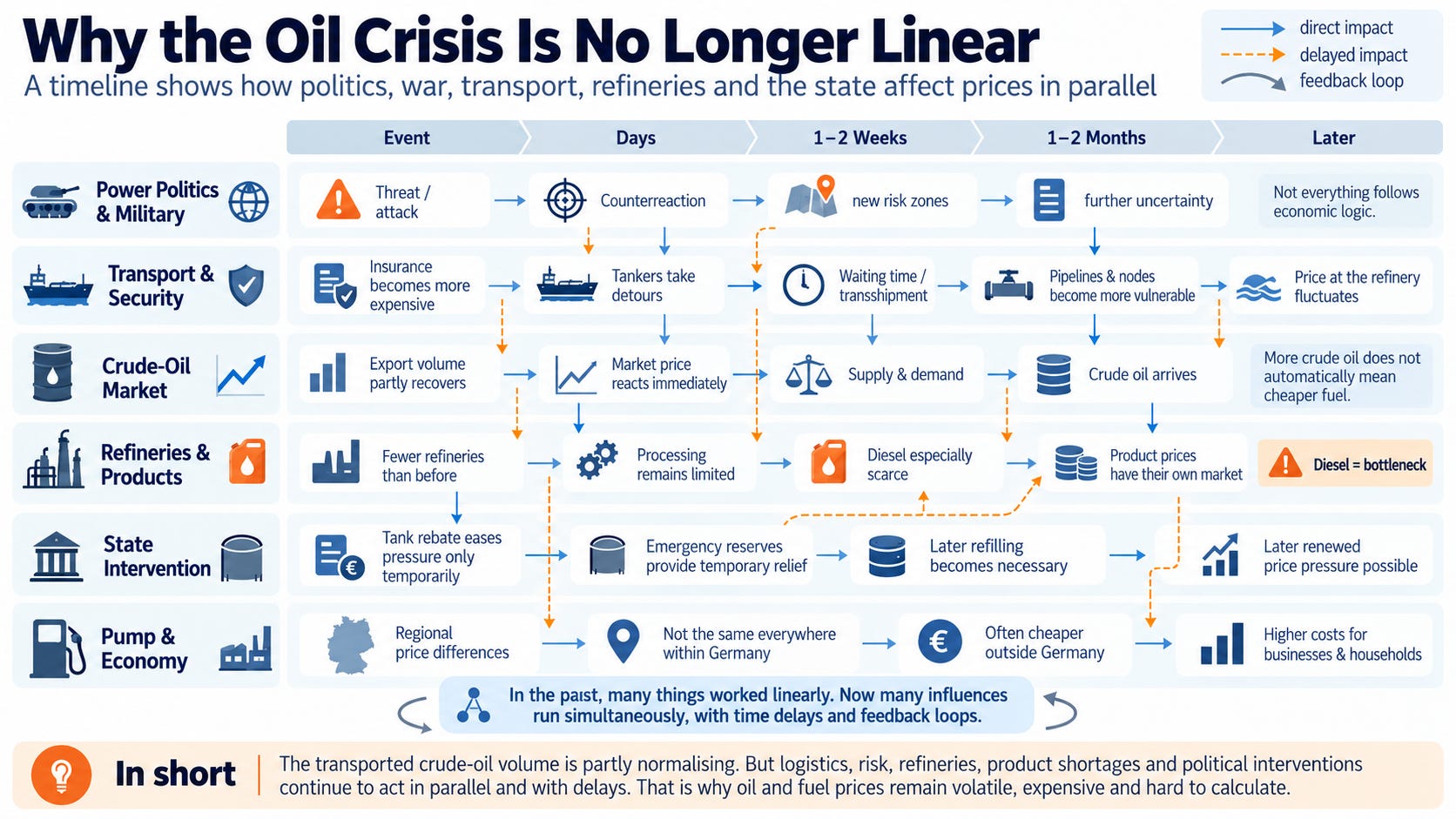
Several chains of effects unfold at the same time, influence each other and reach their greatest impact at different points in time. The time frames shown are schematic and are not forecasts. AI-generated illustration.
A war cannot be repaired by a diversion
All of this economic adaptation is taking place inside an unresolved conflict.
The war involving the United States, Israel and Iran continues to shape the security environment even as considerably larger quantities of crude are once again being transported.[5] Decisions in Washington, Jerusalem and Tehran matter, as do the reactions of other governments and military actors across the region.
For oil markets, this is particularly difficult because political and military actors are not optimising for the same objectives as businesses.
A shipping company weighs transport costs against risk. A refinery tries to operate its facilities as reliably as possible. Military actors may instead be pursuing deterrence, retaliation, strategic control, domestic political effects or bargaining power.
Something that appears economically irrational to the oil market may therefore make sense within a military or political strategy.
A statement by Donald Trump, an Israeli operation or an Iranian response can therefore alter expectations within hours even if the physically available amount of crude has not yet changed at all.
That uncertainty now affects a transport system that has already adapted to previous disruptions. This creates another problem: every successful diversion can create a new critical node.
If less oil moves through Hormuz and more is redirected through a pipeline, that pipeline becomes more important. As its importance grows, so does the potential impact of a technical failure or an attack on pumping stations and loading terminals.
Risk does not necessarily disappear.
It can move.
The system is not permanently unstable, but its vulnerabilities are redistributed. It continues to function while constantly adapting to a situation whose next change nobody can reliably predict.
Relief also has a timeline
For consumers in Germany, another layer is added on top of all this.
Since the beginning of October, the government has temporarily reduced the energy tax on petrol and diesel. Including the VAT effect, this can lower the price by roughly 17 euro cents per litre; under the current rules, the measure is limited until the end of the year.[6]
That can visibly reduce the price at the pump.
It does not, however, increase refinery capacity or make a tanker in the Persian Gulf safer.
The state is reducing one component of the final price while the others continue to fluctuate.
If those other components rise at the same time, part of the relief is absorbed. If they fall, the two effects can reinforce each other.
Strategic oil reserves follow a similar time logic. When they are released, additional physical supply becomes temporarily available to the market. That can soften shortages and buy time, but it does not create new oil.[7]
Eventually, the release ends.
That additional stream of supply then disappears.
Later, reserves have to be rebuilt, which can turn a previous additional supplier into an additional buyer for a period of time.
This does not automatically create another price shock. Reserves do not have to be repurchased on a single day, and if supply has stabilised by then, the market may absorb the extra demand with little difficulty.
But if the market remains tight and expiring relief measures, low inventories and reserve purchases overlap, additional pressure can emerge again.
This is precisely where the importance of time becomes visible.
A measure can provide useful relief today and still create a different effect months later. Whether that later effect remains small or becomes substantial depends not only on the measure itself, but on the condition of the system when that later moment arrives.
The time that has been bought may become a bridge to recovery.
It is not recovery itself.
When postponement eventually becomes abandonment
At this point, the story returns to the family from A007DE and to the businesses whose decisions never appear directly in oil-market statistics.
A trades company postpones the purchase of a new van because fuel costs, financing and the order book have become uncertain. For a few months, that may be a sensible precaution.
If the old vehicle then begins to fail more frequently, repair costs and lost working hours increase. If demand weakens at the same time, the delayed purchase may eventually become an investment that never happens at all.
The same process can happen in a household. It may begin with a cancelled holiday, continue with postponed purchases and eventually reach the point where savings are no longer available for future plans because they are being used to cover ordinary running costs.
None of those decisions has to be a catastrophe on its own.
The problem lies in their combination.
That was already the central idea in A009DE: an energy shock does not arrive at the supermarket checkout on the same day. It moves through transport, production, margins, consumption, investment, employment and public finances, while the next shock may already have begun.
A010DE went one step further and showed how decisions that initially appear rational within their own individual systems can meet again years later. There, chronometric dynamics of impact and agency described the time-dependent change in the relative impact and room for action of different actors.
Applied to the oil crisis, this means that even if crude oil eventually becomes significantly cheaper, the decisions made during the expensive months do not automatically disappear.
A company that has closed does not reopen merely because Brent has fallen by twenty dollars.
An investment that was cancelled does not suddenly produce capacity retrospectively.
Savings that have been consumed do not reappear in a bank account.
And a government that has spent billions on relief measures does not subsequently possess the same fiscal room for manoeuvre it had before.
At some point, secondary damage can therefore continue without the original trigger still being present.
That is the point at which an oil crisis begins to grow beyond the oil price.
An all-clear requires more than a falling market price
None of this means that a multi-year oil crisis is already inevitable.
Political de-escalation could substantially reduce security risks. Transport routes could become more reliable, damaged infrastructure could be repaired, refineries could increase production again and inventories could be rebuilt.
Gradual normalisation without a comprehensive peace settlement is also possible if governments and companies manage to create sufficiently stable alternative structures.
What cannot be derived from the present situation, however, is a simple equation:
More crude oil = crisis over.
For a genuine all-clear, more would have to normalise than the number of barrels being exported. Deliveries would need to work reliably over longer periods, transport costs would need to become more predictable, refineries would need to produce sufficient petrol, diesel and jet fuel, and reserves would need to be rebuilt without creating the next bottleneck in the process.
Above all, the political and military environment would have to become predictable enough that companies no longer begin each new day with a fundamentally different risk calculation.
That is not yet the situation.
Our lake can therefore look calmer on the surface for a few days while currents continue moving below. Some lose strength, others collide only later, and every new impact changes the conditions for everything that follows.
Chronodynamics describes this movement of the system through time.
Chronometric dynamics of impact and agency describes when individual decisions begin to take effect within that system, how they alter other processes and how long their consequences continue to travel.
For the family at the kitchen table, genuine relief would therefore be more than a cheaper fuel receipt.
It would become visible when decisions that have been postponed for months become possible again, when savings can begin to grow rather than shrink, and when an unexpected bill no longer removes the next plan from the table.
The crisis does not end simply because more oil is flowing again.
It begins to end when improvised stabilisation becomes reliable room for action once more.
«»«»«»««»»«»«»«»
Sources and notes
[1] Crude-oil exports from the Gulf region and changing transport routes.
Kpler: Explainer: How Mideast Gulf crude exports returned to pre-war levels. The analysis describes the recovery of crude exports and the increasing use of alternative routes and ship-to-ship transfers.
https://www.kpler.com/ja-jp/blog/explainer-how-mideast-gulf-crude-exports-returned-to-pre-war-levels
[2] Physical supply can normalise faster than costs.
Kpler: Hormuz normalisation no longer needs to wait for a deal. The analysis distinguishes between restored physical export volumes and continuing security, transport and risk costs.
https://www.kpler.com/zh/blog/hormuz-normalisation-no-longer-needs-to-wait-for-a-deal
[3] Refining capacity in the Middle East.
Kpler: Middle East refining under pressure: damage, export disruption and a two-speed recovery.
https://cn.kpler.com/blog/middle-east-refining-under-pressure-damage-export-disruption-and-a-two-speed-recovery
[4] Situation for refined products.
International Energy Agency: statement by the Executive Director on energy security and market conditions in early October 2026.
https://www.iea.org/news/executive-director-participates-in-g7-leaders-meeting-on-energy-security-and-markets
[5] War involving the United States, Israel and Iran.
UK House of Commons Library: overview of the conflict and its regional implications.
https://commonslibrary.parliament.uk/research-briefings/cbp-10637/
[6] Temporary reduction in German energy tax.
German Federal Ministry of Finance: FAQ on the energy-tax reduction for petrol and diesel.
https://www.bundesfinanzministerium.de/Content/DE/FAQ/energiesteuersenkung.html
[7] Strategic oil reserves.
International Energy Agency: Oil security and emergency response.
https://www.iea.org/about/oil-security-and-emergency-response
Methodological note
The terms “chronodynamics” and “chronometric dynamics of impact and agency” are used here as analytical concepts, not as mathematically calculated forecasting variables. Chronodynamics describes how crisis effects change and interact over time. Chronometric dynamics of impact and agency refers here to the time-dependent change in the impact and room for action of different actors, decisions and events.
The causal chains and time sequences shown are intended to illustrate complex interactions. They are not predictions of exactly when, or with what intensity, individual consequences will occur.
Text developed with AI assistance.