


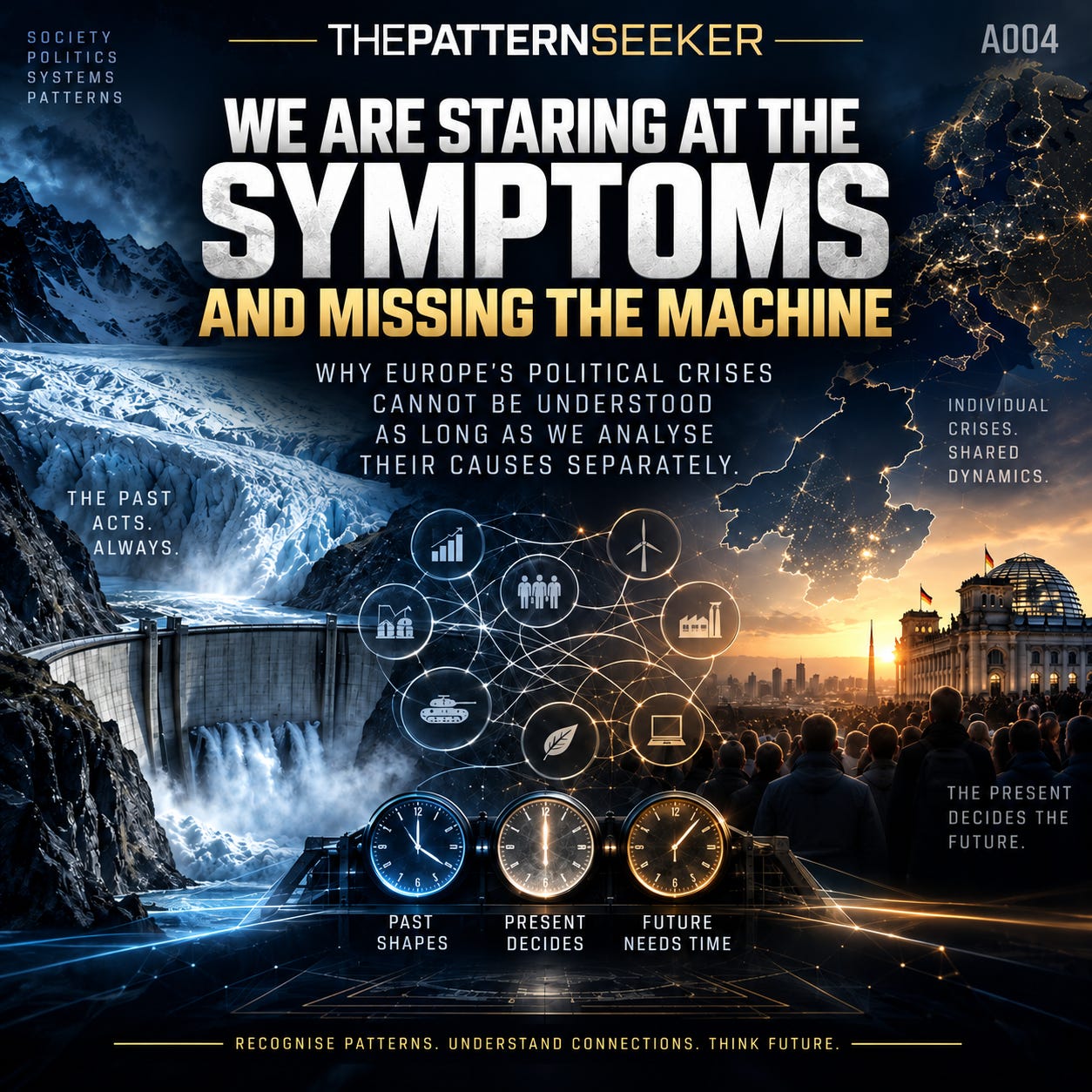
Why Europe’s political crises cannot be understood as long as we keep analysing their causes separately.
Under my last article, a reader wrote that we should pay more attention to people’s living conditions: to dissatisfaction, status loss, cultural uncertainty, the desire for simple explanations, and to parties that know how to translate those needs into emotionally clear messages.
That is true.
But it describes only one part of the problem.
Social psychology can explain why certain messages become attractive. Sociology can show which milieus are changing, which groups are losing social status, or no longer recognise themselves culturally. Political science can examine why established parties lose trust and why protest parties benefit from that erosion.
But all of these explanations begin at a point where society is already under considerable pressure.
The more important question comes earlier:
Why are several European democracies entering conditions in which radical and populist parties are growing stronger at the same time?
«»«»»»»»«»«»»««»«»«»«»«»«»«»
When Similar Patterns Appear in Different Societies
France is not Germany, Italy is not Austria, the Netherlands are not Hungary, Sweden is not Slovakia.
These countries have different political traditions, economic structures, historical experiences and social conflicts.
And yet several European democracies are showing strikingly similar developments: declining trust in established institutions, increasing polarisation, political fragmentation, a growing sense of lost control, and a stronger willingness to support parties that promise to make an increasingly complex world feel simpler and more manageable again.
These societies do not have the same causes.
But they are partly exposed to the same transnational pressures, and those pressures hit very different historical systems.
When similar political symptoms emerge in different societies at the same time, it is no longer enough to study the respective voter groups in isolation.
We have to look at the forces acting on these societies simultaneously.
«»«»»»»»«»«»»««»«»«»«»«»«»«»
We Have Been Looking at Crises Separately for Too Long
We divide the present into political compartments: energy supply, migration, demographic change, infrastructure, security, climate impacts, industrial transformation, digitalisation and public finances.
Each of these fields has its ministries, committees, expert panels and academic disciplines.
Society does not experience them separately.
It experiences them all at once.
A rise in energy prices does not remain inside the economics ministry. It increases production costs, changes investment decisions, burdens companies and households, and puts pressure on purchasing power and competitiveness.
If industry weakens at the same time, fiscal room narrows. When money becomes tighter, necessary investment becomes harder. When infrastructure, education or public services visibly deteriorate, trust in the state’s capacity declines.
When trust declines, political majorities change.
And those changed majorities determine which long-term reforms are still politically possible.
This is no longer a simple chain of cause and effect.
It is a network of feedback loops.
«»«»»»»»«»«»»««»«»«»«»«»«»«»
The Past Does Not Disappear After an Election
Political decisions are often treated as though their effects belong to the legislative term in which they were made.
They do not.
A power grid does not care which government postponed its expansion. A bridge does not know election cycles. The age structure of a society does not follow coalition agreements. An education system may take years or decades before the full social consequences of a reform become visible.
Economic dependencies can also appear perfectly rational for a very long time.
An energy source is cheap as long as it remains available. A supply chain is efficient as long as it works. A military dependency seems acceptable as long as the security order remains stable. Deferred investment looks economical as long as the existing infrastructure still holds.
Many decisions made twenty or thirty years ago were therefore not simply stupid.
They were made under the conditions of their time.
That is precisely what makes the problem more difficult.
Societies can make decisions for decades that appear rational under current conditions, while the combined long-term effects of those decisions still become dangerous later.
«»«»»»»»«»«»»««»«»«»«»«»«»«»
The Glacier Does Not Wait for Politics
Imagine a glacier whose retreat is being reliably observed.
We know that the water is coming. We may not know every litre or every exact date, but the direction of travel is clear.
A dam is therefore planned further down the valley. Construction will take ten years.
At first, it looks absurdly oversized. There is hardly any water behind it. It costs billions and ties up resources for a problem whose full effects are not yet visible.
That is precisely where political short-sightedness begins.
Why build something today that we do not yet fully need today?
Because the dam does not have to be finished when we finally recognise the problem.
It has to be finished when the problem arrives.
If construction begins only once half the glacier has already melted, the engineering challenge has not changed.
We have simply lost one decisive resource:
time.
And time cannot be manufactured later.
«»«»»»»»«»«»»««»«»«»«»«»«»«»
Politics Still Treats Time as Background
We constantly ask what a measure costs, who pays for it, who benefits from it, whether it is fair and what political consequences it has today.
Those are necessary questions.
But one additional question is decisive:
When does a measure have to begin in order to work in time?
Pension systems can require decades between reform and full effect. Power grids are not built within months. Education policy unfolds over years. Military capabilities cannot be rebuilt quickly if personnel, production capacity and equipment have been reduced over long periods.
Trust also has a time dimension.
It can erode slowly.
But it cannot be restored by cabinet decision.
Time is therefore not merely the stage on which politics takes place.
Time changes the effect of political decisions themselves.
«»«»»»»»«»«»»««»«»«»«»«»«»«»
The Pension Debate Shows the Problem in Miniature
Long-term pension reform demonstrates this trap particularly clearly.
The concrete design should be contested: financing, contributions, funded elements, retirement age, social distribution and intergenerational fairness.
That is democratic politics.
But while the debate continues, demographic change does not stop.
A reform that requires many years before its full effects become visible has one characteristic that political debate often underestimates:
Lost lead time cannot simply be recovered later.
Starting five years later does not necessarily mean reaching the same point merely five years later.
In long-term systems, the timing of an intervention changes the effect of the intervention itself.
A non-decision is therefore not neutral.
It changes the system too.
«»«»»»»»«»«»»««»«»«»«»«»«»«»
Decisions Store Effects
This brings us to something political language describes surprisingly poorly.
Decisions do not act only in the moment they are made.
They can store effects.
A postponed renovation stores future repair costs. A power grid that is not built stores future bottlenecks. An inadequate education reform stores future labour shortages. A failure to adapt to climate change stores future damage.
Societies store effects as well.
Experiences of social decline, political disappointment, transformation, loss of control or cultural change do not disappear simply because a statistic improves.
They are remembered.
They are passed on.
They shape expectations.
And in doing so, they alter the way a society reacts to the next crisis.
The past does not live only in archives. It lives in the behaviour of the present.
«»«»»»»»«»«»»««»«»«»«»«»«»«»
The Past Does Not Act Only Through Material Structures
This is where a crucial part of political analysis often disappears.
We are not only trapped in the consequences of old decisions.
We also carry forward the ways of thinking that produced those decisions.
If political culture rewards short-term success more strongly than long-term prevention, if risks are taken seriously only once they become visible, and if responsibility is thought primarily in electoral cycles, then the present reproduces some of the very patterns whose consequences it is trying to repair.
The past therefore continues to act on several levels.
Infrastructure stores it materially.
Demography stores it biologically and socially.
Institutions store it organisationally.
Public debt stores it fiscally.
Social groups store it culturally and psychologically.
The past acts not only through old decisions. It acts through the way we still make decisions today.
«»«»»»»»«»«»»««»«»«»«»«»«»«»
We Need a Term for This
In technical systems, this idea is ordinary.
A complex electrical circuit does not consist of a single current moving from A to B. It contains multiple loops, resistances, storage elements, delays and feedback.
A capacitor has a state that depends on its past.
What happens now therefore also depends on what happened before.
Societies have storage elements too.
They are called infrastructure, demography, public debt, trust, institutions, political culture, technological dependency and collective experience.
They do not store electrical charge.
They store causal potential.
And that potential can meet new developments years or decades later.
I call this time-dependent causal effect chronodynamics.
Chronodynamics describes how past decisions, cultural patterns and social developments store effects over time, and how those stored effects later couple with new events.
«»«»»»»»«»«»»««»«»«»«»«»«»«»
The Real Danger Lies at the Intersections
High energy prices meet an industry that is already being forced to transform. Demographic change meets an already strained labour market. Migration meets housing shortages, schools and municipalities with limited reserves, while climate adaptation, defence and infrastructure compete for the same fiscal and human resources.
None of these developments exists in isolation.
Their impact increasingly emerges where their causal chains intersect.
At those intersections, the individual problems begin to alter one another.
A system that could absorb one crisis without major difficulty can lose its reserves when several pressures become coupled at the same time.
And once political responses generate new economic or social consequences, the system begins feeding back into itself.
Several problems become a self-reinforcing dynamic.
«»«»»»»»«»«»»««»«»«»«»«»«»«»
People React to the Present With Their Past
This is where social psychology finds its proper place.
People obviously respond to current living conditions.
But they do not react as blank slates.
A new economic crisis meets earlier experiences. Political decisions meet existing trust or mistrust. Migration meets already established ideas about belonging and normality. Changes at work meet memories of social advancement or decline.
People therefore do not react only to the present.
They react to it through the stored effects of their past.
That applies to individuals.
And it applies to groups.
Cultural causal effects can therefore persist across decades.
Social psychology can explain how people react.
Chronodynamics adds another question:
Why were certain reaction patterns already prepared, and why can the same external impulse produce completely different political effects in different societies?
«»«»»»»»«»«»»««»«»«»«»«»«»«»
Europe Is Made of Different Historical Storage Systems
That is why the European perspective matters.
Member states are partly exposed to the same external pressures, while carrying very different historical reservoirs: different economic structures, different experiences of statehood, different transformation histories, different migration patterns and very different political cultures.
The same external forces therefore do not hit the same system everywhere.
But they move through the same European network.
Energy, trade, capital, migration, security, digitalisation, climate change and technological development do not stop at national borders.
A crisis in one part of the network changes conditions in another.
Europe is no longer simply a collection of independent political systems.
It is a coupled network of different historical causalities.
«»«»»»»»«»«»»««»«»«»«»«»«»«»
That Is Why the Search for a Single Culprit Falls Short
Political communication loves simple responsibility.
Who failed? Which government messed this up? Which minister should resign? Which party is to blame? Which group of voters does not understand what is happening?
These questions are emotionally satisfying.
Complex systems do not work according to the logic of a single culprit.
Europe’s present situation was not created on a Tuesday morning in a cabinet meeting.
It emerged from thousands of decisions, non-decisions, economic developments, cultural changes and external events that became coupled over decades.
Some of them were foreseeable.
Some were not.
Some could have been prevented.
Others could only have been influenced to a limited degree.
What matters now is something else:
These causal chains exist at the same time.
We cannot reverse their history.
But we can decide whether we continue managing every visible crisis separately, or finally begin to look at the loops together.
«»«»»»»»«»«»»««»«»«»«»«»«»«»
The Third Clock
A003 described two political clocks.
The clock of problem-solving runs in years.
The clock of trust runs in months.
A004 adds a third:
the clock of accumulated effects.
It can run for decades.
Demographic change did not begin in the year labour shortages became visible. Infrastructure decline did not begin with the first closed bridge. Strategic dependency did not begin on the day a supply chain collapsed. Social mistrust did not begin on election night, when it suddenly appeared in percentages.
By the time a crisis becomes politically impossible to ignore, its chronodynamics has often been working for years or decades.
And this is where the three clocks collide.
Past decisions create effects in the present. Repairing them takes years. The political trust required to do so can disappear within months.
The three clocks do not run at the same speed.
That is the problem.
«»«»»»»»«»«»»««»«»«»«»«»«»«»
The AfD Is Not the Machine
This brings us back to the starting point.
The AfD is not the cause of all these developments.
But it is not merely a passive symptom either.
It benefits from these dynamics, amplifies some of them and thereby changes the political system from which it emerged.
It does not have to solve the complex causal chains.
It is enough to name their visible effects, offer simple culprits and promise to make the world comprehensible again.
That is politically effective precisely because the actual causes are complicated.
A government has to explain why a solution will take ten years.
A populist party only has to explain who is supposedly to blame.
This is where political communication collides with chronodynamics.
«»«»»»»»«»«»»««»«»«»«»«»«»«»
We Have to Treat the Future as Present
We have better scientific models, more data, more powerful computers and more detailed forecasts than any generation before us.
We can identify many developments long before their full effects arrive.
And yet political decisions are still organised mainly around what is visible, what is immediate and what can be communicated within a manageable electoral cycle.
That is why we repeatedly react to damage whose emergence we had already observed years earlier.
Not because nobody knew.
But because scientific knowledge and political action operate according to different timelines.
This is not a side issue of democratic politics.
It is a structural problem of democratic steering capacity.
A future that requires twenty years to prepare for is not politically twenty years away.
It has already begun.
A glacier does not begin to matter politically only when the water reaches the dam.
Demography does not begin to matter only when pension systems come under pressure.
Cultural change does not begin with the election result in which it finally becomes visible.
And technological dependency does not begin only when someone decides to use it against us.
A foreseeable future already has political relevance today as soon as dealing with it requires time.
That is the core of chronodynamics.
We are not only prisoners of the decisions of our past.
As long as we fail to change them, we are also prisoners of the ways of thinking through which those decisions were made.
That is why it is not enough to manage the next crisis better.
We have to learn to judge political systems by their causal effects over time.
Not when the reservoir is already full.
But while the glacier is still melting before our eyes.
How long are we going to keep watching before we start building the dam?