
JCMI - Ike Aaren Adira Hadler

2️⃣ The seven PJenga Towers

Avatar von JCMI - Ike Aaren Adira Hadler
JCMI - Ike Aaren Adira Hadler
März 05, 2026
Artikel-Voiceover
0:00
-4:08
Die Audiowiedergabe wird von Ihrem Browser nicht unterstützt. Bitte führen Sie ein Upgrade durch.

The PJenga Framework by

Ike Aaren Hadler -

5. March 2026
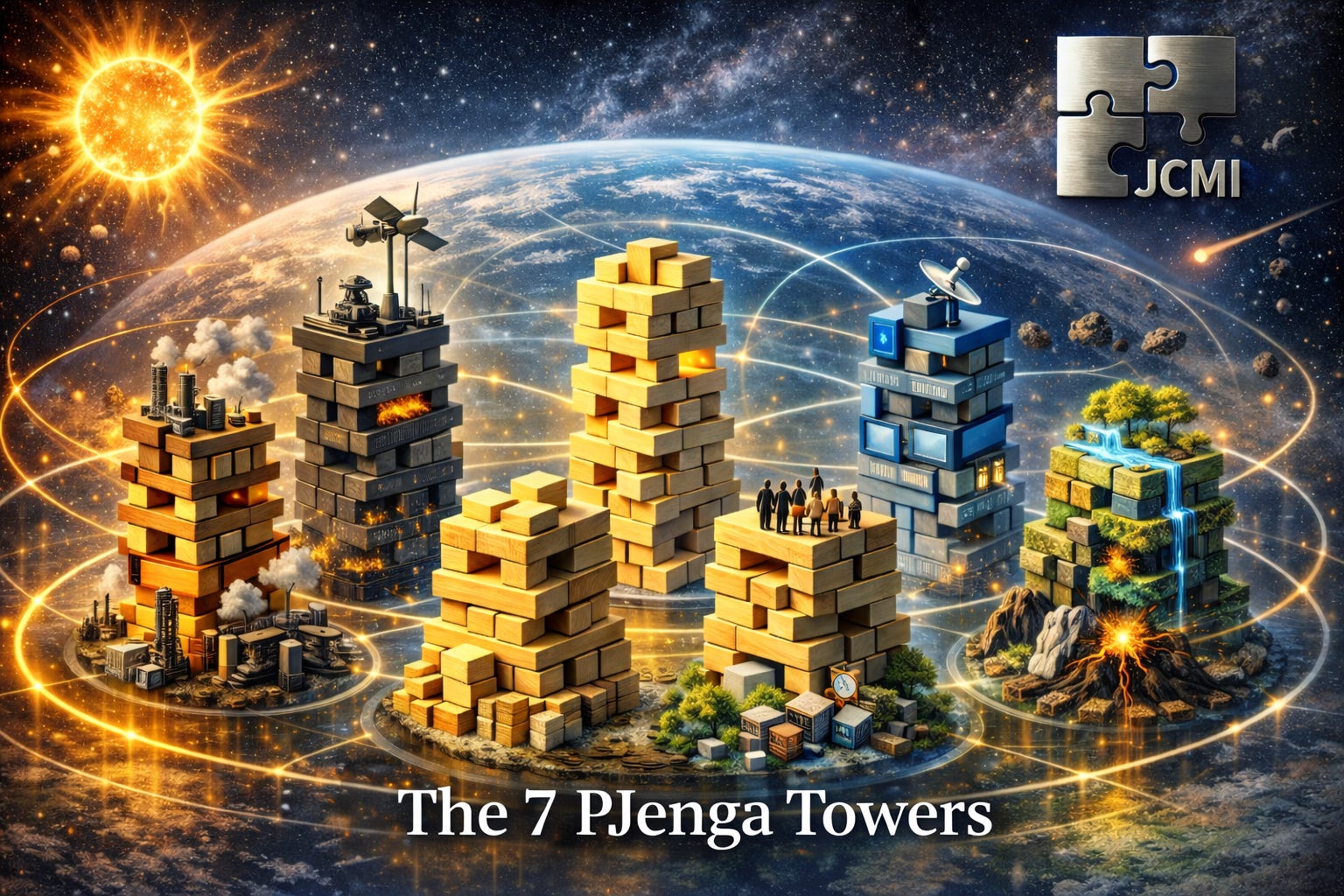
The structural foundations of the PJenga system

Modern civilization rests on several interconnected structural systems.

In the PJenga Framework, these systems are represented as seven towers.

Each tower contains the structural elements that maintain global stability. When blocks within a tower shift, the balance of the entire system changes.

1. The Energy Tower

Energy is the foundation of modern industrial civilization.

Oil, gas, electricity, and energy infrastructure power transportation, manufacturing, communication networks, and food production.

Disruptions in energy supply – whether through geopolitical conflict, market volatility, or infrastructure damage – rapidly propagate across the global economy.

Energy shocks rarely stay contained within the energy sector.

They move directly into inflation, political instability, and social unrest.

⸻

2. The Security and Military Tower

Military power and security structures shape the geopolitical environment in which economic and political systems operate.

This tower includes:

• military alliances

• deterrence structures

• weapons systems

• defense industries

• active conflicts.

When this tower destabilizes, the effects can ripple through energy markets, trade routes, and political alliances.

⸻

3. The Economic and Financial Tower

The global economic system connects production, trade, finance, and investment flows.

Supply chains, financial markets, currency systems, and capital flows all form blocks within this tower.

Economic instability can rapidly propagate across borders, especially in a highly interconnected global economy.

⸻

4. The Information Tower

In the 21st century, information systems have become structural infrastructure.

This tower includes:

• media ecosystems

• social networks

• digital platforms

• narrative competition

• information warfare.

Control over information increasingly shapes political legitimacy, public perception, and geopolitical influence.

⸻

5. The Societal and Political Tower

Societies depend on institutions, trust, governance, and political legitimacy.

Polarization, political fragmentation, and institutional erosion can weaken this tower from within.

When this tower becomes unstable, political systems struggle to respond effectively to external crises.

⸻

6. The Demographic Tower

Demographic structures shape long-term stability.

Population age structures, migration flows, labor markets, and education levels influence economic productivity and political stability.

Demographic changes move slowly, but when they shift, they reshape multiple other towers simultaneously.

⸻

7. The Planetary Tower

Human civilization operates within a planetary system.

Climate dynamics, water systems, biodiversity, and geological resources form the physical foundation upon which all other systems depend.

Environmental stress does not remain isolated within ecological systems. It influences food security, migration patterns, political stability, and economic productivity.

⸻

Together these seven towers form the structural framework of the PJenga system.

No single tower determines global stability on its own.

But when multiple towers experience stress simultaneously, the system becomes increasingly fragile.


Part of the PJenga Framework Series

The PJenga Framework is a systems-analysis model developed by Ike Aaren Hadler.

The following articles explain the structure of the model step by step:

1. Introduction – The PJenga Framework

2. The Seven PJenga Towers – Structural foundations of the system

3. Forces within the PJenga System – Pressure, friction and acceleration

4. The PJenga Dashboard – Monitoring systemic stability

5. Cascades and Domino Effects within the PJenga Framework

6. PJenga Case Study – Hormus: Energy shock and systemic stress

7. PJenga Case Study – Ukraine: Military conflict and structural strain

8. PJenga Case Study – Information War: The destabilization of perception

Diskussion über diese Post

Avatar von User
Avatar von JCMI - Ike Aaren Adira Hadler
JCMI - Ike Aaren Adira Hadler
Mar 5

Part of the PJenga Framework Series

https://jcmi2025.substack.com/p/1-indroduction

https://jcmi2025.substack.com/p/the-seven-pjenga-towers

https://jcmi2025.substack.com/p/3-forces-within-the-pjenga-system

https://jcmi2025.substack.com/p/4-the-pjenga-dashboard

https://jcmi2025.substack.com/p/5-cascades-and-dominoeffects-within

https://jcmi2025.substack.com/p/6-pjenga-case-study-hormus

https://jcmi2025.substack.com/p/7-pjenga-case-study-ukraine

https://jcmi2025.substack.com/p/8-pjenga-case-study-information-war

Antworten
Teilen

Keine Posts

Sind Sie bereit für mehr?

© 2026 JCMI - Ike Aaren Hadler · Datenschutz ∙ Bedingungen ∙ Hinweis zur Erfassung
Starten Sie Ihre SubstackApp herunterladen
Substack ist der Ort, an dem großartige Kultur ein Zuhause findet.