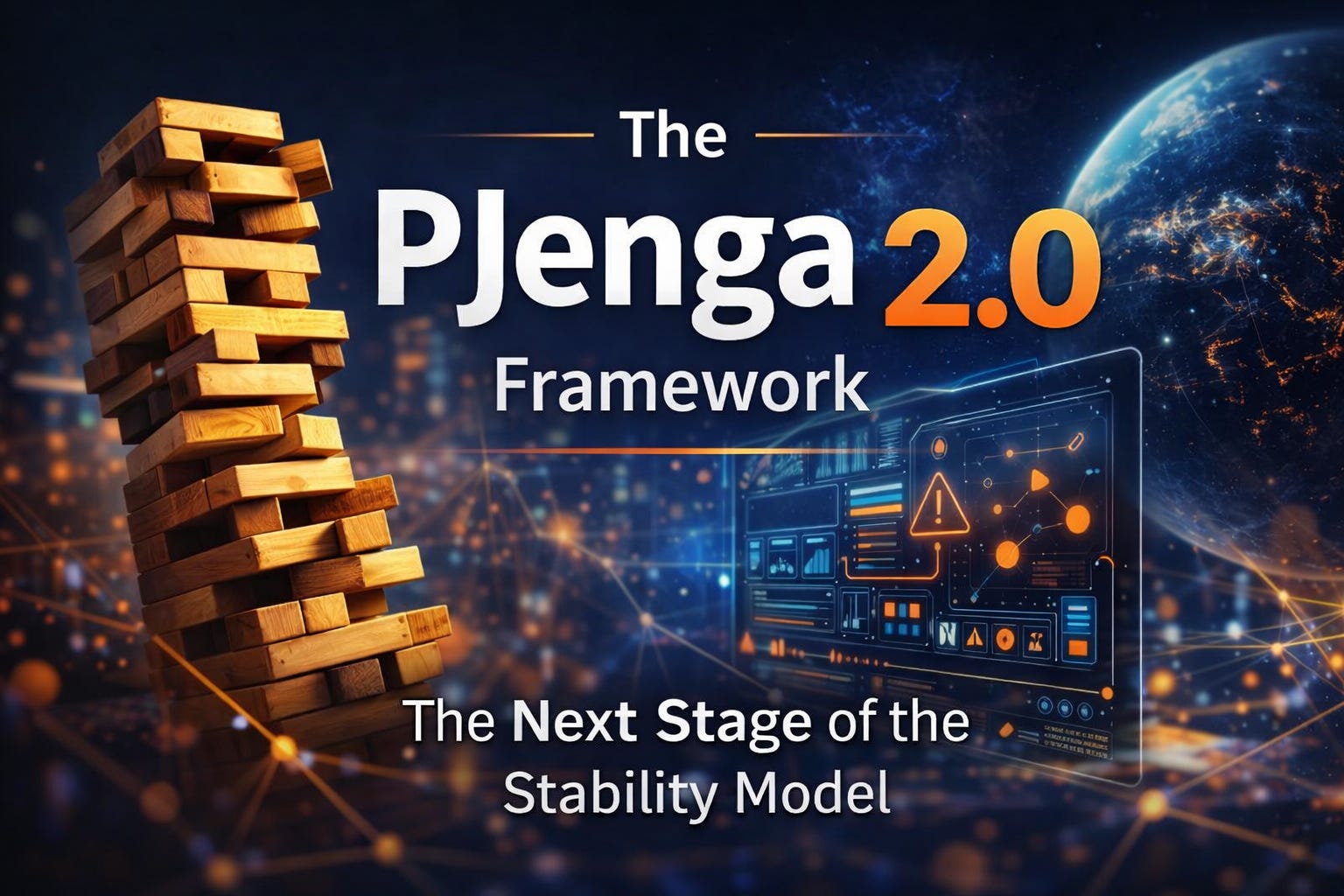
Why the model had to evolve
A framework that aims to describe real systemic instability must not itself remain rigid. That is exactly the point PJenga has now reached. The first version showed that the core idea works: modern crises do not unfold like a simple linear row of falling dominoes, but rather as an interconnected set of coupled structures in which pressure migrates, accumulates out of sight, and suddenly becomes visible somewhere else.
At the same time, the first practical applications of the model, the feedback it received, and the effort to translate it into concrete case studies also revealed where the framework needed to become more precise. Not because its core was wrong, but because real systems operate in even more contradictory, recursive, and time-shifted ways than even a good first model can fully capture.
PJenga 2.0 is therefore not a break with the previous framework. It is its maturation. The basic architecture remains intact, but it is expanded by the elements that become indispensable in real-world application: feedback loops, time delays, foundational support structures, internal voids inside seemingly stable systems, and a clearer distinction between visible drama and actual load-bearing stress.
What remains unchanged
The core principle of PJenga stays the same. The world does not rest on a single supporting system, but on several interlinked towers. Energy, security, the economy, information, society, demography, and planetary systems together form the structural statics of the present. When load-bearing elements shift in one of these towers, this rarely happens without consequences for the others. Modern instability is therefore almost never monocausal. It is networked, layered, and often invisible for long stretches.
The distinction between domino effects and cascades also remains central. Domino effects are linear and comparatively easy to trace. PJenga, however, is primarily interested in structural cascades, where pressure jumps from one domain into another, changes form there, and becomes politically, economically, or socially visible in an entirely different place.
The dashboard principle likewise remains essential. PJenga is not meant merely to describe what has already openly collapsed. The model is supposed to make it visible earlier where tension is rising, where buffers are shrinking, and where a system is being held together only by residual stability.
What is new in PJenga 2.0
The most important expansion in PJenga 2.0 is the systematic introduction of feedback loops. The first version already contained the idea that load can move from Tower A to Tower B and from there to Tower C. In practice, however, that movement almost never ends there. Economic pressure feeds back into political institutions, political polarization reshapes information spaces, information warfare in turn affects security conditions and investment decisions. Chains become loops. Loops become amplifiers. And this is often where the dynamic emerges that pushes systems from manageable tension into critical instability.
The second major expansion is time logic. Not every stone acts immediately. Some shifts trigger market reactions within hours. Others remain invisible for weeks, months, or even years until their consequences surface at the same time as a new shock. PJenga 2.0 therefore explicitly thinks in time delays. The model distinguishes more clearly between acute pressure, medium-term load migration, slow erosion, and delayed tipping processes. This temporal layer is essential if we want to avoid mistaking what is visible for the whole cause.
New as well is the idea of a foundation or base plate. Not all relevant factors are towers in their own right. Some conditions lie beneath the entire structure and determine how resilient the overall statics are in the first place. These include institutional maturity, historically accumulated trust, long-term demographic trends, the condition of critical infrastructure, and underlying climatic stress. These factors do not always attract media attention, but they often decide whether a system bends under shock or breaks.
A fourth expansion concerns the internal structure of the towers. Previously, a tower could appear stable as long as it had not visibly started to tip. PJenga 2.0 asks more directly what is happening inside the towers. Are there hollow spaces, fracture lines, overstretched load points, or merely buffers buying time? An economic or social tower may appear intact from the outside while already eroding internally. The distinction between visible façade and internal load-bearing capacity makes the model more realistic.
Another addition is a clearer distinction between buffering and real stability. Many systems appear stable not because they are healthy, but because they are mobilizing reserves, emergency interventions, debt financing, exceptional rules, or improvised compensations. That may be necessary and may buy time. But analytically, it must not be confused with robust stability. Buffer statics are not the same as structural resilience.
Finally, PJenga 2.0 integrates the actor dimension more explicitly. Real instability does not arise only from abstract systemic forces. States, corporations, networks, movements, and elites act strategically, opportunistically, panic-driven, or deliberately destructively. A model that thinks only in terms of mechanical load distribution remains too smooth at this point. PJenga 2.0 therefore also asks how actors generate pressure, redirect it, exploit it, or intentionally intensify it.
Visibility is not the same as structural load
One of the analytically most important refinements concerns the difference between visibility and real load. In modern crises, what looks most spectacular in real time is not automatically what matters most structurally. Explosions, escalations, and headlines dominate attention. But the actual load-bearing pressure points often lie elsewhere: the insurability of transport routes, credit chains, logistical redundancy, institutional trust, or social exhaustion.
PJenga 2.0 therefore aims not only to observe obvious shocks, but especially those quieter shifts that make the system more fragile from within. The model thus becomes less vulnerable to spectacle and analytically more sober.
Why this upgrade was necessary
This upgrade is not cosmetic. It is the logical consequence of the model’s own ambition. Anyone who wants to understand systemic instability must accept that real systems do not react in clean, linear, and transparent ways. They buffer, conceal, delay, mirror, amplify, and sometimes tip only after several layers of stress have already charged one another.
That is precisely why the first response to PJenga was so valuable. It did not invalidate the core of the framework. It made its next stage of development visible. A good model does not become stronger by defending itself against criticism. It becomes stronger by turning justified objections into a more precise form.
What PJenga 2.0 means for future analysis
Future PJenga analyses will therefore not only ask which tower is currently under pressure. They will ask more directly which feedback loops are already active, which time delays are hidden in the system, whether stability is genuine or merely buffered, how viable the foundation still is, and whether the affected towers have already become hollow inside.
That makes the model more demanding. But it also brings it closer to reality. And that has to be the standard. An analytical model that seeks to describe global instability must not only sound elegant. It must prove itself under real pressure.
PJenga 2.0 is therefore not the end of the framework, but the step from a strong core idea toward a more robust instrument. The first eight modules laid the foundation. The first case studies showed that the application works. The move to version 2.0 now makes clearer what the model is meant to achieve in the future: not merely to illustrate crises, but to make structural tension, hidden load, buffer statics, and systemic tipping risk visible earlier and more sharply.
Anyone who reads PJenga merely as a metaphor may see in it only a new language for old crises. But a closer reading reveals the actual ambition: to develop a framework that makes interconnected instability visible across multiple levels without reducing it to monocausal narratives.
That is the next step.
Not less model, but a more precise one.
Not less complexity, but a more readable complexity.
Not less PJenga, but PJenga 2.0.