


This is a long and in-depth article, as is typical for me. Others are better at writing snackables. But snacks cannot really explain something or make it understandable in its depth. A topic has to bite into the brain somewhere between the eye and forgetting, and trigger real thinking — unlike TikTok and YouTube Shorts.
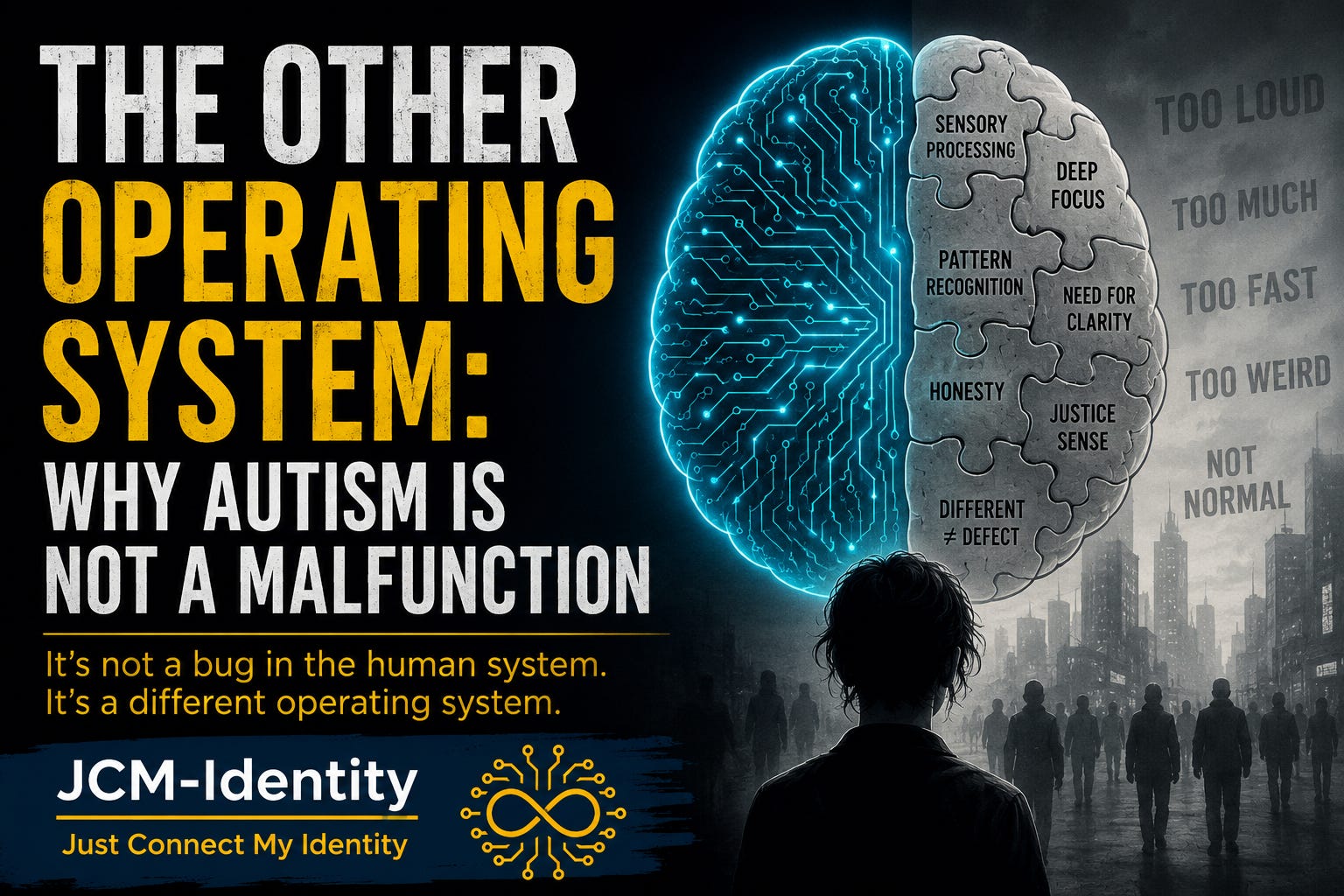
From 2012/2016 until today, more than ten years have passed in which I have studied a great deal in the field of autism. What I learned sharpened my perception and my understanding. And I do not look into this as a neurotypical researcher, but as someone who is on the spectrum myself.
In 2016, I had myself diagnosed. By then I was already almost 40 years old.
At 35, I already knew I was on the spectrum. But first I wanted to fully educate myself: What exactly is the autism spectrum? Where am I within it? And what exactly do I want this diagnosis for?
Is it distress? Do I want support through it? And if so: from whom, and for what?
Or is it mainly a scientific confirmation that I am not crazy, not broken, not — as I might have phrased it internally back then — “mental scrap”?
Finally, an answer to so many questions. To problems I could not solve, and that simply made no sense without autism as an explanation.
Who even needs the diagnostic name?
Who actually takes the diagnostic path — and why?
I did not take this path as an adult because I wanted to be ill, or because I felt ill. I took it because I wanted to understand. Because without autism as an explanation, too many experiences in my life were lying around loosely: overwhelm, misunderstandings, social exhaustion, sensory reactions, this constant feeling of living in a world whose instruction manual had been written for other people.
Exactly: parents are actually supposed to give a child that instruction manual, to read it aloud, to model it. But amusingly enough, either one parent is often on the spectrum too — usually without ever having received a diagnosis themselves — or a grandparent is. And then the whole thing with the instruction manual stops working.
For children, it is often different than for adults.
Usually, the parents first take that path for and with the child. Or the school pushes. Or the kindergarten. Or the environment asks questions. Often after an odyssey from pediatrician to general practitioner, psychologists, clinics, specialist services, and back again.
Other terms often appear first: ADHD, high sensitivity, social anxiety, depression, personality disorder, perhaps even borderline in earlier years. Some of that can genuinely exist in parallel. Much of it is misinterpretation. And sometimes the parents simply sense: something does not quite fit the picture.
Who exactly is under distress then?
The parents? The child? Both? The school? The social environment?
Seen from the outside, some parents may at first think: My child is disabled, ill, disturbed, not normal. Surely there must be a solution for that. Medication. Therapy. Something. Surely this must be curable!
But the child often does not initially experience itself as wrong. To the child, many things feel coherent. I am just like this. To me, it makes sense. The others are strange. Why do they not understand me? Why do they not accept me as I am? And why do other children and their parents constantly claim that I am wrong, ill, not normal?
So what is true?
The pressure moves between parents and the social environment.
Often, the visible distress begins with the parents; they see that their child clashes with expectations, is excluded, becomes overwhelmed, or does not fit into the intended frameworks. They hear how others deal with their child. How other parents ask, comment, judge in irritated ways. How people speak of “strange”, “disturbed”, “not normal”, or even mental illness.
But the pressure does not remain with the parents. It lands on the child — as shame, as anger, as withdrawal, as exhaustion, or as this diffuse feeling: Something is wrong with me.
So parents search for an explanation. Not always because they want to pathologize their child, but often because they want their child not to be seen as ill, wrong, or defective — but loved, accepted, at least understood and integrated, instead of excluded and bullied.
Suddenly, a pattern appears!
At some point, after a long odyssey, perhaps a specialized professional or diagnostic center appears and provides a diagnosis that finally makes sense.
Suddenly, many things form a pattern: things that previously seemed contradictory gain context.
If the professional is good, they will not say: Your child is ill, disabled, broken. Rather, something closer to: Your child has a different neurological development. A different way of perceiving and processing. In short: a different operating system. But beware: your environment will frame it as illness!
The child is not ill. It is different!
But this difference has consequences. Because the child still grows up in a social world mostly built by neurotypical people — with neurotypical expectations, communication rules, resilience, noise, breaks, spontaneity, and neurotypical ideas of what “normal” is supposed to mean.
And then comes the next point: the diagnostic code sticks.
Alright, but my child now has an ICD code and a DSM diagnosis. And of course, in everyday life, this quickly turns into: incurable mental illness, disease, disability, totally disturbed!
After all, ICD stands for International Classification of Diseases. The word “Diseases” is right there. So the thought seems obvious: if it is classified and coded there, it must be an illness.
And the DSM, as a psychiatric diagnostic system, is not exactly the shelf for “everything is completely normal, please move along” either.
This is where the problem begins!
Because as soon as something is listed in a medical classification system, many people no longer read it as a description, but as a verdict.
“This person has a different, rather rare neurological development” very quickly becomes: “this person is mentally ill.”
“Needs different conditions” becomes: “functions incorrectly.” “Has support needs” becomes: “is defective.”
An ICD code can be necessary so that help, diagnostics, therapy, accommodations, or support can even become accessible. At least with and for children. Without a code, the system often says: “We are not responsible for that.” With a code, the same system quickly says: “Aha, ill, needs support.” But between us: only for children. Adults cannot expect these supports in the same way.
And there lies the contradiction.
The code opens a few doors — but it also sticks a label onto your forehead.
It makes visible — but it also pathologizes.
It can explain — but it can also create the false impression that a different operating system is automatically a malfunction.
This is precisely where the limits of a system become visible: a system that views almost everything through the lens of illness, treatment, responsibility, and billing.
Coded does not mean broken!
Pregnancy is not an illness. Nevertheless, it is classified and coded within the medical system because prenatal care, birth, medical support, follow-up examinations, vaccinations, and so on must be documented and billed.
I wear glasses. My driver’s license states that I need a visual aid. Nobody sees me as “ill” because of that. It is simply a technical adjustment so that my perception fits the environment.
But a noise-canceling headset is not prescribed to young people with an autism diagnosis! Glasses still are for impaired vision. Whether for a child or for that child once grown up. A noise-canceling headset is very expensive! For many, a luxury. For people on the spectrum, essential for survival!
Homosexuality, too, used to be pathologized and criminalized. Anyone who held hands or kissed in public with a person of the same sex could, under certain circumstances, be committing a criminal offense.
Today, this example mainly shows how deeply medical and legal categories can be shaped by social norms.
What was once considered ill, wrong, or criminal can later be understood as a completely normal variation of human life.
I do not swallow the terminology of “disorder” and “illness”!
Back to autism.
Officially, in German it is still usually called Autismus-Spektrum-Störung, abbreviated ASS — autism spectrum disorder. I prefer to use Autismus-Spektrum-Kondition, ASK — autism spectrum condition.
In English, the term ASC exists: Autism Spectrum Condition. It is used, among others, by Simon Baron-Cohen, one of the best-known autism researchers.
What I like about it: “condition” describes a neurological condition, a configuration, a way of being — not automatically a defect.
The official DSM term, however, is ASD: Autism Spectrum Disorder.
Not “disease”, so not illness — but still “disorder”. And this word is already an interpretation.
Who or what is actually disordered here?
Is a brain disordered merely because its development takes a different path? Is a rarer neurological configuration automatically an illness? Or does it become a disability primarily where the environment is built exclusively for neurotypical perception, communication, and resilience? And yes, we simply have only the healthcare system that can and is supposed to help here — whether in pregnancy, although pregnancy is not an illness; transsexuality/transness, although that is not an illness either; or autism?
Physics is not bridge-building.
We would need to distinguish far more precisely who is actually asking which question.
If I want to understand why bridges can bear large forces, why they oscillate, why they can break, and what laws govern all of this, I need physics.
But if I want to develop a bridge myself — one that has not existed before, that must function in a specific landscape, under real conditions, with real materials and real people — then I need engineering.
One is not better than the other. But they are not the same.
And it is exactly the same with autism.
Researchers ask: How does this brain develop? How does perception work? How are stimuli processed? What patterns exist? What variations? What talents, what burdens, what risks?
Clinicians diagnose differently: Which criteria are fulfilled? Which ICD or DSM category fits? What can be documented, what can be billed? What support can be derived from it?
And someone who is affected may ask something else entirely:
Why does my life make no sense without this explanation?
Every translation loses something.
The diagnosis translates my experience into the language of the system. But which system are we even talking about? The healthcare system, the research system, the school and education system, or even our entire social system?
That can help. But every translation loses something.
Perception becomes symptom.
Stimulus processing becomes abnormality.
Protective behavior becomes avoidance.
The need for clarity becomes rigidity.
A different operating system becomes a disorder.
This translation can be necessary.
Without a diagnosis, there is often no help, no accommodations, no responsibility, no billing, no protection.
The code opens doors, but it also sticks a label on you.
And that is exactly why we must ask: Who actually benefits from what in the end?
I received an explanation. The system received a code. The file received order. Authorities received responsibility — or at least that is how it should be.
Other people received a word with which they could categorize me and stamp me in advance.
Not repaired, but recognized.
The diagnosis helped me mainly because it made my life no longer look like a series of personal defects.
It turned many separate fractures into a pattern.
It did not explain everything. But it explained enough for me to stop seeing myself as broken.
The diagnosis did not repair me. But it explained to me why I had never been broken. And it gave me keywords with which I could search for and find specialist literature and specialist videos, and keep my knowledge up to date. For me, that is almost even more important — no, it is more important! Because for adults who are not very deep in the spectrum, there is no systemic support. I had to learn to help myself!
Healing? Why?
After an ASS diagnosis, something strange happens: there is no medication against autism, no therapy that heals autism, no pill that turns an autistic person into a non-autistic person.
Why would there be?
Autism is not the flu, not a tumor, not an infection, not a broken bone.
Because autism is not an illness that needs to be eliminated.
Autism is a different, rather rare neurological development of the human brain, a different way of perceiving and processing. A different operating system.
You cannot “heal” an operating system without wanting to abolish the person themselves. But that does not mean autistic people do not need help.
This is exactly where the misunderstanding lies.
Being wired differently does not automatically make someone ill. But having to live permanently in a world built almost exclusively for neurotypical perception, communication, and resilience can make someone ill — no: it makes them ill!
Autism is not what makes people ill.
Medically, additional diagnoses are often referred to as comorbidities. I understand why that term is used in the clinical system — wrongly, unfortunately. But for my argument, it falls short, because it quickly sounds as if autism were the underlying disease alongside which further illnesses occur.
And that is exactly not my point. My point is: autism is not the underlying disease.
What can make people ill are the conditions under which autistic people have to live: chronic stress, masking, exclusion, bullying, sensory overload, constant misunderstandings, and the permanent expectation to adapt to a neurotypically built world.
If anxiety, depression, exhaustion, sleep disorders, or psychosomatic complaints arise from that, then to me these are not simply “secondary illnesses of autism”.
A more accurate term would be: secondary illness-producing consequences of chronic misfit.
Medically, this may still appear in files as comorbidity. But linguistically and politically, this distinction matters to me.
Language sorts guilt and prejudice.
Unfortunately, such fine-grained differentiation is too exhausting for many people.
It is easier to dismiss people who perceive differently, communicate differently, or react differently as ill, disturbed, or disabled.
Then one no longer has to ask whether the social environment, expectations, and social rules themselves might be part of the problem.
I do not deny that autism can involve substantial support needs, distress, and limitations. That would be wrong and disrespectful toward people who need far more support in everyday life than I do.
But I do deny that this automatically means: autism is a malfunction, an illness.
For me, autism is first of all a different neurological base configuration. A different operating system.
Whether this operating system runs stably or constantly crashes depends not only on the system itself, but also on the environment in which it has to run.
Whether autism becomes visible as disability, burden, or simply another way of being depends massively on the environment.
Autism does not arise from the environment. But how hard autism becomes is very often decided by the environment.
The environment reads along.
A trait does not become a problem through the body alone, but through environmental conditions: light, noise, climate, social norms, medical care, violence, prejudice, communication rules, spaces for retreat, school, work, bureaucracy.
Skin pigmentation is a simple example.
Very light skin is one thing in a region with little sun, and something else in an environment with intense UV radiation. The same trait may barely stand out in one place and suddenly require protection, adaptation, or medical precautions in another.
Not because the person is therefore fundamentally ill, but because body and environment do not exist independently of one another.
Albinism makes this even clearer:
Albinism, too, is not simply one fixed image, but has different genetic forms and expressions.
But let us take the visible example: an extremely light-skinned child of dark-skinned parents in a predominantly dark-skinned society is far more likely to be marked as conspicuous, in need of explanation, perhaps ill, disabled, or even socially threatening.
In Northern Europe, the same light skin would be much closer to the local social norm. There, the dark-skinned parents would be more likely to stand out — not the child.
That does not mean the biological difference is irrelevant.
Albinism can have medical consequences, for example for the eyes, light sensitivity, and skin protection. But it shows: what is read as “deviation” does not arise only in the body.
It also arises in the gaze of the environment: in the sun, in the majority society, in prejudice, medical care, protection options, violence, or acceptance.
That is exactly why this example interests me — not because albinism and autism are the same, but because both show: a trait is not understood merely by locating it in the body. We also have to ask in what environment this body has to live.
Not the same. But similar enough.
With autism, it is similar.
Not the same. But similar enough to ask: what exactly is the problem here?
The autistic brain? Or a world that has only a very narrow idea of what perception, communication, resilience, and social behavior are supposed to look like?
Impaired vision is different with glasses or contact lenses than without.
A sensitive nervous system is different in a quiet, clearly structured environment than in a loud, chaotic, socially indirect world. See the noise-canceling headphones above.
Can autistic people with high support needs easily learn to cope in a highly condensed city, in a school with glaring light, noise, group pressure, and constant unspoken expectations, in a workplace full of spontaneous meetings, small talk, ringing phones, smells, fluorescent light, and shifting priorities?
Or does the problem lie not only in the person, but also in what we so self-satisfiedly call “normality”?
In which society, in which culture, in which environment do autistic people develop problems?
Where do they receive support, and where are they excluded?
Where are they understood, and where are they misread?
Please build better interfaces!
For me, the crucial question is therefore not: How do we make autistic people more normal?
The crucial question is: How do we build environments in which different operating systems do not constantly crash into one another?
Autism is not a malfunction.
But a world that accepts only one operating system as normal produces constant crashes. It creates chronic illnesses in people who were not born ill!