

The Arena of Power: How Trump Is Pushing America Toward an Authoritarian Threshold
Will this be the future of the States?

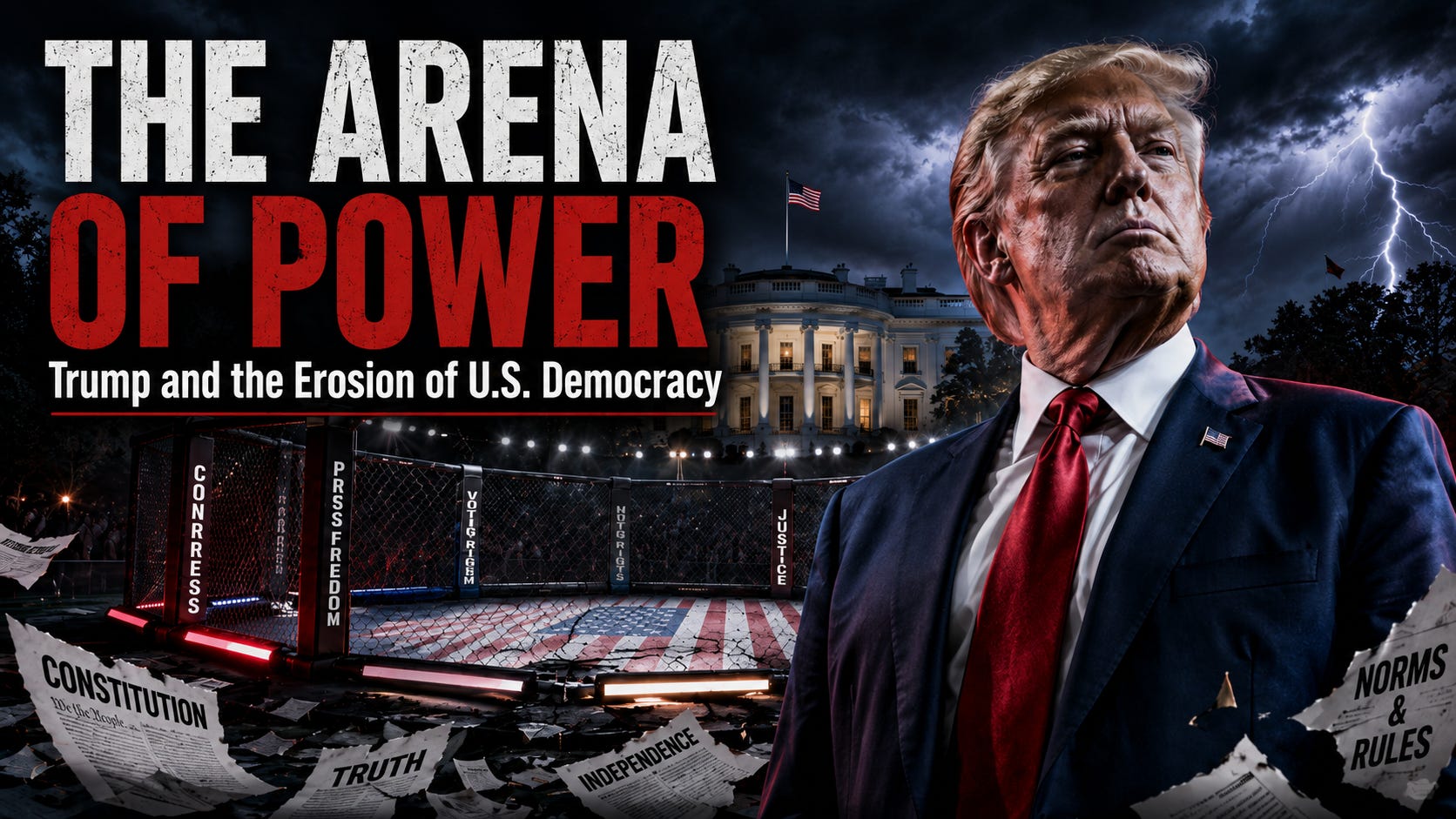
The United States is not facing a classic coup. There are no tanks rolling toward Washington, no formal suspension of Congress, no grand announcement that the Constitution has been taken offline until further notice. That is exactly what makes the situation so dangerous.
American democracy is not being threatened by one cinematic rupture. It is being worn down by a sequence of fact-making acts — each one still explainable, each one still deniable, each one still somehow “within the system,” until together they begin to form a new operating system of power.
That operating system is brutally simple: Whoever holds power defines reality. Whoever questions that reality becomes an enemy. Whoever checks power is delegitimized. And whoever insists on procedure is recast as a saboteur of the people’s will.
Donald Trump does not govern merely through harsh rhetoric. He governs through spectacle, pressure, and the permanent manipulation of meaning. His politics is not made only of laws, executive orders, appointments, and threats. It is made of media events: interviews turned into combat, elections turned into conspiracies, journalists turned into hostile actors, courts turned into obstacles, sports turned into state ritual, and national holidays turned into stages for personal power.
The planned UFC fight on the South Lawn of the White House during America’s 250th anniversary year is therefore more than a bizarre piece of political theater. It is a symbol. On the lawn where presidents host foreign leaders, children’s events, ceremonies, and rituals of state, there is now supposed to be a cage fight.
One can dismiss this as modern sports culture. One can also look at it more carefully.
The state offers its most sacred executive backdrop. A private spectacle receives national consecration. The president appears as host of a fighting nation, celebrating itself not in the language of constitutional restraint, but in the language of the arena.
That is not automatically fascism. But it is also not just entertainment. It is political aesthetics.
And the image is powerful because it is so honest. A cage on the lawn of the White House is not merely a set piece. It represents a deeper shift in political culture: public life is no longer treated as a space for democratic examination, but as an arena. In an arena, the central question is not who has the stronger evidence. It is who looks stronger, who strikes first, who marks the enemy, and who keeps the crowd emotionally locked in.
At the same time, Trump continues to escalate his war against the press. When journalists ask for evidence, the claim itself is not examined; the person asking the question is attacked. Oversight becomes hostility. A follow-up question becomes betrayal. Journalism becomes alleged election interference.
This is the mechanism. Trump does not simply attack the press because it contradicts him. He needs the press as an enemy because his story does not work without one.
His central legend is not merely that he lost in 2020 because of fraud. It is that an entire information system conspired against him: the media, election officials, courts, Democrats, bureaucrats, and the so-called “deep state.” This story is not about the past. It is a tool for the future.
Because if Trump can convince enough people that previous elections were shaped by corrupt media and manipulated procedures, he can pre-poison the interpretation of future elections. The midterms no longer have to be simply won or lost. They can be delegitimized in advance.
Slow vote counts become suspicious. Mail-in ballots become “found” votes. Close races become proof of conspiracy. Court reviews become delay tactics. Certification becomes a battlefield. Every normal feature of a complex democracy becomes raw material for the next fraud narrative.
The danger is not that every lie will be believed. The danger is that enough people, media outlets, officials, party structures, and state actors may behave as if the lie has already become a legitimate political reality.
That is the threshold.
A democracy does not survive on elections alone. It needs shared procedures, recognized outcomes, and institutions that retain legitimacy even when they disappoint one’s own side. If a president treats every unfavorable result as fraud, every check as sabotage, and every criticism as an attack on the people, the democratic form may remain standing while its meaning is hollowed out from within.
The United States still has strong counterforces. States retain administrative power. Courts can block presidential actions. Local election officials do not run elections from the White House. Investigative media, civil society organizations, universities, NGOs, and parts of the bureaucracy can resist. All of that is real.
But none of it is an automatic firewall.
The decisive question is no longer: Does America have a Constitution? Of course it does.
The decisive question is: Are there enough people in key positions willing to defend that Constitution against power, threats, career risk, public intimidation, institutional pressure, and the hunger for proximity to authority?
Because constitutions do not defend themselves. They are defended by people — or hollowed out by people.
The executive branch is especially dangerous in this equation. A president does not have to abolish every institution to damage democratic competition. He can politicize agencies, block funding, economically pressure media organizations, open investigations into opponents, install loyalists in key positions, and frame every corrective mechanism as illegitimate.
Formally, the system may still be visible. Courts still meet. Journalists still publish. Elections still happen. Legislatures still debate.
Operationally, power shifts.
These shifts are not abstract. The plans surrounding “Schedule F” already pointed toward making large parts of the professional federal workforce easier to replace politically. Under new labels and new administrative forms, that logic continues: civil servants in policy-related roles can be made more vulnerable to removal and replacement. It is sold as efficiency and accountability. But when neutral administration is transformed into a loyalty-dependent executive body, the state’s internal architecture changes.
That is modern autocratization. It rarely arrives holding a sign that says “dictatorship.” It comes as a security measure, an administrative reform, a campaign against corruption, a defense against voter fraud, a correction of “fake news,” a restoration of national greatness.
Trumpism has developed a particularly effective method for this: it produces conflicts in which the democratic system’s own response is used as evidence against the democratic system itself.
When the press asks for evidence, the press is corrupt.
When a court blocks an order, activist judges are defying the people.
When a state counts votes slowly, they are “finding” votes.
When citizens protest, order is under threat.
When the opposition disagrees, it hates America.
That is the trap.
Democracy has to respond. But every response is folded back into Trump’s narrative as an attack on him and his movement. Oversight is not ended, but poisoned. And poisoned oversight is weaker, because a large part of the public no longer sees it as protection. It sees it as conspiracy.
This is where the danger becomes acute.
An election can be correctly counted and still be politically destroyed if a large enough share of the public refuses to accept the result. A court can rule properly and still be delegitimized if its decision is framed as betrayal. A free press can report accurately and still lose force if its evidence is read only as enemy propaganda.
The real danger, then, is not Trump alone. It is his operating body: loyal media, obedient party machinery, politicized agencies, intimidated Republicans, aggressive online networks, financial interests, symbolic mass spectacles, and an exhausted public that eventually just wants the noise to stop.
Authoritarian politics does not always win because everyone becomes a fanatic. Sometimes it wins because enough people get tired.
That is why the connection between UFC spectacle, media warfare, and election-fraud rhetoric is so alarming. It shows a politics that does not understand the public sphere as a democratic space, but as an arena. In that arena, it matters less whether a claim is true than whether it is repeated loudly enough, defended aggressively enough, and translated into action quickly enough.
This is bread and circuses in the digital republic — not as mere distraction, but as a technique of rule.
The president is not outside the show. He is its center. The cage on the White House lawn is therefore not just an event on the anniversary calendar. It is an image of the political culture itself: combat replacing procedure, loyalty replacing scrutiny, spectacle replacing accountability.
And while the arena is being prepared on the South Lawn, the press is being dragged into the cage in the studio. Whoever asks questions is disrupting the show. Whoever challenges the story is fighting the president. Whoever demands evidence becomes part of the problem.
That is exactly where Trump wants the watchdog press: not standing outside the arena as an observer, but trapped inside it as an enemy.
America is not yet lost. But it is no longer protected by tradition alone. Anyone saying “the institutions will handle it” is mistaking paper for practice. Institutions are only as strong as the people who carry them. And those people are being tested — not someday, not in some distant emergency, but now.
So the warning is not: American democracy has already fallen.
The warning is: American democracy is being pushed into a condition where its outer form may continue while its inner binding force dissolves.
If that threshold is crossed, the seizure of power will not arrive as one sudden break. It will arrive as habituation. As daily drift. As permanent provocation. As the next step that is still somehow explainable.
Until one day the central question is no longer whether the Constitution applies.
It is only who is strong enough to impose their reality.