
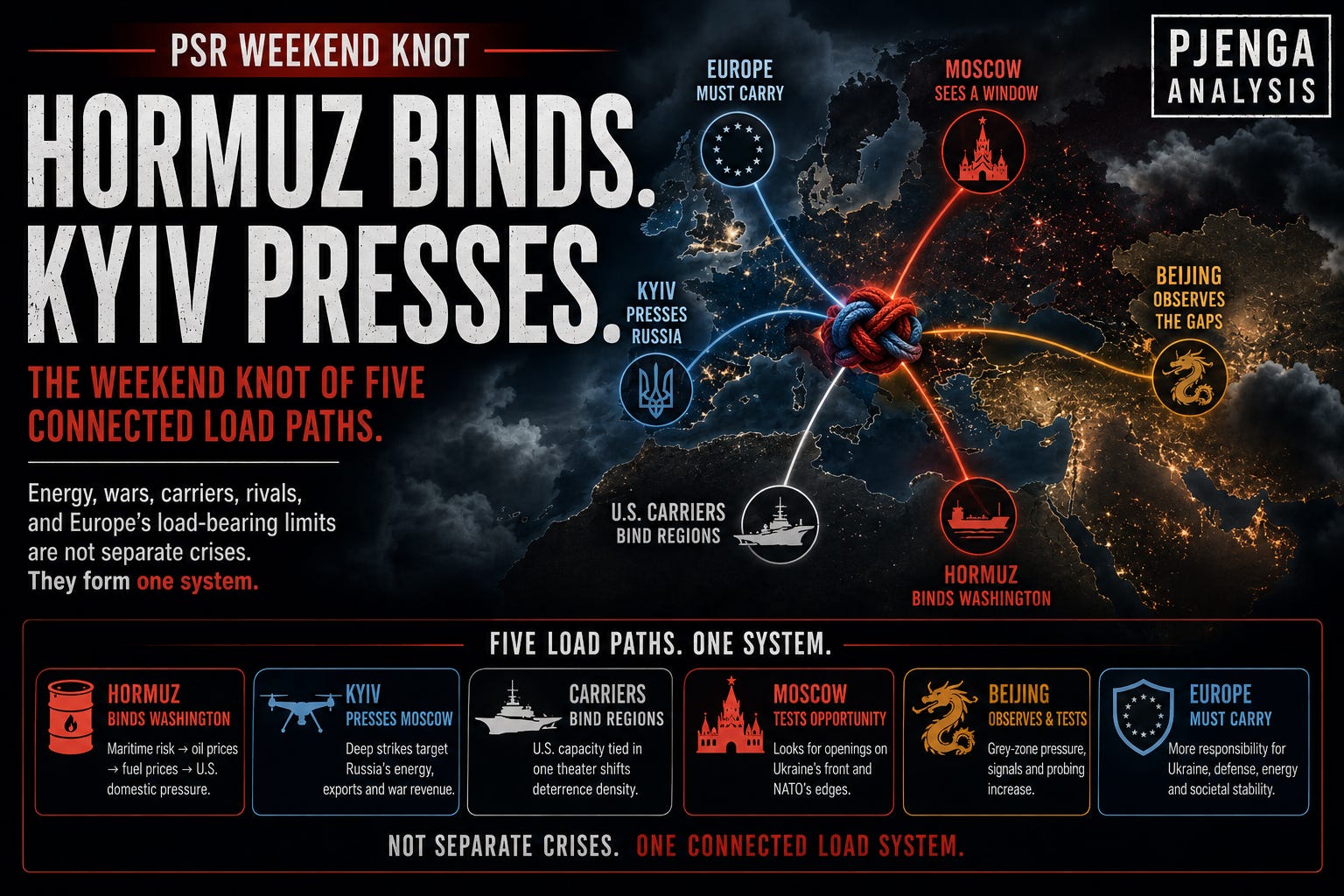
PSR Weekend Knot — Hormuz Binds. Kyiv Presses.
Trump, Zelenskyy and the shrinking fault tolerance of Western stability
Subtitle:
A PJenga situation report on how Hormuz, U.S. fuel prices, Ukrainian pressure on Russia’s war economy, carrier deployments, China’s observation posture and Europe’s load-bearing limits connect into one weekend knot.
Lead Thesis
In short:
This weekend was not defined by one single geopolitical explosion. It was defined by load transfer.
Hormuz binds Washington.
Kyiv presses Moscow.
U.S. carriers shift deterrence density.
China observes the gaps.
Europe becomes the heavy system expected to absorb more load.
The wrong sentence would be:
“Several crises happened at the same time.”
The better sentence is:
“Several load-bearing systems were stressed through the same structural knot.”
This is the difference between news chronology and PJenga analysis.
Reading Aid
PJenga does not treat events as isolated stories. It asks:
What is the visible trigger?
What is the real load?
Which towers are stressed?
Which stability stones matter?
Where does pressure migrate?
What looks stable, but is hollow inside?
What looks dramatic, but carries less load than assumed?
Where is the system buying time instead of creating stability?
This weekend’s central knot connects four major strands:
Hormuz and energy risk
Trump and U.S. domestic pressure
Ukraine and Russia’s war economy
U.S. carrier capacity and Europe’s need to carry more
1. The visible weekend pattern
At first glance, the weekend can be read as a cluster of different stories.
Iran and Hormuz create maritime risk.
Oil prices and fuel prices pressure U.S. politics.
Ukraine strikes Russian energy and export infrastructure.
Russia looks for opportunities while the U.S. is busy.
U.S. naval power is shifted or tied into the Middle East.
China watches whether American deterrence density thins out elsewhere.
Europe debates defense, reform, budgets, resilience and social stability.
But these are not merely parallel events.
They are coupled.
PJenga-readable:
The visible trigger is distributed.
The real load lies in the shrinking fault tolerance of the Western system.
The key question is not:
Which crisis is most important?
The key question is:
Where does each crisis move load into the next tower?
2. Hormuz binds Washington
The Strait of Hormuz is not just a maritime passage. It is a global energy valve.
If it becomes unstable, the consequences do not remain at sea. They move into:
oil prices,
tanker routing,
insurance premiums,
shipping decisions,
inflation expectations,
fuel prices,
political pressure,
and U.S. presidential decision-making.
For Trump, Hormuz is not only foreign policy. It becomes domestic pressure through the fuel pump.
The wrong sentence would be:
“Trump has to keep Hormuz open.”
The better sentence is:
“Trump has to stabilize Hormuz enough for markets and voters to believe energy flows remain predictable.”
A shipping lane can be formally open and still economically damaged.
If tankers move only under higher insurance costs, higher risk, heavier naval protection and heightened market anxiety, the system is not stable. It is merely functioning under stress.
Load transfer:
Hormuz → oil price → fuel price → Trump pressure → U.S. military/diplomatic action
3. Kyiv presses Moscow
While Washington is forced to deal with Hormuz, Ukraine has strong reasons not to wait passively.
If Putin reads U.S. Middle East involvement as distraction, he may test Ukraine, Europe or NATO’s political endurance. Kyiv therefore pressures Russia’s own war system.
Ukraine’s strikes on Russian energy and export logistics are not only symbolic attacks.
They target throughput:
oil exports,
refinery capacity,
port logistics,
tanker flows,
repair costs,
air defense allocation,
state revenue,
war financing,
and the Kremlin’s claim that Russia’s hinterland remains safe.
The wrong sentence would be:
“Ukraine is attacking Russian oil targets.”
The better sentence is:
“Ukraine is moving the war into Russia’s war-financing machine.”
Oil in the ground is not enough.
Russia needs extraction, refining, transport, export, payment and political insulation from sanctions and risk.
Kyiv pressures that chain.
Load transfer:
Ukrainian strikes → Russian energy logistics → war revenue → repair burden → air defense diversion → political narrative stress
4. A carrier is not just a ship
A U.S. carrier group is not simply a vessel moving from one region to another.
It is mobile air power.
It is command infrastructure.
It is a political signal.
It is deterrence.
It is reassurance.
It is escalation capacity.
But it is also tied capacity.
When the United States concentrates carrier groups, escort ships, air defense assets, logistics and attention in the Middle East, other actors read the signal.
Iran reads it one way.
Russia reads it another.
China reads it differently again.
Europe must read it as a warning.
The wrong sentence would be:
“The U.S. sends a carrier, therefore strength has been shown.”
The better sentence is:
“The U.S. shows strength — and also shows where strength is currently tied down.”
This is the concept of deterrence density.
Not total military mass.
But available, credible, coordinated, politically usable mass at the right place and time.
Load transfer:
Middle East carrier deployment → reduced global slack → China observes → Russia tests → Europe must carry more
5. China does not have to pull immediately
The most important effect of U.S. capacity binding may occur far from the Middle East.
China does not need to launch a major military move to benefit from perceived American overload. It can observe, test and shape perception.
Beijing may ask:
How fast does Washington move assets?
How long do they remain tied?
How nervous do allies become?
How much does U.S. domestic politics constrain action?
How much must Europe compensate?
How does Trump balance strength, cost and escalation?
The wrong sentence would be:
“China will immediately exploit U.S. distraction militarily.”
The better sentence is:
“China can exploit the perception of U.S. overload before it exploits an actual military gap.”
Grey-zone activity, maritime pressure, cyber operations, airspace probing, coercive diplomacy and psychological signaling may matter more than immediate open war.
When a tower creaks, an opponent does not always pull hard.
Sometimes it only tests which stone has loosened.
6. Europe becomes the load receiver
This is where the weekend knot ends.
Not in Washington.
Not in Hormuz.
Not in Moscow.
Not in Kyiv.
But in Europe.
If U.S. capacity is tied down in the Middle East, Europe must carry more:
Ukraine support,
NATO’s eastern flank,
ammunition,
air defense,
logistics,
reserve capacity,
industrial production,
critical infrastructure protection,
social stability,
and political legitimacy.
Europe is not weak.
Europe is heavy.
It has economic mass, social-state capacity, institutions, democratic legitimacy, industrial potential and cultural depth.
But heavy systems move slowly.
Europe’s mechanisms were built to prevent abuse, overreach and rushed centralization. That is valuable in normal conditions. But in a crisis era, those same mechanisms can become friction.
The wrong sentence would be:
“Europe is too weak.”
The better sentence is:
“Europe is strong, but its strength is too slow to mobilize.”
Load transfer:
U.S. binding → European responsibility → national budgets → social policy → public trust → defense capability
7. PJSI / PJIEF
PJSI — PJenga Stability Index: 36/100
Damaged normality / low fault tolerance.
The system is not collapsing. But several central buffers are being used simultaneously: energy markets, U.S. military capacity, Ukrainian adaptability, Russian economic stress, NATO deterrence and European political cohesion.
PJIEF — PJenga Interlock/Escalation Factor: very highly strained
The interlocks are clear:
Hormuz → oil prices → U.S. domestic politics
U.S. carrier binding → deterrence density shifts → China/Russia observation
Ukraine strikes → Russian war economy → energy-market spillover
U.S. binding → Europe must carry more
European social mass → slower security mobilization
This is one weekend knot.
Final Conclusion
The weekend did not show a world breaking apart.
It showed a world with shrinking reserves.
Hormuz binds Washington.
Kyiv presses Moscow.
Carriers bind regions.
China watches.
Europe must carry.
The wrong sentence would be:
“The West is collapsing.”
The better sentence is:
“The West still carries enormous mass, but its fault tolerance is shrinking because too many load-bearing systems are stressed at once.”
PJenga-readable:
The tower still stands.
But several stones now carry more load than they were designed for.
Back to the Landing Article:


