
Subtitle:
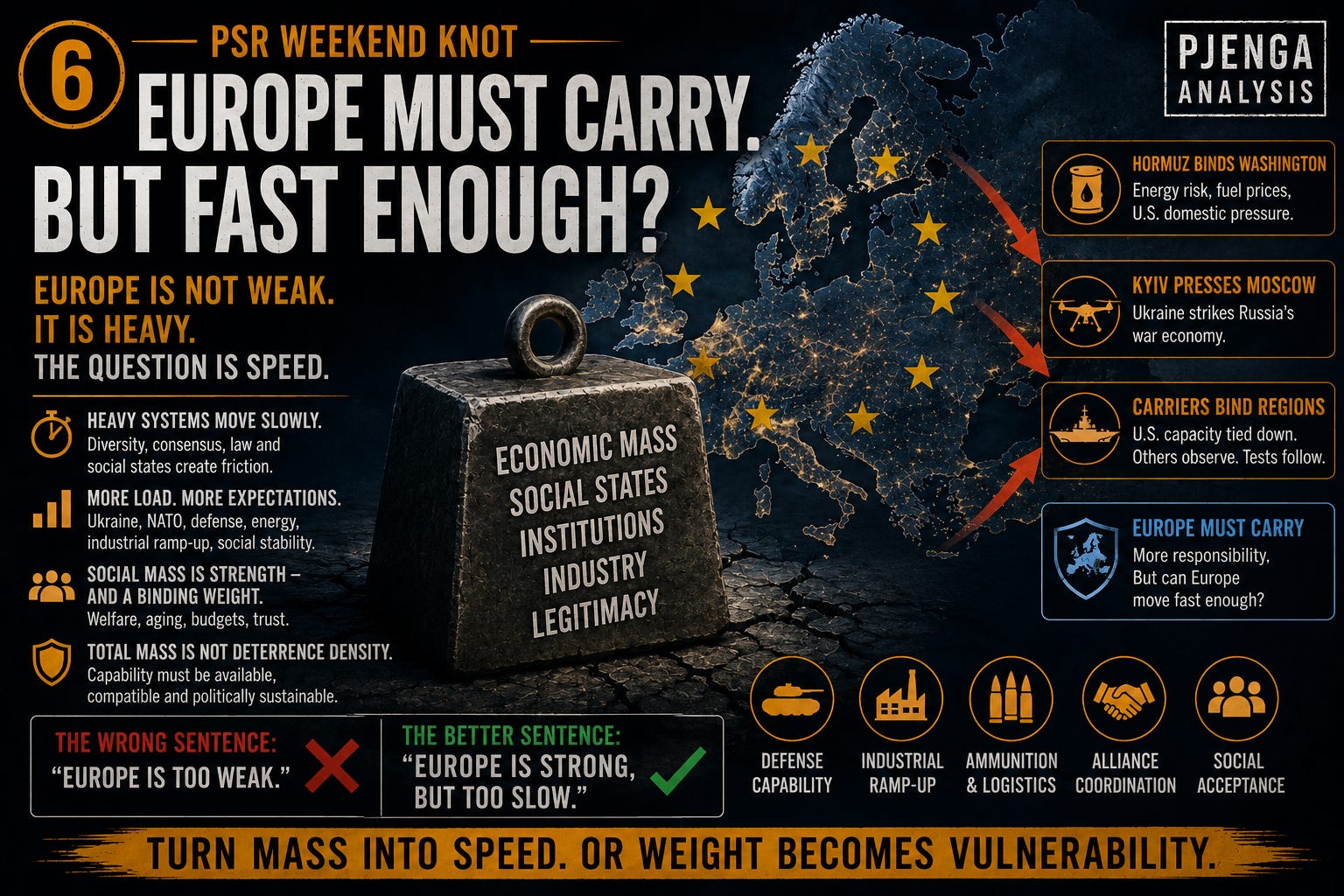
Europe is not weak. It has enormous economic, social, industrial and institutional mass. But that mass is slow. Diversity, consensus mechanisms, national interests and legal safeguards protect the system in normal times — yet they can become friction when load moves faster than procedures react.
⸻
Where this excerpt comes from
This text is the fourth and final excerpt from the larger PSR Weekend Knot “Hormuz Binds. Kyiv Presses.”
The first three excerpts isolated the main load paths:
Hormuz Binds Washington
A sea lane becomes a domestic pressure point through oil prices, fuel prices, insurance costs and market expectations.
Kyiv Presses. Moscow Pays.
Ukraine attacks not only Russian infrastructure, but Russia’s war throughput: oil exports, war revenue, air defense allocation and the illusion of a safe hinterland.
Carriers Bind. Regions React.
A U.S. aircraft carrier is not just a ship, but tied deterrence density — and Moscow, Beijing, Europe, NATO and markets observe where U.S. strength is currently bound.
This fourth excerpt brings the series together.
It asks:
What happens to Europe when Hormuz binds Washington, Kyiv presses Moscow and U.S. deterrence density has to be distributed across several theaters?
Or shorter:
Europe must carry more. But can it move fast enough?
⸻
Lead Thesis
In short:
Europe is not a weak tower. Europe is a heavy tower. It has enormous economic, social, political and cultural mass. But in crisis mode, that mass is slow. What creates stability in normal times — diversity, consensus, law, social protection, slow power control — can become friction when load moves fast.
The wrong sentence would be:
“Europe is too weak.”
The better sentence is:
“Europe is strong, but its strength is in the wrong state of matter: too much mass, not enough speed.”
PJenga-readable:
Europe has load-bearing capacity. But load-bearing capacity without speed becomes time-buying.
⸻
1. Europe is not a spectator
At first glance, Europe does not seem to be the main actor in this weekend knot.
The visible theaters are elsewhere:
Iran and Hormuz,
Trump and fuel prices,
U.S. carriers,
Ukrainian drones,
Russia’s war economy,
China’s observation posture.
But PJenga does not follow headline logic.
PJenga asks:
Where does the load land once it moves?
And that is where Europe becomes central.
If the United States is tied down in the Middle East, Europe becomes more important for Ukraine.
If Russia tests Western distraction, Europe becomes more important for NATO’s eastern flank.
If energy prices rise, Europe becomes socially and politically stressed.
If arms production must grow, Europe becomes industrially tested.
If public support weakens, Europe becomes politically slower.
The wrong sentence would be:
“Europe watches while others act.”
The better sentence is:
“Europe is the load receiver in the background.”
⸻
2. Europe’s mass is real
Europe is not powerless.
It has major buffers:
economic scale,
industrial capacity,
welfare states,
infrastructure,
legal stability,
research and technology,
diplomacy,
NATO integration,
EU coordination structures,
democratic legitimacy,
cultural depth,
and a population that can carry crises when it understands why.
This mass matters.
It is why Europe did not simply collapse under energy crisis, inflation, war in Ukraine and political stress.
But mass is not the same as mobility.
Not: Europe is weak.
But: Europe is heavy, complex and slow to mobilize.
A light authoritarian state can move faster, but may break brutally.
A heavy pluralist Europe can carry longer, but often moves only when the load is already audible.
⸻
3. European slowness is not stupidity
Europe is not slow simply because people are incapable.
Europe is slow because many safeguards were designed to limit speed.
After two world wars, dictatorships, colonial violence, national trauma and abuses of power, Europe’s architecture was not built for rapid concentration of power. It was built for control, balance and prevention of abuse.
That includes:
parliaments,
courts,
national vetoes,
federal layers,
EU negotiations,
minority protection,
budget control,
procurement law,
transparency rules,
coalition politics,
consensus-seeking,
social balancing,
legal review.
In normal times, this protects.
In a slower world, it creates stability.
But in an era of drone warfare, hybrid attacks, energy coercion, rapid market reactions and strategic simultaneity, the same protections can become brakes.
The wrong sentence would be:
“European safeguards are bad.”
The better sentence is:
“European safeguards were built for power control — but the crisis era also demands reaction speed.”
PJenga-readable:
What used to be a buffer can become friction.
⸻
4. Diversity as strength and drag
Europe’s diversity is real: cultural, historical, linguistic, economic and political.
That is a strength.
It gives Europe many perspectives and deep resilience. Estonia reads Russia differently than Portugal. Poland reads threat differently than Ireland. France understands strategic autonomy differently than Germany. Italy, Spain, Greece, Scandinavia, the Balkans and Central Europe all bring different instincts and scars.
But this diversity slows decision-making.
Each common decision must pass through different threat perceptions.
For Estonia, Russia is not abstract.
For Portugal, it is far away.
For Poland, security is existential.
For Germany, security was long filtered through trade, NATO and U.S. protection.
For France, strategic autonomy is a different tradition.
For Hungary, the EU itself is part of a domestic power game.
That is not a moral failure.
It is European statics.
Load transfer:
different threat perceptions → slower agreement → delayed capability → increased reliance on the U.S. → higher stress when the U.S. is tied down
Europe’s diversity increases long-term resilience.
But it slows acute reaction.
⸻
5. Social mass: Europe’s strongest buffer and binding weight
Europe is not only an economic space. It is a social-political space.
Its states carry enormous social loads:
pensions,
healthcare,
care systems,
unemployment protection,
education,
housing,
energy relief,
regional balancing,
migration and integration,
infrastructure,
climate adaptation,
social stabilization.
This is a real buffer.
It prevents shocks from turning instantly into social fracture. It holds people, regions and political systems together. It creates trust. It stabilizes democracy.
But it also binds.
When defense becomes more expensive, it must be explained against other pressures.
Rearmament does not meet empty budgets.
It meets aging societies, care costs, housing pressure, energy prices, infrastructure decay, climate damage, migration stress, education gaps and political fatigue.
The wrong sentence would be:
“Europe simply has to spend more on defense.”
The better sentence is:
“Europe has to finance more security without damaging its social statics — otherwise it loses the public consent that makes security politically sustainable.”
Security without social acceptance becomes brittle.
Welfare without security becomes vulnerable.
⸻
6. Germany as a critical hollow
Germany matters not because it is Europe, but because it is a central load-bearing state.
It is large enough to make a difference.
But it is also an example of European inertia.
Germany is moving:
defense reform,
conscription debate,
higher spending,
procurement,
new security language,
greater awareness of Russia,
more discussion of NATO capability.
But movement is not yet load-bearing capability.
The wrong sentence would be:
“Germany is rearming now.”
The better sentence is:
“Germany is trying to make a long-hollowed security tower load-bearing again — while more load is already being placed on it.”
Germany needs not only money, but:
personnel,
reserves,
training capacity,
ammunition,
air defense,
drone defense,
medical support,
logistics,
command capability,
digital situational awareness,
resilient infrastructure,
faster procurement,
industrial delivery capacity,
public explanation,
and political endurance.
A state can be wealthy and still slow.
⸻
7. NATO: total mass is not deterrence density
NATO is strong.
But there is a dangerous confusion here.
Total mass is not the same as deterrence density.
Total mass means:
How much economic, military and technological power does the alliance possess?
Deterrence density means:
How much of that power is available at the right place, at the right time, with the right ammunition, under credible political will, in compatible structures and with functioning logistics?
That is a different test.
NATO may be strong in aggregate and still appear thin at specific points:
if ammunition is short,
if air defense is scarce,
if logistics are insufficient,
if political coordination is slow,
if U.S. capacity is tied down in the Middle East,
if European production does not ramp fast enough,
if national interests diverge,
if societies do not understand why burdens rise.
The wrong sentence would be:
“NATO is strong, therefore Europe is safe.”
The better sentence is:
“NATO has enormous total mass — but the current question is whether that mass is available, compatible, politically sustainable and operationally usable in time.”
⸻
8. Buffers vs. facades
Europe has real buffers:
economic strength,
industrial base,
social states,
democratic legitimacy,
NATO structures,
Eastern European threat clarity,
French and British military substance,
German production potential,
research and technology,
Ukrainian experience as brutal situational teacher.
But there are also buffer facades:
“NATO is strong” without checking availability.
“Germany has money” without deployable mass.
“Europe stands together” without rapid execution.
“The U.S. will handle it” despite global U.S. binding.
“Ukraine holds Russia back” without sufficient European supply.
“Reforms are underway” without proof of timely effect.
The wrong sentence would be:
“Europe has enough buffers.”
The better sentence is:
“Europe has buffers, but some of them are already leaking politically, industrially or temporally.”
That is damaged normality.
⸻
Mini PJSI / PJIEF
PJSI: 37/100 — damaged normality / low fault tolerance
Europe is not in acute collapse. But its fault tolerance is shrinking. The mass is large, yet mobilization remains too slow for the speed of the situation. Security, social, economic and trust loads interlock.
PJIEF: very highly strained
U.S. binding → European load uptake → NATO eastern flank
Ukraine pressure → Russian reaction → European supply obligation
Hormuz → energy prices → social acceptance → defense space
national diversity → slow agreement → weaker deterrence density
welfare state → budget binding → security financing
EU safeguards → procedural stability → crisis inertia
This is not an isolated European issue. It is the feedback point of the weekend knot.
⸻
Final Conclusion
Europe must carry.
But the decisive question is:
Can Europe carry fast enough?
Europe is not weak.
Europe is heavy.
It is rich in institutions, welfare states, cultures, industries, laws and historical experience. That is what makes Europe stable in normal times.
But in a crisis era, the same stability can become inertia.
Hormuz binds Washington.
Kyiv presses Moscow.
Carriers shift deterrence density.
China observes.
Russia tests.
Markets react.
And Europe must turn mass into speed.
The wrong sentence would be:
“Europe must simply take more responsibility.”
The better sentence is:
“Europe must organize responsibility so that economic and social mass becomes available security capability in time.”
PJenga-readable:
Europe is the heavy tower in the system.
It still stands.
But if load moves faster than reinforcement grows, weight alone will no longer be enough.
Here is the main Article:


