
Subtitle:
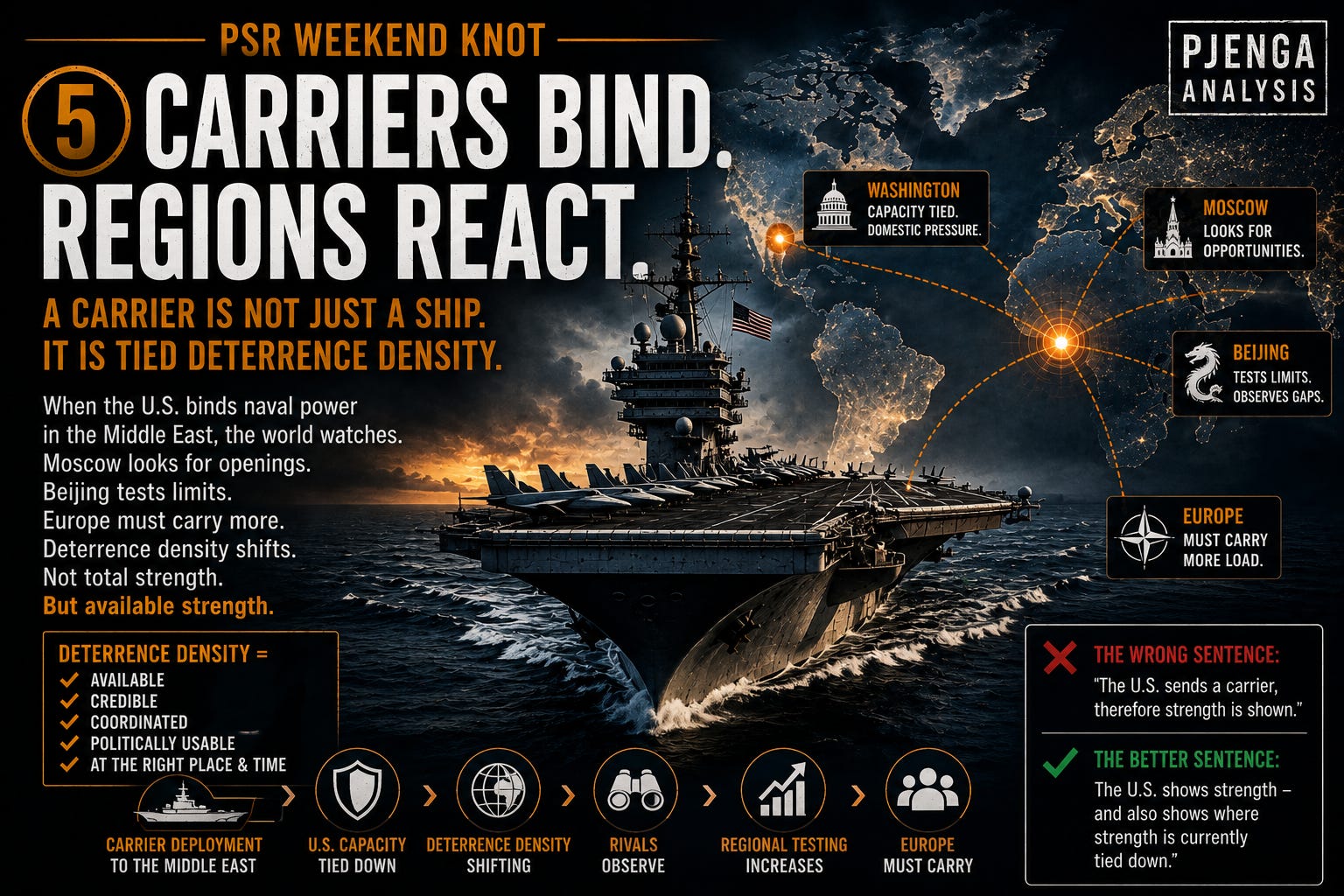
A U.S. aircraft carrier is not just a ship. It is mobile deterrence mass. When the United States binds carrier groups, escort ships, air defense, logistics, ammunition and attention in the Middle East, the statics shift in regions where no shot has been fired.
⸻
Where this excerpt comes from
This text is the third excerpt from the larger PSR Weekend Knot “Hormuz Binds. Kyiv Presses.”
The first excerpt showed how Hormuz becomes a domestic pressure point for Washington.
The second showed how Kyiv pressures Russia’s war economy.
This third excerpt focuses on U.S. capacity:
What does it mean when American power is tied down in the Middle East?
⸻
Lead Thesis
In short:
When the United States moves maritime power into the Middle East, it is not only signaling to Iran. It is shifting global deterrence density. What becomes visible in the Gulf changes calculations in the Indo-Pacific, Moscow, Europe and NATO.
The wrong sentence would be:
“The U.S. sends a carrier against Iran.”
The better sentence is:
“The U.S. shifts deterrence mass into an acute crisis zone — and shows how expensive multi-theater deterrence has become.”
PJenga-readable:
A carrier is not only a ship. A carrier is tied decision power.
⸻
1. Why a carrier is more than a ship
An aircraft carrier is not merely a large warship.
It is a floating air base.
It is a command platform.
It is a signal.
It is a threat.
It is a shield.
It is reassurance.
It is escalation capacity.
It is political communication.
But for that exact reason, it is also more than hardware.
A carrier binds:
escort ships,
submarines or anti-submarine protection,
air defense,
supply ships,
intelligence,
ammunition,
personnel,
maintenance,
aircraft rotation,
communications,
diplomatic support,
and strategic attention.
Not:
A ship moves into a region.
But:
A whole portion of U.S. decision capacity is concentrated there.
That is why carriers matter.
And why their binding matters.
⸻
2. Presence is finite
The United States remains extremely powerful. That is not in question.
But even great power is finite when it must remain credible in multiple theaters at once.
Washington must watch:
Middle East / Iran / Hormuz,
Ukraine / Russia,
NATO’s eastern flank,
Indo-Pacific / China / Taiwan,
South China Sea,
Korea,
global sea lanes,
cyber and space domains,
and U.S. domestic pressure.
Every region cannot receive equal density at the same time.
When one acute crisis consumes more presence, other regions do not become empty. But the reserve thins.
The wrong sentence would be:
“The U.S. can be everywhere at once.”
The better sentence is:
“The U.S. can do many things at once — but not everything with the same density, duration and political cost.”
PJenga does not ask only:
How large is the U.S. Navy?
PJenga asks:
How much of it is available, credible, sustainable, politically usable and not already tied down?
⸻
3. Hormuz binds decision space
If Hormuz becomes unstable, Washington must achieve several goals at once:
Deter Iran.
Stabilize energy flows.
Reassure Gulf partners.
Calm oil and fuel prices.
Avoid escalation.
Show strength.
Avoid binding too much capacity.
Prevent China and Russia from reading overload.
These goals do not automatically align.
Too little presence may signal weakness.
Too much presence may raise escalation fear and oil prices.
Hard rhetoric may unsettle markets.
Soft rhetoric may invite testing.
Long binding may thin other theaters.
PJenga-readable:
Hormuz is not one problem. It pulls military presence, market psychology, U.S. domestic politics and global deterrence into one knot.
⸻
4. China does not have to pull immediately
The most important effect of U.S. capacity binding may not be in the Middle East.
It may be in the Indo-Pacific.
China does not need to act militarily immediately to benefit from perceived American overload. It can observe, test and shape perception.
Beijing may ask:
How quickly does Washington move forces?
How long do they remain tied?
Which stocks are consumed?
Which allies look nervous?
How united are Japan, Taiwan, the Philippines, Australia and South Korea?
How much must Europe carry?
How much does the Middle East dominate U.S. politics?
How does Trump react under multi-front pressure?
The wrong sentence would be:
“China will now attack Taiwan because the U.S. is distracted.”
The better sentence is:
“China does not need immediate escalation. It can use, test and price in the perception of American overload.”
Grey-zone pressure, maritime coercion, cyber operations, airspace probing, disinformation and diplomatic messaging can matter before open war.
When the tower creaks, an opponent does not always pull hard.
Sometimes it simply checks which stone is loose.
⸻
5. Moscow reads U.S. binding differently
China watches long-term power ratios.
Russia may look for shorter windows.
Putin could read U.S. Middle East binding as a chance for:
more pressure on Ukraine,
heavier air strikes,
drone and missile waves,
testing European reaction speed,
pressure on NATO’s edges,
information operations,
and a bet on U.S. distraction.
That does not mean Russia automatically has free space. Kyiv’s pressure on Russia’s war economy is designed precisely to prevent that.
But the coupling is clear:
The more Washington looks tied down in the Middle East, the more important Ukrainian self-generated pressure becomes.
Moscow and Beijing read the same U.S. capacity knot differently.
China asks:
What does this reveal about long-term American overstretch?
Russia asks:
What can I exploit now?
Europe must ask:
What must we carry ourselves if Washington cannot dampen everything at once?
⸻
6. Europe discovers the bill
The United States cannot remain the full damping mechanism for every Western security theater without cost.
That does not mean the U.S. disappears. It means Europe must carry more real load.
Not only rhetorically. Not only financially.
Practically:
ammunition,
air defense,
logistics,
reserves,
arms production,
Ukraine support,
NATO’s eastern flank,
cyber defense,
critical infrastructure,
intelligence cooperation,
political endurance.
Germany is moving, but slowly.
The UK remains militarily relevant, but politically strained.
France has strategic substance, but its own frictions.
Eastern Europe is alert, but not large enough to carry alone.
The wrong sentence would be:
“If the U.S. is distracted, Europe must just do more.”
The better sentence is:
“If the U.S. is tied down, Europe must generate more available, compatible and politically sustainable security mass.”
That is a much harder task.
⸻
Mini PJSI / PJIEF
PJSI: 34/100 — damaged normality / low fault tolerance
American power is not collapsing. But simultaneity stresses multiple theaters: Middle East, Ukraine, Indo-Pacific, NATO, energy prices, U.S. domestic politics and European load-bearing capacity.
PJIEF: very highly strained
Hormuz → U.S. naval binding → global deterrence density
U.S. binding → China observation → Indo-Pacific grey-zone tests
U.S. binding → Russian opportunity window → Ukraine pressure
U.S. binding → European load uptake → NATO structure problem
U.S. presence → oil-market psychology → Trump domestic pressure
This is not an isolated carrier story.
It is an interlock knot.
⸻
Conclusion
A carrier is not just a ship.
It is visible power.
It is mobile air power.
It is deterrence.
It is political signal.
It is reassurance.
It is threat.
But it is also tied capacity.
That is why U.S. movement toward the Middle East matters.
In short:
When Hormuz binds Washington, Tehran is not the only observer. Moscow watches. Beijing watches. Europe watches. NATO watches. Markets watch. American voters watch the fuel price.
The wrong sentence would be:
“The U.S. sends a carrier, therefore strength is shown.”
The better sentence is:
“The U.S. shows strength — and also shows where strength is currently tied down.”
Here is the main Article:


