
Subtitle:
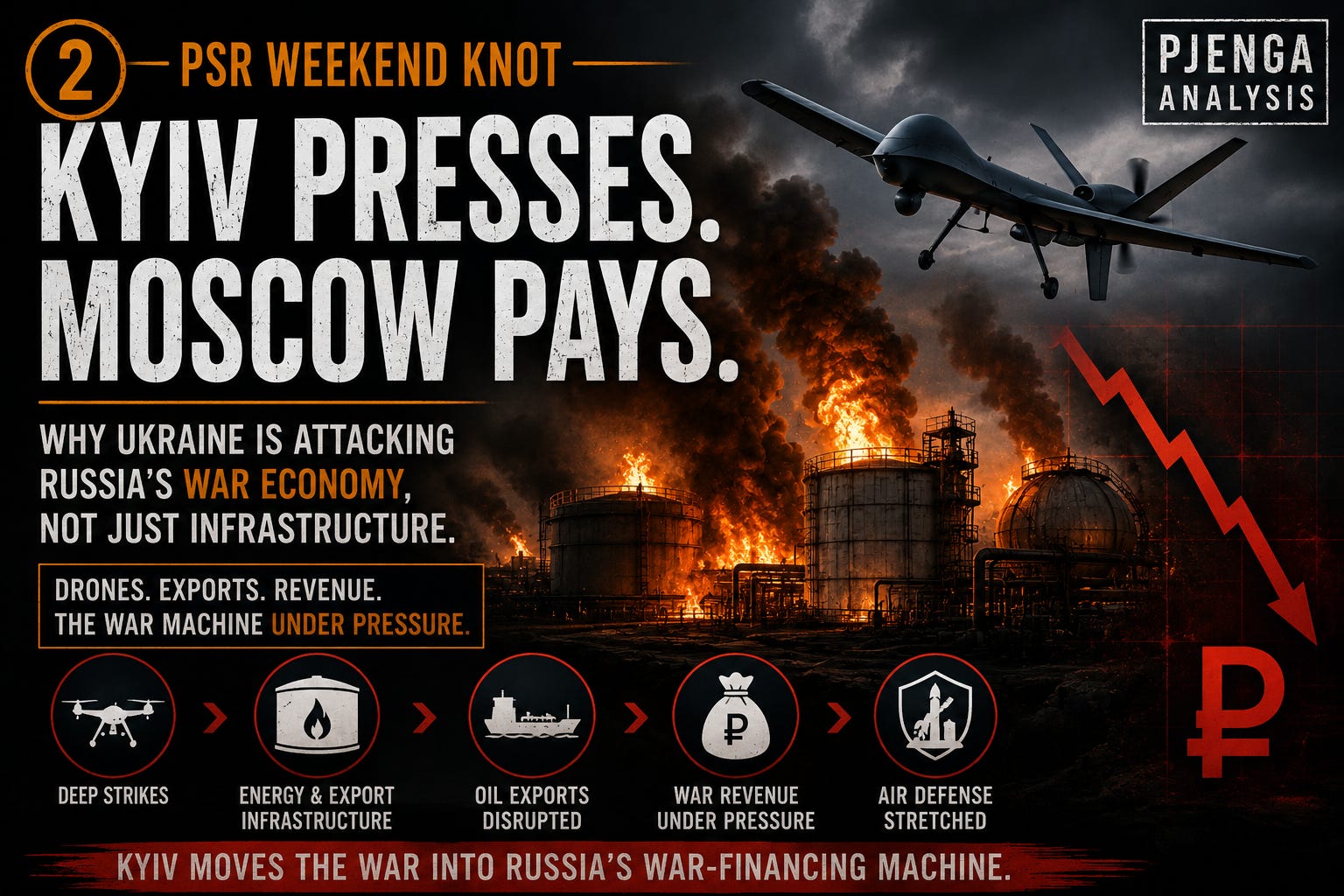
While Hormuz ties down American capacity and Trump faces domestic pressure through energy prices, Ukraine uses a dangerous time window: it moves the war deeper into Russia’s energy, export and financing system.
⸻
Where this excerpt comes from
This text is the second excerpt from the larger PSR Weekend Knot “Hormuz Binds. Kyiv Presses.”
The first excerpt examined the Hormuz strand: how a sea lane becomes a domestic pressure point for Washington.
This second excerpt turns to Ukraine and Russia:
Why is Kyiv pressing Russia’s war economy now?
The full weekend knot connects Hormuz, U.S. capacity, fuel prices, Ukrainian deep strikes, Russia’s war economy, Europe’s load-bearing limits and the shrinking fault tolerance of Western stability.
⸻
Lead Thesis
In short:
Ukraine is not only attacking infrastructure. It is attacking Russia’s war throughput: export revenue, repair capacity, air defense allocation, transport routes, insurance evasion and the illusion that Russia’s hinterland remains safe.
The wrong sentence would be:
“Ukraine is attacking Russian oil targets.”
The better sentence is:
“Ukraine is moving the war from the front line into Russia’s war-financing machine.”
PJenga-readable:
Kyiv is not only pressing militarily. Kyiv is pressing economically, logistically and psychologically.
⸻
1. The visible trigger
At first glance, the events appear separate:
Iran and Hormuz as Middle East crisis.
Trump and fuel prices as U.S. domestic politics.
Ukrainian drones as war events.
Russia as the battlefield opponent.
Europe as supporter and observer.
PJenga reads them differently.
Stressed tower: Russia’s war economy
Critical stability stone: energy and export logistics
Load transfer: front war → Russian hinterland → export revenue → state finances → war endurance
The visible trigger is a series of Ukrainian strikes.
The real load lies in the question whether Russia can keep financing, repairing, protecting and politically explaining its war.
⸻
2. Why Kyiv targets Russia’s economy
Ukraine cannot simply mirror Russia’s scale.
Russia has more territory, more population, more strategic depth, more raw materials and a brutal authoritarian capacity to push costs inward.
So Kyiv must press differently.
Not only where Russian soldiers stand.
But where Russia’s war is paid for, supplied and stabilized.
Russia’s war depends on:
oil and gas revenue,
refineries,
export terminals,
tank farms,
pipelines,
rail logistics,
tankers,
shadow fleets,
insurance evasion,
Asian buyers,
price discounts,
repair capacity,
air defense in the hinterland,
and propaganda that simulates stability.
When Kyiv strikes these points, it does not merely hit infrastructure.
It hits the operating system of the Russian war.
The wrong sentence would be:
“Ukraine wants to economically annoy Russia.”
The better sentence is:
“Ukraine forces Russia to protect, repair and explain the war inside its own depth.”
⸻
3. Oil export logistics as stability stone
Oil is not only a resource for Russia. It is foreign-policy leverage, budget support, war financing and geopolitical influence.
But oil in the ground is not enough.
To stabilize Putin’s war, oil must be:
extracted,
refined,
transported,
loaded,
insured or moved around insurance,
sold,
paid for,
and politically shielded from sanctions and risk.
The critical stone is not only the oil field.
The critical stone is throughput.
Not: Does Russia have oil?
But: Can Russia reliably, profitably and predictably turn oil into money?
If ports, terminals, refineries or tankers are hit, friction rises:
repair costs increase,
export delays grow,
insurance and security costs rise,
air defense must be redistributed,
buyers demand deeper discounts,
shadow fleets become riskier,
rerouting becomes more expensive,
and Moscow’s stability narrative weakens.
Not total collapse.
Increased cost.
That is the point.
⸻
4. Putin’s possible window
Why does timing matter?
Because Iran and Hormuz tie down American attention.
If the United States is militarily, diplomatically and domestically occupied in the Middle East, Putin may read this as an opportunity.
Not necessarily for one dramatic strike. More likely as a strategic temptation:
more pressure on Ukraine,
heavier air attacks,
intensified front operations,
psychological escalation,
disinformation campaigns,
pressure on European support,
testing NATO’s edges,
betting on American distraction.
Putin does not need to believe the U.S. is paralyzed. He only needs to believe attention, ammunition, political energy and deterrence density are thinner.
The wrong sentence would be:
“Putin automatically benefits from Trump’s Middle East problem.”
The better sentence is:
“Putin may try to read U.S. Middle East binding as a window — and Kyiv tries to close that window by raising Russia’s costs.”
⸻
5. Kyiv’s counter-move
Ukraine cannot simply wait to see whether Washington is distracted, Europe delivers enough, or Russia uses a new escalation window.
Kyiv’s logic appears to be:
If Russia hopes the West is distracted, Russia itself must be made distracted, tied down and more expensive.
Ukraine forces Russia to answer:
Which refineries need protection?
Which ports are vulnerable?
Which tank farms need air defense?
Which terminals must be repaired?
Which routes must be rerouted?
How many drones can be intercepted deep inside Russia?
How much protection must move from the front to the rear?
How does the Kremlin explain that the war has reached its own economic body?
PJenga-readable:
Kyiv shifts Russian protection load from the front into the depth.
Every additional air defense unit protecting refineries or export facilities is not fully available elsewhere.
Every repair crew becomes part of a cost chain.
Every export delay becomes part of a finance chain.
Every uncertain buyer becomes part of a discount chain.
⸻
6. Russia adapts — but adaptation is not stability
Russia has adapted many times: sanctions evasion, trade rerouting, shadow fleets, repression, propaganda and military improvisation.
That is real.
But PJenga separates adaptation from true stability.
A system can adapt and still become more expensive, brittle and less fault-tolerant.
Russia may continue to sell oil, repair damage, deny impact, keep buyers through discounts and escalate militarily.
But all of that costs.
The wrong sentence would be:
“Russia can absorb it.”
The better sentence is:
“Russia absorbs damage, but each absorption increases cost, binding and friction.”
Not every struck stone falls immediately.
But if more stones require support, pressure and rerouting, fault tolerance declines.
⸻
7. The double energy knot
Kyiv’s pressure on Russian energy logistics does not happen in a calm energy market.
At the same time, Hormuz stresses the global energy tower.
That means:
Iran/Hormuz creates risk premiums in oil and gas flows.
Ukraine creates friction in Russia’s energy throughput.
Trump feels fuel prices domestically.
Europe feels energy, security and defense costs.
Markets watch whether multiple chokepoints become nervous at once.
This does not mean Ukraine is wrong to strike Russia’s war economy. Militarily, it may be highly rational.
But structurally:
A justified strike against Russia can still create side-loads in the global energy tower.
PJenga is not moral equivalence.
It is structural analysis.
⸻
Mini PJSI / PJIEF
PJSI: 35/100 — damaged normality / low fault tolerance
Russia’s war economy is not collapsing immediately. But its export logistics, Ukraine’s endurance, Western support, global energy prices and U.S. Middle East binding are being stressed simultaneously.
PJIEF: very highly strained
Ukrainian drones → Russian oil/export logistics → Putin’s war financing
Iran/Hormuz → U.S. capacity binding → Russian opportunity window
Kyiv’s deep strikes → Russian protection load → air defense redistribution
Russian energy friction → global energy market → Western domestic politics
This is not isolated.
This is an active load knot.
⸻
Conclusion
Kyiv presses because Moscow might otherwise press harder.
That is the sober statics of this weekend.
While Hormuz binds Washington, Putin may try to read American distraction as opportunity. Ukraine responds not only defensively, but offensively: by forcing Russia to shift protection, repair cost and political attention into its own depth.
In short:
Ukraine is not only attacking targets. Ukraine is attacking throughput.
Throughput of oil.
Throughput of money.
Throughput of spare parts.
Throughput of security.
Throughput of propaganda.
Throughput of war capacity.
The wrong sentence would be:
“Kyiv attacks Russian infrastructure.”
The better sentence is:
“Kyiv forces Putin to pay for the war where Russia used to think it had a safe hinterland.”
Here is the main Article:


