
Subtitle:
The Strait of Hormuz is not just a maritime chokepoint. It is a political amplifier: when risk appears there, pressure travels through oil prices, fuel prices and market expectations directly into Washington’s domestic decision space.
⸻
Where this excerpt comes from
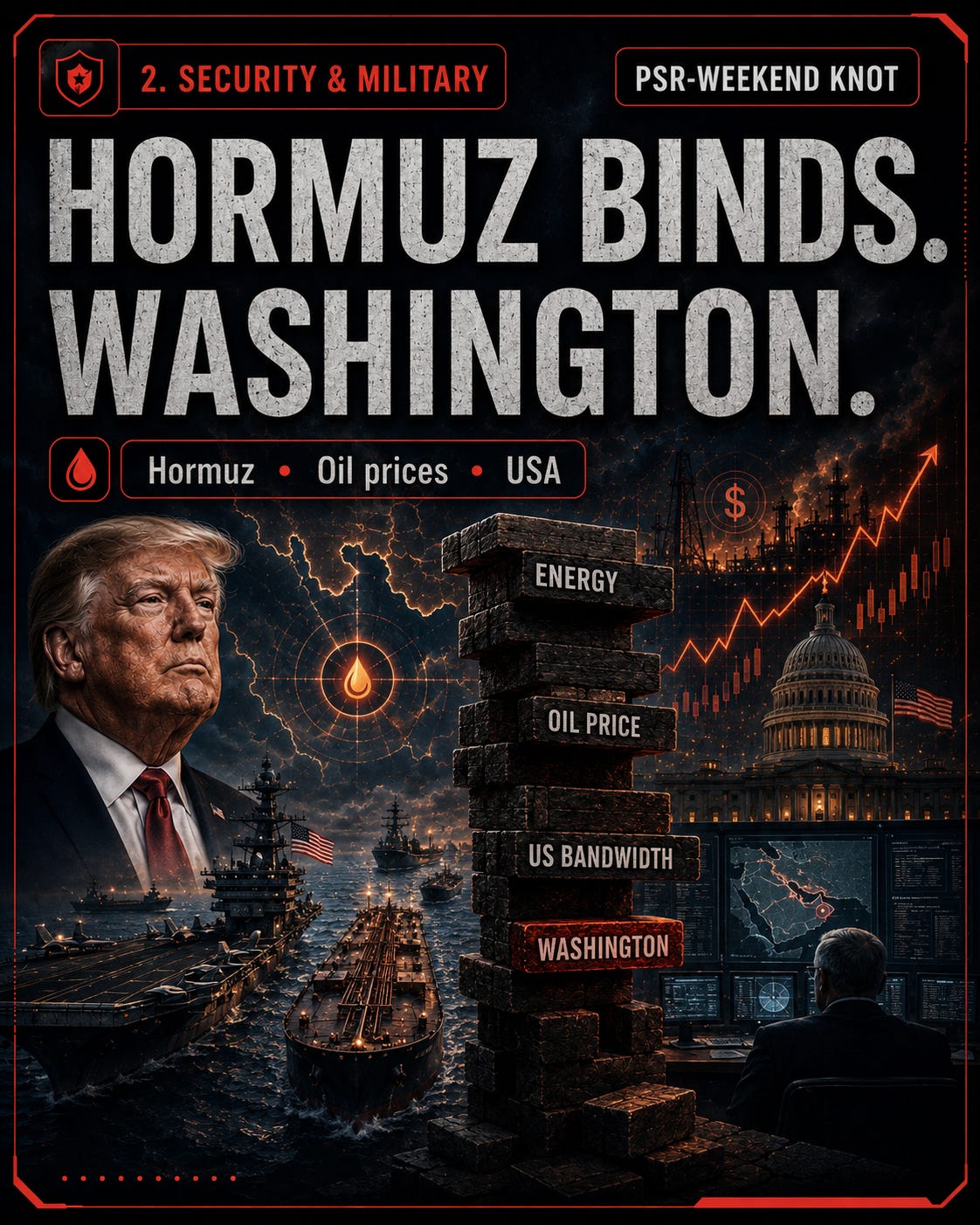
This text is the first excerpt from the larger PSR Weekend Knot “Hormuz Binds. Kyiv Presses.”
The full weekend report connects several strands: the Iran/Hormuz crisis, Trump’s domestic pressure through high fuel prices, the binding of U.S. naval capacity, Ukrainian strikes against Russia’s war economy, Putin’s possible window of opportunity, Europe’s load-bearing problem and the shrinking fault tolerance of Western stability.
This first excerpt isolates the Hormuz strand.
It asks:
How does a sea lane become a domestic pressure point for the United States?
⸻
Lead Thesis
In short:
Hormuz is not only a point on the map. Hormuz is a load channel. What becomes militarily, politically or commercially unstable there does not stay with tankers and oil companies. It reaches American fuel stations, inflation expectations, voter sentiment and the White House.
The wrong sentence would be:
“Trump has to keep Hormuz open.”
The better sentence is:
“Trump has to stabilize Hormuz so that markets, insurers, shipping companies and American voters believe energy flows are predictable again.”
That is harder than a military show of force.
A sea lane can remain formally open and still be economically damaged.
⸻
1. The visible trigger
During the weekend, several developments condensed into a PJenga knot: the Iran/Hormuz situation tied down American capacity, while energy prices remained politically sensitive.
The obvious story is maritime risk.
The real load is broader:
Stressed tower: Energy
Critical stability stone: reliable, insurable transit
Load transfer: Middle East crisis → maritime risk → oil price → fuel price → U.S. domestic politics
PJenga-readable:
The visible trigger is a crisis at sea.
The real load lies in energy, politics, markets and global power projection.
⸻
2. Why Hormuz is more than a strait
The Strait of Hormuz is one of those places where geography becomes world politics.
It connects the Persian Gulf to the Gulf of Oman and global shipping routes. A substantial share of global oil and LNG traffic depends on this chokepoint.
That makes Hormuz not only a military location, but a price location, an insurance location and an expectation location.
A common mistake is to ask only:
Are tankers still moving?
That is not enough.
The more important questions are:
Can tankers move at predictable cost?
Are insurers willing to cover risk at tolerable premiums?
Do shipping companies believe the route remains usable tomorrow?
Do traders price in escalation?
Must governments commit naval protection?
Do consumers believe prices will stabilize?
Not open or closed. Predictable or poisoned.
That is the PJenga core.
⸻
3. Fuel prices as political sensors
In the United States, gasoline prices are more than prices. They are political sensors.
Many foreign-policy risks remain abstract for voters. Hormuz, Iran, carrier strike groups, shipping insurance and LNG flows feel distant.
Fuel prices do not.
They are visible, repeated and emotionally loaded. They affect commuters, families, small businesses, logistics and the symbolic promise of control.
If Trump wants to project strength abroad but that strength fails to calm energy markets, he faces a dangerous feedback loop:
Military toughness can become domestically expensive if it keeps energy markets nervous.
The wrong sentence would be:
“High fuel prices are only an economic problem.”
The better sentence is:
“High fuel prices make geopolitical insecurity domestically measurable.”
That is why Hormuz is not a side theater for Washington. It becomes a domestic test.
⸻
4. U.S. capacity gets tied down
The United States remains militarily powerful. That is not the issue.
The issue is that even American power is not infinitely available everywhere at once.
Carrier groups, escort ships, air defense, logistics, munitions, intelligence, command structures and political attention are real mass.
When more of that mass is bound in the Middle East, it does not mean the U.S. is suddenly weak elsewhere. But global deterrence density becomes thinner.
Stressed tower: U.S. global power
Critical stability stone: simultaneous presence across multiple theaters
Load transfer: Indo-Pacific/global reserve → Middle East/Hormuz protection
Hormuz does not only bind ships.
Hormuz binds decision space.
Every additional U.S. asset tied to the Gulf raises questions:
What remains available for the Indo-Pacific?
What does China observe?
How much more must Europe carry?
How long can Washington sustain presence without domestic cost?
How much air defense and ammunition are being tied down?
What happens if Russia or China tests the system elsewhere?
The point is not American weakness.
The point is opportunity cost.
⸻
5. Why “keeping Hormuz open” is not enough
It sounds intuitive: Trump must keep Hormuz open.
But PJenga separates visible action from real stability.
A military move can force short-term passage while raising long-term risk. A threat can deter and still push prices upward. A deal can calm markets but be framed politically as weakness. Strategic reserves or tax relief can buy time but fail to solve the risk node.
The critical distinction:
Militarily open means ships can pass.
Economically open means ships can pass at predictable cost.
Politically open means consumers believe the situation is controlled.
Strategically open means the U.S. does not have to tie down disproportionate power indefinitely.
Trump does not only need movement through the strait.
He needs damping.
Damping means the system does not react to every new signal with oil-price spikes, insurance jumps, fuel anxiety and political panic.
⸻
6. Narrative vs. real statics
Narrative: Trump shows strength against Iran.
Real statics: Strength helps only if it lowers or contains escalation risk. Strength that makes markets more nervous becomes a domestic liability.
Narrative: Hormuz is open, so the problem is solved.
Real statics: Openness without insurability is only half stability.
Narrative: The U.S. can handle this alone.
Real statics: The U.S. can do a lot, but the more it secures the Middle East, the more load moves into Europe, NATO’s eastern flank, Ukraine support and the Indo-Pacific.
Narrative: Fuel prices are domestic, Hormuz is foreign policy.
Real statics: That separation collapses. Hormuz is foreign policy disguised as domestic politics.
⸻
Mini PJSI / PJIEF
PJSI: 36/100 — damaged normality / low fault tolerance
Hormuz is not necessarily collapsing. But one maritime chokepoint is stressing energy, U.S. domestic politics, global deterrence, NATO responsibility and market expectations.
PJIEF: very highly strained
Hormuz → oil price → fuel price → Trump pressure
Hormuz → U.S. naval binding → Indo-Pacific thinning → China observation
Hormuz → European energy and security costs → NATO load transfer
Hormuz → market expectations → political fault tolerance
This is not isolated.
This is load transfer.
⸻
Conclusion
Hormuz is the first great binder of the weekend knot.
The sea lane binds U.S. capacity.
The oil price binds Trump’s domestic politics.
The uncertainty binds markets.
The naval presence binds deterrence mass.
And the resulting load moves into Europe, NATO and indirectly into the Ukraine war.
In short:
Hormuz is not just an oil chokepoint. It is a chokepoint for Western fault tolerance.
The wrong sentence would be:
“As long as tankers move, everything is under control.”
The better sentence is:
“As long as tankers move only under higher risk, higher cost and heavier military binding, the system is buying time — not real stability.”
Here is the main. Article:


