
The market has long smelled the fire, even while the loudspeakers are still calling it weather
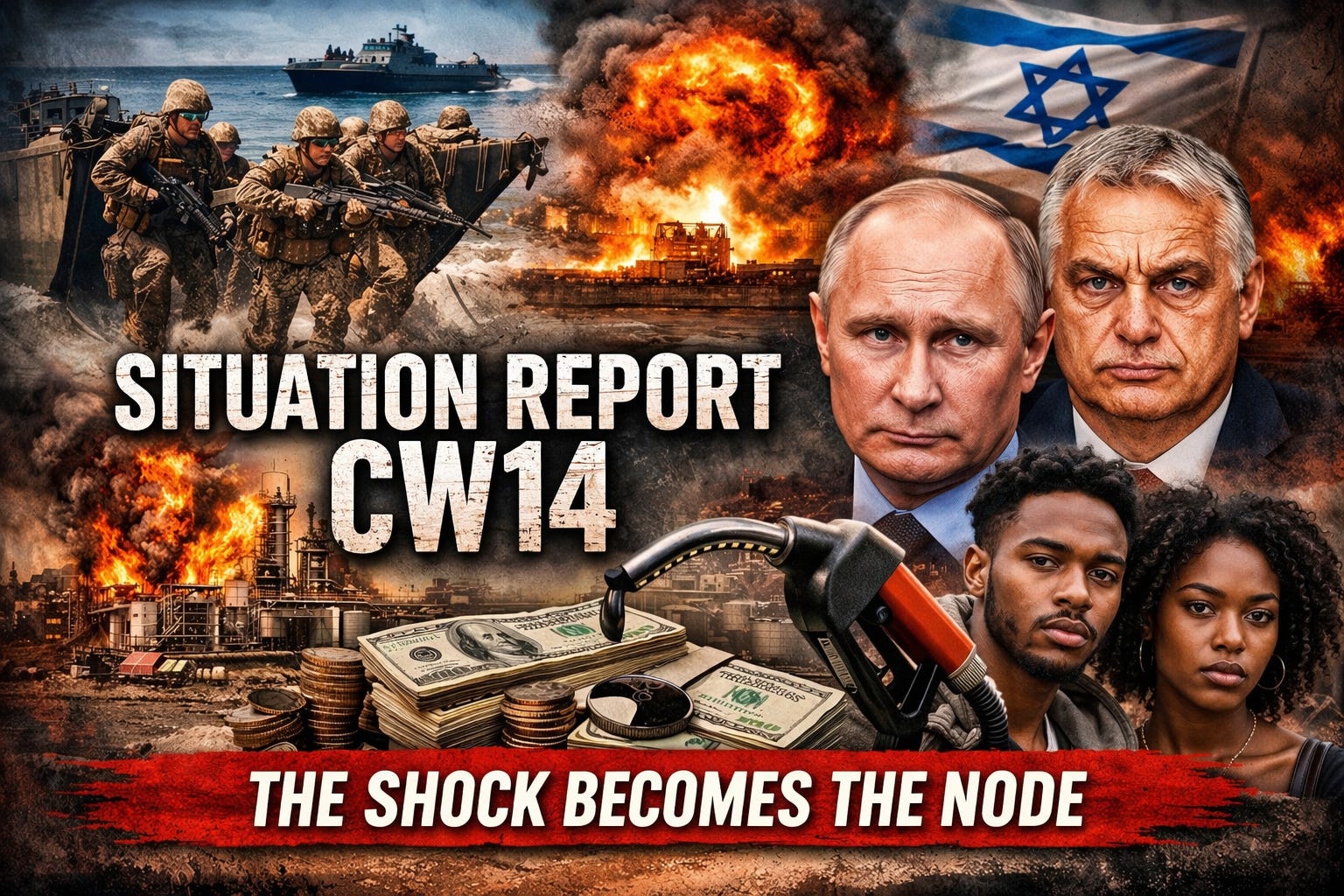
CW13 → CW14 in one sentence
CW13 was the week in which the system began sorting out what can still hold under load. CW14 is the week in which it becomes clearer that part of the damage is no longer merely shock, but is already being priced in as a new, sticky form of damage across energy, security, trade, and politics.
Situation picture
This week, the world does not look like a cleanly collapsed system. It looks like a house in which the lights are still on upstairs while water is already running into the shafts below. From the outside, for many, this still appears to be “tense, but manageable.” In real structural terms, it is already far messier: Israel continues striking deep inside Iran, including South Pars; the Strait of Hormuz remains disrupted despite ceasefire proposals; Ukraine is shifting impact more deeply into Russian oil and export infrastructure; Orbán’s blockade logic continues to damage EU integrity; Sudan continues to disintegrate; and beyond the main theatres, China, India, Latin America, Africa, and Russia’s neighbourhood are sorting new load paths.
The most important sentence-level error of this week remains:
“If a little diplomacy comes in, or if Trump steps back, things will calm down.”
No. Even if military pressure suddenly falls, damaged facilities, insurance risk, political fear of renewed strikes, and altered trade flows remain embedded in the material. That is exactly why the IEA reserve release was a shock absorber, not a restoration of normal market statics.
Loaded towers
1. Energy
The energy tower remains the most heavily loaded tower. According to AP on April 6, Israel struck Iran’s South Pars facility — not just any target, but a central stone in Iran’s energy and revenue system. At the same time, Hormuz remains only partially or politically filtered open; AP continues to describe massive disruption, international diplomacy, and a 45-day proposal, but no stable restoration of normal passage.
For the market, that means this: the price is no longer trading only war, but damage duration. Part of the price is not just an escalation premium, but a repair premium, an insurance premium, and a renewed-strike premium. That is the difference between de-escalation and restoration. De-escalation can come quickly. Restoration cannot.
2. Military / Security
The security and military tower is no longer just a front-line tower, but a deep-impact tower. Israel here is not merely a subordinate actor of the United States, but an operational accelerator in its own right: AP reports strikes on South Pars, the killing of high-ranking Iranian actors, and further attacks on Iranian infrastructure.
Ukraine, in parallel, provides the second major example of how war works today: according to Guardian/ISW, Russia’s frontline gains in March were minimal, but Ukrainian strikes on Novorossiysk, Ust-Luga, Primorsk, and other infrastructure are pressing much deeper into export, fuel, and logistics chains. A few kilometres of front-line movement therefore say less and less about the real effect of war.
3. Economy / Financial system
The economic situation continues shifting from short-term shock into permanent friction. The market is learning that this is not just about impacts, but about sticky damage to energy, export capacity, political trust, and willingness to invest. Orbán’s blockade against aid to Ukraine is a European example of this: not because everything fails immediately, but because predictability, payout speed, and institutional credibility are being damaged. AP now itself describes this as an exposed weakness of the unanimity architecture.
4. Information / Narratives
The information tower remains massively distorted. The dominant calming narrative still runs roughly like this: a bit more diplomacy, a bit more reserve release, then oil falls, then markets settle, then everything returns to its old form. The problem is that this story is selling linear hope inside a nonlinear system. That is why your own uploads on executive acceleration and autocratic axis formation remain useful as interpretive layers, even if they are not primary news sources.
Critical stability stones
The key supporting stones this week are:
The Strait of Hormuz as an energy and transport bottleneck.
Iranian energy infrastructure, especially South Pars.
Russian oil and export infrastructure, which Ukraine is increasingly hitting in depth.
EU decision-making capacity, which continues to be damaged by Orbán’s veto power.
African critical mineral zones, and at the same time disintegration zones such as Sudan.
Latin American lithium, copper, and energy axes as alternative and competitive spaces.
Relevant agents
Israel must be upgraded: not a tagalong, but an active escalation and acceleration agent in the Iran war.
The United States remains the largest external coercive actor in the Iran/Hormuz field, also because of deadlines, threat posture, and military power.
Iran continues to hold the energy tower through Hormuz and retaliatory capacity in a way that goes far beyond regional effect.
Ukraine is increasingly acting as a deep disruptor of Russia’s war economy rather than merely a front-line defender.
China acts simultaneously as diplomat, veto-brake, and opportunistic power: it slows escalation where its own interests are affected, while strengthening its relative leverage in alternative energy and supply chains. This should be understood here as a systemic inference; in the openly available material it is especially visible in China’s mediation between Pakistan and Afghanistan, as well as in raw-material and supply-chain matters.
India is not a front-line actor, but a major load diverter in the oil market. We underweighted this before; its geo-economic role follows from its size as a demand centre and from the rerouting of global oil flows, even if in this round we do not yet have equally strong primary sourcing for it as we do for Israel or Orbán. The evidence level here is lower.
Orbán / Hungary remain a leverage point of blackmail within the EU tower.
The RSF and Sudanese war actors keep Africa under load as a disintegration zone.
Time dynamics and load shifting
From front war to depth war
Ukraine shows it most clearly: little front-line shift, more effect in ports, export logic, refineries, and fuel chains. Russia continues responding with air and drone warfare. So the front is not freezing; it is relocating damage deeper into the system.
From price shock to damage price
Oil is reacting not only to troops or headlines, but increasingly to the assumption that facilities, passage, and insurability will remain broken or poisoned for longer. That is why reserve opening matters, but is no magic trick.
From regional conflict to global load migration
The Middle East is pressing on energy. Energy presses on inflation, shipping, subsidies, electoral politics, and investment. At the same time, other regions are shifting load: Latin America gains importance as a mineral and oil alternative space; Africa likewise as both raw-material base and disintegration zone; Russia’s neighbourhood drifts out of clear blocs into mixed buffer, circumvention, and competitive spaces.
Additional regional additions
Pakistan – Afghanistan
This is not a primary global driver, but it is a southern friction zone with spillover potential. AP reports that talks between Pakistan and the Taliban, under Chinese mediation, resumed after weeks of heavy fighting; Pakistan is pressing for action against the TTP. This binds Chinese, Pakistani, and Afghan security bandwidth and turns the region into a side theatre with real systemic relevance.
Russia’s outer stress belt
Russia’s neighbourhood outside the EU is not a protective ring, but a fragmented belt of stress. Belarus remains a military forward zone. Armenia is drifting politically away from Moscow without yet being able to fully detach economically; Putin’s warning to Armenia shows this pressure openly. Central Asia remains both a buffer and a circumvention zone. China is a backer, but on its own terms.
Central and South America
The region is not a marginal theatre, but a strategic raw-material and fallback zone. Latin America holds major lithium and copper reserves, while the United States is expanding critical mineral agreements with countries such as Argentina, Ecuador, Paraguay, and Peru. At the same time, Argentina, Guyana, and Brazil are seen in 2026 as the key regional growth drivers in oil. That makes the region both a relief space and a competitive zone for energy and industrial supply chains.
Cuba
Cuba is not a major global lever, but a small, sharp tension stone. The recent Russian oil delivery to Cuba during a severe energy crisis shows the limits of U.S. sanctions coherence and Russia’s ability to project both symbolic and practical effect even in immediate U.S. proximity. We had weighted this too weakly before.
Africa
Africa works in CW14 in a dual way: as a disintegration zone and as a critical-material zone. Sudan remains an extreme case of breakdown and spillover; AP reported a deadly drone strike on a hospital. In parallel, the strategic relevance of African critical minerals continues to rise; WEF points to the growing importance of copper, nickel, cobalt, and lithium in the global transition and technology economy.
Narratives vs. real statics
The largest perception gap remains this: many are still looking for the old crisis in the old costume. They are waiting for the one stock-market crash, the one banking panic, the one historic rollover. But the current crisis is more networked, more digitally accelerated, and more vulnerable at infrastructural nodes. That is why it can be systemic without looking everywhere at once like 1929 or 2008. Your additional sections on the new form of global economic crisis fit exactly here: what matters is not the classic collapse, but coupled permanent instability.
Secured facts
Israel struck South Pars and other Iranian targets on April 6.
There is a 45-day ceasefire proposal concerning the war and Hormuz, but no secured implementation.
Russia’s territorial gains in Ukraine were very small in March, while Ukrainian strikes on oil and export infrastructure increased.
Orbán’s veto and blockade logic continues to burden EU decision-making on Ukraine.
Pakistan and Afghanistan are negotiating under Chinese mediation after heavy fighting.
Sudan remains highly unstable; a hospital was hit by drone in early April.
Latin America and Africa are becoming more strategically important as raw-material and material spaces.
Robust findings
The greatest pressure continues to lie on energy, military/security, economy/finance, and information/narratives.
Israel was underweighted in the first version and must be visibly upgraded as an active primary agent.
China, Latin America, Africa, and Russia’s neighbourhood are not peripheral scenery, but load distributors, circumvention spaces, or raw-material pillars.
Ukraine is less and less merely a front war and more and more an infrastructure and export war.
Plausible inferences
Even with rapid de-escalation, a price floor will remain as long as damaged energy installations, routes, and insurability are not normalised.
The global economic crisis of the present does not need to look like earlier global economic crises in order to be real; its present form is more networked, more digitally accelerated, and more vulnerable at nodes. This statement here is an analytical inference, supported by the coupled developments in energy, war, raw materials, and politics.
Russia’s environment is no longer a stable ring, but a differentiated stress belt made up of forward zones, drift zones, and buffer states.
Open questions / data gaps
How deep is the actual physical damage to Iranian energy infrastructure?
How durable will the disruption in Hormuz remain, even if there is an interim pause?
How far can Orbán’s blockade be concretely bypassed before institutional damage overtakes material aid?
In India’s case, the geo-economic relevance is high, but in this version the direct primary evidence is thinner than in other sections.
For Belarus and North Korea, day-to-day open transparency remains limited; the level of assertion there must stay lower.
PJSI
PJSI: 38/100
Not because everything is collapsing at once, but because more and more things are continuing only through reserve consumption, improvisation, and damaged trust statics. This is an analytical PJenga estimate based on the developments outlined above.
PJIEF
PJIEF: very high
Integrity pressure between energy, war, export capability, prices, and political capacity to act continues to rise. What matters is not only the impact itself, but the migration of load between already damaged towers.
Final conclusion
CW14 is the week in which the system becomes unpleasantly honest.
Not because everything suddenly falls apart. But because it is becoming increasingly clear that much of it is now functioning only through reserve burn, repair hope, and political euphemism.
Israel is more clearly visible as an active escalation engine. Ukraine is showing ever more clearly that a few front-line kilometres mean little when the enemy’s depth is burning. Orbán continues damaging Europe’s statics. China, Pakistan–Afghanistan, Russia’s neighbourhood, Latin America, Cuba, and Africa are no longer side stages, but parts of the load field. The crisis has therefore not merely become larger. It has become more densely coupled.
The clean short form for CW14 is this:
The shock is not gone. It has changed shape.
From impacts come damaged nodes.
From crisis reporting comes crisis material.
Here is the link to the previous situation report, CW13
For analysis instead of noise, for statics instead of keyword fog: subscribe to the PSR and share this report with people who still want to know what truly holds, what is already rotting, and what is becoming newly visible beneath the rubble.