
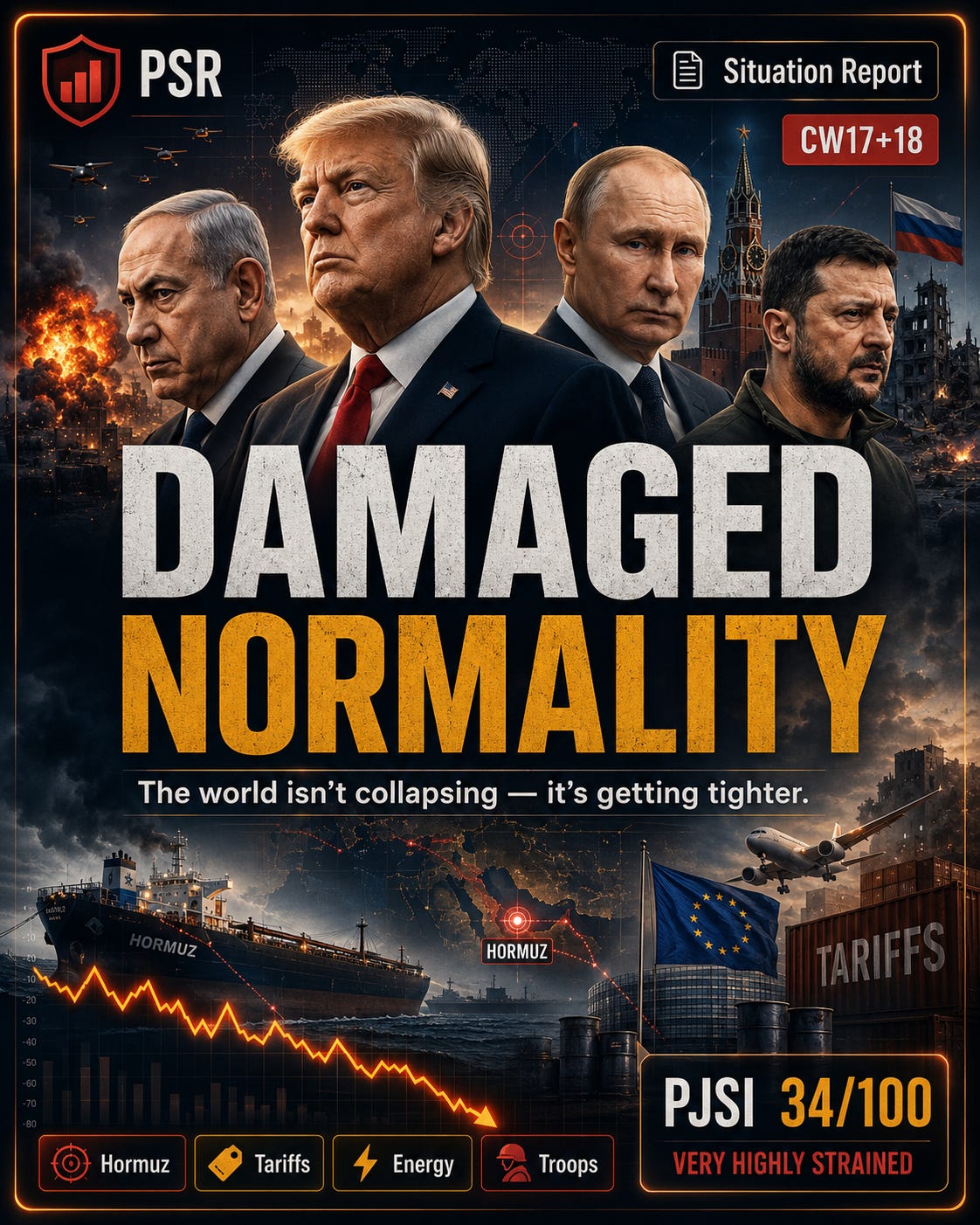
PSR – PJenga Situation Report CW17+18 2026 — Damaged Normality
PJD – Global PSR by regions and system towers
Why the global situation is not collapsing, but becoming tighter, hotter, more expensive, and politically more toxic
PJD – Global PSR by regions and system towers
Reporting window: CW17+18, updated through May 8, 2026
PJSI: 34/100
PJIEF: very highly strained to critical
⸻
Core Thesis
CW17+18 do not show a global situation that is cleanly returning to relaxation. They show a global situation rehearsing damaged normality.
That sounds more harmless than it is. These weeks are not defined by the one big bang. They are defined by systems continuing to operate under worsening conditions. Hormuz is not simply open or closed; it remains politically, militarily, and insurance-wise poisoned. Jet fuel is no longer merely an oil-price issue; it is moving into flight schedules. Trump is not merely sounding off against Europe; he is coupling tariff policy, troop withdrawal, and alliance pressure. Israel is not only keeping the Iran channel open; it is burdening neighboring systems from Gaza to Lebanon. Germany is cushioning crises with buffers that are themselves becoming leaky. Russia calls it a ceasefire, but means a protective shield for its own symbolic politics, backed by threats against Kyiv.
And beneath all of that lies a second energy fracture: Germany simultaneously has expensive fossil energy and green electricity surpluses that cannot be sufficiently stored, routed, or used.
CW16 had already set the core diagnosis: multiple load fields, no clean easing. Hormuz remained the global choke point, Ukraine remained Europe’s high-load zone, the Indo-Pacific was not relieved despite the Middle East, and Africa and Latin America remained friction spaces. The previous report explicitly warned against breaking the global situation back down into isolated headlines, because the real system statics had already become more tightly coupled.
CW17+18 confirm that line, but they shift the tone.
Warning stones are turning into first operational loads.
⸻
Short Reading Guide
The PSR does not read crises as mere chains of events, but as questions of load-bearing capacity.
Towers are major system areas: energy, military/security, economy, information, society, politics, demography, and planetary systems.
Stability stones are the load-bearing factors inside those towers: a strait, a refinery chain, air defense, a power grid, social trust, a supply system, a corridor, or an institution.
Load migration means that pressure rarely stays where it originates. It moves from war into energy prices, from energy prices into state budgets, from state budgets into party conflict, and from there into trust or radicalization.
PJSI is the estimated stability level of the overall system.
PJIEF describes how strongly loads interlock between towers.
This report therefore asks not only what happened. It asks what still holds.
⸻
1. Situation Picture: Operations Continue, But Tighter
In short: CW17+18 do not show the repair of the system, but a thickening of its poor operating conditions.
The most important shift lies in the transition from acute fear of escalation to structural long-term friction. On the surface, the world appears calmer than during the immediate shock moments. That is exactly what makes the situation deceptive. The load has not disappeared. It has been redistributed.
From open war into legal formulas.
From oil prices into jet fuel.
From Hormuz into insurability and shipping planning.
From fossil energy into fuel rebates.
From electricity surplus into negative prices.
From health reform into load sorting.
From alliance policy into coercive rhetoric.
From ceasefire into threat posture.
The false sentence of these weeks would be:
“As long as everything keeps running, the system is stable.”
The better sentence is:
The system keeps running because more and more load is being invisibly shifted, delayed, fiscally cushioned, or politically renamed.
That is damaged normality.
⸻
2. Hormuz / Iran / United States: The Ceasefire Is Grinding
In short: Hormuz remains the global choke point, and the ceasefire is no longer merely fragile; it has become operationally scratched.
The Strait of Hormuz is not simply a geographic bottleneck. It is a valve in the global energy, transport, and security statics. Whoever generates pressure there is not merely playing with oil prices, but with insurability, delivery times, aviation fuel, market psychology, inflation, and military readiness to respond.
Several sources now report renewed clashes in the area around the Strait of Hormuz. Iran accuses the United States of attacks on ships and civilian areas; the United States speaks of self-defense after attacks on American destroyers. The Guardian describes the situation as a serious threat to the ceasefire, including mutual accusations, U.S. counterstrikes, and regional missile and drone incidents.
This sharpens the previous warning stone. The question is no longer merely whether a ceasefire holds. The question is who politically and legally exploits its breach.
Trump can argue that a new Iranian action created a new situation. From that, a new military measure and possibly a new War Powers narrative could be constructed. Critics would counter that blockade, troop presence, and threat posture show that the conflict was never truly over.
The false sentence would be:
“The ceasefire stabilizes the Gulf.”
The better sentence is:
The ceasefire itself has become an instrument of conflict.
PJenga-readable, this is a dangerous legal and security mechanism. When military situation, legal deadlines, and political self-narrative interlock, the clock itself becomes a stability stone. Or a detonator.
⸻
3. Energy: The Most Critical Tower Remains Damaged
In short: The energy tower is under double strain: externally through fossil geopolitical friction, internally through insufficiently integrable renewable surpluses.
The energy tower in CW17+18 is not only under classic scarcity pressure. It is also under integration pressure.
On the fossil side, Hormuz, oil, gas, refined products, jet fuel, and OPEC coordination remain burdened. On the renewable side, the planetary tower is increasingly delivering large quantities of electricity, but grids, storage, demand flexibility, and market design cannot fully absorb that energy.
This is not a contradiction. It is the core of the modern energy crisis.
Germany can generate large amounts of PV electricity on sunny spring days and still suffer under fossil price shocks. It can experience negative electricity prices and still have high end-consumer prices. It can export or curtail green surplus and still pass fuel rebates.
The false sentence would be:
“Germany has an energy problem because energy is missing.”
The better sentence is:
Germany has an energy problem because energy forms, times, locations, grids, storage, and markets are not cleanly coupled.
⸻
3.1 Jet Fuel: The Energy Crisis Reaches the Flight Schedule
In short: Jet fuel is not a by-product of the oil crisis, but its own critical supply node.
Oil is not the same as jet fuel. Jet fuel depends on refinery logic, product competition, import routes, terminals, airport networks, hedging, storage, and time-specific availability.
This is exactly where damaged normality is now becoming especially visible. Airlines cut around 13,000 flights and roughly two million seats worldwide in May because rising jet-fuel costs and fuel uncertainty are feeding into capacity planning.
Jet fuel is therefore no longer merely a price issue. It is becoming a mobility issue.
The false sentence would be:
“As long as planes take off, air traffic is stable.”
The better sentence is:
When planes still take off, but capacity is cut, routes are thinned, and costs are redistributed, the crisis has already reached everyday life.
PJenga-readable, the load migrates cleanly through several towers:
Military/security → Hormuz → oil/refined products → jet fuel → flight schedules → tourism, freight, commuting, prices, and perception.
⸻
3.2 OPEC / UAE: The Producer Order Is Cracking
In short: The UAE’s exit from OPEC and OPEC+ is not an immediate supply shock, but it is a structural coordination break.
The United Arab Emirates announced or completed its exit from OPEC and OPEC+ effective May 1, 2026. The official reasoning points to national interests, production capacity, long-term energy policy, and a more independent role in global energy markets.
That does not automatically mean oil chaos tomorrow. But it damages the expectation that producers will collectively steer under stress.
OPEC was never only a quantity machine. OPEC was also expectation management. When that expectation cracks, the market is not only trading barrels. It is trading discipline, mistrust, and possible producer rivalry.
The false sentence would be:
“If more production becomes possible, the market becomes more stable.”
The better sentence is:
More national flexibility can calm the short term and damage collective steering in the medium term.
⸻
3.3 Energy Majors: Not Shell as Culprit, But Market Design as Asymmetry
In short: The energy crisis does not create a simple story of greedy corporations and suffering consumers. It creates structural asymmetry.
Shell, BP, Exxon, and other oil and gas majors show why journalistic caution is necessary. Shell is visible, BP as well, Exxon more complicated. Large integrated energy players sit close to production, trading, storage, refinery optimization, and global price movements. Households, airlines, small and medium-sized businesses, and the state sit much closer to cost pass-through.
BP reported an underlying replacement cost profit of $3.2 billion for Q1/2026 and referred, among other factors, to exceptionally strong oil-trading results. Exxon, by contrast, reported headline earnings of $4.2 billion, but the picture changes significantly once specific special items and timing effects are removed. This shows that headline profits alone do not cleanly explain who benefits how strongly.
The false sentence would be:
“Shell is simply enriching itself at the customer’s expense.”
The better sentence is:
The crisis reveals a market design in which integrated, capital-strong, trading-capable actors can use volatility, while end consumers and the state carry the price and relief burden.
This resembles electricity-market logic. When gas prices drive the market price, producers with lower marginal costs also benefit. That is not automatically fraud. It is a market design that produces politically difficult-to-explain windfall effects in crisis conditions.
PJenga finding:
The energy crisis damages not only purchasing power. It damages the perception of fairness.
When fuel rebates do not fully arrive, relief bonuses fail, and major energy players simultaneously report high profits, the problem is not purely economic. It becomes a legitimacy problem.
⸻
3.4 PV Surpluses: The Planetary Tower Delivers, the Energy Tower Cannot Carry It All
In short: Germany does not have too much solar power. Germany has too little system to fully utilize its solar power.
Spring 2026 is excellent for many PV owners. Anyone with self-consumption, storage, heat pump, or wallbox experiences real relief. Their own roof becomes a stability stone.
At system level, the same success is more complicated. When a lot of PV electricity is generated at midday, but demand does not respond flexibly enough, storage is lacking, and grid bottlenecks occur, market prices fall into negative territory. Electricity must be exported, curtailed, or stabilized through complex grid measures. Euronews describes negative electricity prices in Europe as the result of excess generation and insufficient storage capability; precisely this gap is driving calls for more battery storage and flexibility.
The false sentence would be:
“Solar power is the problem.”
The better sentence is:
Solar power reveals the problem: Germany expanded generation faster than storage, grids, load shifting, and market logic.
PJenga-readable, this is a hollow space in the energy tower. Visible capacity grows. The inner load-bearing structure lags behind.
The critical stability stone is no longer simply: more renewable capacity.
It is:
Absorption capacity.
That includes grids, storage, dynamic tariffs, smart meters, heat storage, hydrogen, industrial load flexibility, electric vehicles, heat pumps, district storage, and a market logic that actually allows consumers and assets to respond.
⸻
4. Planetary Tower: Climate Pressure Becomes an Infrastructure Question
In short: The planetary tower is no longer background. Through heat, water, cooling, and electricity, it directly reaches energy, health, and urban planning.
The PV spring shows only one side. The other side is urban heat. Cities store heat, reflect radiation, fail to cool sufficiently at night, and drive cooling demand. Glass façades, asphalt, concrete, dark roofs, street canyons, and lack of evaporation turn solar energy into built load.
This point deserves its own article, probably an entire series. In the situation report, one anchor is enough:
Cities will need not only electricity and heat networks in the future, but also cooling and storage logic.
The city of the future must not merely endure heat and air-condition it away. It must route heat, store it, shift it, and translate it into cooling where people would otherwise become ill.
This applies especially to data centers. They are not only electricity consumers, but heat producers, cooling consumers, and potential district nodes. The classical logic of cooling server rooms with overburdened rooftop AC units and pushing heat into the city air is damaged normality in technical form. Fraunhofer ISE describes data centers in Germany as strongly growing energy consumers and points to the need for sustainable concepts combining renewable supply, waste-heat use, grid integration, and efficiency.
The false sentence would be:
“More air conditioners solve the heat problem.”
The better sentence is:
More air conditioners often solve indoor heat by shifting it outward, unless they are embedded in cooling, storage, and urban-climate systems.
This report only sketches the issue. A follow-up project should go deeper there: overheated cities, district cooling, thermal storage, data-center waste heat, PV-coupled cooling, mine water, aquifers, façades, and social heat risks.
PJenga finding:
The planetary tower no longer delivers an abstract climate background. It produces concrete load migration into power grids, cities, health systems, work, and social stability.
⸻
5. Military / Security: Several Escalation Channels Remain Open
In short: The military situation is not calmed; it is distributed.
The security tower is not carried by one conflict, but by several at once. United States/Iran. Israel/Lebanon/Gaza. Russia/Ukraine. Indo-Pacific. Each of these spaces has its own logic. But all of them feed back into energy, markets, narratives, and political agency.
⸻
5.1 Israel / Neighborhood Space: Deterrence as Permanent Load
In short: Israel is not only acting against Iran, but as a regional permanent-load agent against several neighboring systems at once.
Lebanon shows this most clearly. Despite ceasefire, Israeli airstrikes and Hezbollah rockets continue. AP reports Israeli air attacks in southern Lebanon with at least five deaths and Hezbollah rockets fired into northern Israel. Israel also stated that it had killed more than 85 Hezbollah fighters and struck around 180 targets over the previous week.
This is not peace. It is limited permanent violence.
The false sentence would be:
“As long as Israel does not escalate directly against Iran, the regional conflict remains contained.”
The better sentence is:
Israel can generate regional load even without a direct strike on Iran — through Lebanon, Gaza, Syria, airspace dominance, proxy structures, and political pressure waves in Jordan and Egypt.
PJenga-readable, Israel does not hold a single tipping switch, but a regional switchboard.
⸻
5.2 Russia / Ukraine: Ceasefire as Threat Posture
In short: Russia’s Victory Day ceasefire is not real de-escalation, but a symbolic protection operation with an escalation threat.
Russia declared a unilateral ceasefire for May 8 and 9 around Victory Day, while simultaneously threatening retaliation if Ukraine disrupted the celebrations. AP reported that Russia called a ceasefire for Friday and Saturday and announced it would strike Kyiv back if Ukraine tried to interfere with Victory Day events. Al Jazeera also reported competing ceasefires from Russia and Ukraine during this period.
This is not a normal ceasefire. It is a protective dome for symbolic politics.
Victory Day is a stability stone of the Putin system. It is meant to stage historical strength, military continuity, and state control. If Moscow has to secure that staging against Ukrainian long-range drones, that does not show Russian calm. It shows vulnerability.
The false sentence would be:
“Russia is offering a ceasefire.”
The better sentence is:
Russia is demanding a pause for its own performance and turning it into an escalation instrument at the same time.
Load migration:
Front war → deep drone war → threat to Russian symbolic spaces → domestic nervousness → threat against Kyiv.
⸻
5.3 Indo-Pacific: Parallel Load Instead of Relief
In short: Washington is not vacating Asia despite the Middle East.
Balikatan and the continued U.S. presence in the Indo-Pacific show that the United States wants to carry several security spaces at the same time. This increases deterrence, but also overextension.
The false sentence would be:
“If the United States is tied down in the Middle East, Asia automatically moves into the background.”
The better sentence is:
Washington is attempting parallel load-bearing. That is strength and risk at the same time.
⸻
6. Trump / EU / Germany: Alliance as Daily Bargaining Material
In short: Trump in CW17+18 is not an external commentator on the crisis. He is himself a load stone inside the Western system.
Trump is increasing pressure on Europe and especially Germany through several channels. AP reports that the United States wants to withdraw around 5,000 troops from Germany over the next six to twelve months. That corresponds to around 14 percent of U.S. troops in Germany and affects a country that hosts central American facilities such as Ramstein.
At the same time, Trump is threatening the EU with higher tariffs on cars and trucks. German media report an ultimatum until July 4 and a threat to raise EU auto tariffs from 15 to 25 percent if the EU does not implement its part of a trade agreement.
Germany thus stands at the center of a double pressure: industry and security.
Auto tariffs do not hit some minor European side sector, but a core area of German export and employment statics. Troop withdrawal affects not only military logistics, but trust in the American security guarantee.
The false sentence would be:
“Trump is just blustering.”
The better sentence is:
Trump rhetoric is itself a load stone because markets, military planners, governments, and companies respond not only to actions, but to the expectation that language can become policy at any moment.
PJenga-readable, Trump damages the predictability of the Western load-bearing structure.
The transatlantic bridge is still standing. But Trump is jumping on it while Europe has to transport goods, weapons, energy prices, budget holes, and political expectations across it.
⸻
7. Germany: Buffer State Under Pressure
In short: Germany recognizes crisis load, but does not find a load-bearing relief architecture.
Germany is not only under global load during these weeks. It is also showing its own repair weakness.
Fuel rebate. Relief bonus. Health reform. Electricity surpluses. Grid expansion. Storage deficit. Trump pressure. Ukraine costs. Energy prices. Industrial fear. Federal-state blockades. Party-political fraying.
The federal government wants to cushion. But it often fails to find measures that are socially tangible, economically bearable, federally financeable, and politically majority-capable at the same time.
The false sentence would be:
“Germany has a relief problem.”
The better sentence is:
Germany has a load-bearing problem: it lacks a political mechanism that distributes crisis load reliably, fairly, and durably.
⸻
7.1 The 1,000-Euro Bonus: Wash Me, But Don’t Get Me Wet
In short: The failed relief bonus is not a minor legislative detail, but a symptom of damaged government statics.
The Bundestag had passed a tax- and contribution-free relief bonus of up to 1,000 euros, which employers would have been able to pay voluntarily to employees. The federal government presented it as crisis assistance.
On May 8, the Bundesrat blocked the measure for the time being. Reports cite, among other reasons, the burden on states and municipalities through tax revenue losses, as well as the question of whether many employers would have been able to pay such a voluntary bonus at all. The maximum state costs were estimated at up to 2.8 billion euros.
This is the political moment: wash me, but don’t get me wet.
The state wants relief to be visible, but it does not want to fully carry the real load itself. Employers are supposed to pay, employees are supposed to benefit, the state and social insurance funds give up revenue, and states and municipalities carry part of the revenue losses. That is exactly why this buffer was politically brittle from the start.
The false sentence would be:
“The federal government had planned an effective relief measure, and the Bundesrat prevented it.”
The better sentence is:
The federal government had planned a visible relief buffer whose real load-bearing capacity depended on employers, states, and municipalities.
PJenga finding:
The bonus does not only show that a measure failed. It shows that the load carrier itself remains unclear.
⸻
7.2 Fuel Rebate: Buffer With Leakage
In short: The fuel rebate reduces short-term pain at the pump, but repairs no global load stone.
The federal government had planned a temporary reduction in energy tax on fuels. The Bundestag described it as relief for consumers and companies. At the same time, the measure remains structurally limited: it does not reduce Hormuz risk, refinery bottlenecks, jet-fuel logic, OPEC cracks, or market-design asymmetry.
The fuel rebate shifts part of the energy shock out of everyday life and into the public budget.
If it is not fully passed on, it additionally creates mistrust. Fiscal relief then becomes a narrative problem: who benefits? Consumers, gas stations, mineral-oil companies, or the state?
The false sentence would be:
“The fuel rebate defuses the energy crisis.”
The better sentence is:
The fuel rebate cushions a symptom price, but it repairs no energy statics.
⸻
7.3 Health System: Mini-Reforms on a High-Load Tower
In short: The German health system is not truly relieved; it is being resorted.
Hospital reform, emergency-care reform, statutory health-insurance savings logic, better patient steering, more networking, more specialization, more efficiency: on paper, this sounds like structural work. PJenga-readable, however, it looks more like a set of adjustment screws on a system that is simultaneously under staff wear, cost pressure, demographic load, hospital deficits, rural-service fear, and rising patient expectations.
The false sentence would be:
“Germany is reforming its health system, so the health tower becomes more stable.”
The better sentence is:
Germany is trying to sort overload better without sufficiently reducing the load itself.
The health system is not tipping. But it carries less and less through reserve, and more and more through rerouting, prioritization, and habituation.
⸻
7.4 Government Statics: The Center Under Counter-Pull
In short: The government must visibly stabilize, but is increasingly appearing frayed.
In this situation, Germany needs a government that translates global load into load-bearing domestic policy. That only partially succeeds. SPD and CDU/CSU are pulled by different political reflexes. The SPD must make social cushioning visible; the Union must limit economic burden and prevent state overextension. Both are understandable. But they do not automatically pull the same stone.
The risk does not lie only in a single law. It lies in the feedback loop:
external global load → insufficient relief → loss of trust → party conflict → inability to act → strengthening of radical edges.
If the government visibly fails under crisis load during its legislative period, space opens for political margins that offer simple narratives against an overburdened center.
The false sentence would be:
“This is normal coalition friction.”
The better sentence is:
In a global economic and security crisis, coalition friction itself becomes a stability risk if it blocks the capacity to relieve.
⸻
8. Hungary: The Rare Relief Stone With Delay
In short: Hungary is strategically important, but not yet an operational relief breakthrough.
The change of power in Hungary is one of the few positive European stones in this situation. Orbán’s defeat and Péter Magyar’s rise change Europe’s expectation architecture. An internal EU blocking actor loses power. Reforms, rule of law, and the release of frozen EU funds become more realistic.
But the Orbán system did not consist only of parliamentary seats. It consisted of media power, economic networks, administration, loyal institutions, and political milieu.
The false sentence would be:
“Orbán is gone, so Europe’s Hungary problem is solved.”
The better sentence is:
Hungary is a tower under reconstruction, not yet a repaired stability stone.
For the PJSI, Hungary is positive, but not yet strong enough to offset Hormuz, Trump, jet fuel, Israel, Germany, and Russia.
⸻
9. Narratives vs. Real Statics
In short: The greatest danger of these weeks does not lie in missing information, but in wrong sorting.
Narrative
Real Statics
“The ceasefire holds.”
It is already being exploited militarily, legally, and politically.
“Hormuz is open.”
What matters is normal, insurable, repeatable passage.
“Oil prices are falling again.”
Product markets such as jet fuel remain damaged.
“Trump is only talking.”
His language becomes tariff, troop, and trust policy.
“Germany is providing relief.”
The relief buffers are leaky, voluntary, or blocked by federalism.
“Solar power causes negative prices.”
Missing storage, grids, and flexibility create the hollow space.
“Shell is the scandal.”
The real point is asymmetric market design.
“Russia offers a ceasefire.”
Russia protects symbolic politics while simultaneously threatening escalation.
“More air conditioning solves heat.”
Without system coupling, it shifts heat, grid load, and social risks.
The central PJenga sentence is:
Visibility is not load-bearing relevance. And calm is not stability.
⸻
10. Loaded Towers – Ranking
1. Energy / Passage / Jet Fuel
The most critical tower. Hormuz, OPEC cracks, jet fuel, market design, fuel rebate, PV surpluses, and storage deficits are coupling.
2. Military / Security
United States/Iran, Israel/Lebanon/Gaza, Russia/Ukraine, and the Indo-Pacific remain active at the same time.
3. Economy / Industry / Financial System
Jet fuel, auto tariffs, energy prices, energy majors, the German auto industry, and market trust interlock.
4. Information / Narrative / Trust
Language replaces statics. Ceasefire, relief, reform, market profit, and alliance rhetoric become contested narratives.
5. Society / Political Stability
Germany, health system, mobility, heat, energy prices, and radicalizable dissatisfaction become more tightly coupled.
6. Planetary Systems
Not as background, but as a direct load driver through heat, urban climate, cooling, water, energy integration, and health.
⸻
11. Acting Forces
Pressure
Hormuz standoff
damaged U.S.-Iran ceasefire
Israeli operations against neighboring systems
OPEC/UAE structural break
jet-fuel shortage and flight-schedule impact
Trump tariffs and U.S. troop withdrawal
Russian Victory Day threat posture
German relief weakness
PV surpluses without storage architecture
urban heat and growing cooling question
Friction
ceasefire vs. counterstrikes
formal passage vs. real insurability
green electricity surpluses vs. high end-user prices
energy-major profits vs. state relief need
coalition logic vs. crisis-action capacity
Russian commemorative politics vs. Ukrainian drone war
urban heat vs. private air-conditioning logic
Acceleration
new Hormuz incident
Israeli strike against Lebanon/Gaza/Syria
Iranian proxy reaction
further U.S. tariff step against EU
U.S. troop withdrawal larger than announced
Russian strike against Kyiv
jet-fuel price jump with further flight cancellations
federal political blockade on relief measures
heat wave with grid and health stress
⸻
12. PJSI / PJIEF
PJSI:
34/100
The value does not fall compared with CW16 because of a global collapse. It falls because several warning stones are showing operational effect.
Hormuz is grinding again.
Jet fuel reaches flight schedules.
Trump is putting Europe under pressure.
Israel burdens neighboring systems.
Germany cannot find a load-bearing relief architecture.
Russia uses ceasefire as threat posture.
PV surpluses reveal storage and grid hollow spaces.
The planetary tower migrates through heat and cooling into the energy and social towers.
34/100 means: no collapse, but low error tolerance.
PJIEF:
very highly strained to critical
The strongest coupling lines:
Hormuz → oil/jet fuel → flight schedules → prices → political perception
Trump → tariffs/troop withdrawal → Germany/EU → industry + security → NATO trust
Israel → Lebanon/Gaza/proxy spaces → Iran ceasefire → regional escalation
global economy/Iran/energy → German relief policy → Bundesrat/federalism → government trust
PV surplus → negative prices → storage deficit → energy-transition narrative → political acceptance
climate heat → urban heat → cooling demand → power grid → health → social stability
⸻
13. Next Shifts
What to watch now:
Hormuz: new exchanges of fire, tanker seizures, insurer withdrawal, transit regime, AIS/GNSS disruptions.
United States/Iran: Trump rhetoric, War Powers argumentation, new military strikes, Pakistan or backchannel diplomacy.
Jet fuel: further flight cancellations, surcharges, regional shortages, freight costs.
OPEC/UAE: Saudi reaction, quota breaches, producer rivalry.
Israel: Lebanon, Gaza, Syria, Hezbollah, Iranian proxy reactions.
Russia/Ukraine: Victory Day window, drones against Moscow, Russian retaliation against Kyiv.
Trump/EU: auto tariffs, EU countermeasures, further troop withdrawal, NATO rhetoric.
Germany: mediation committee on the relief bonus, fuel-rebate impact, health reform, coalition conflicts.
Energy/planet: negative electricity prices, storage build-out, PV curtailment, dynamic tariffs, heat waves.
Hungary: institutional transfer of power, EU funds, Ukraine policy, Orbán networks.
⸻
14. Final Conclusion
CW17+18 do not show a global situation that is healing. They show a global situation learning to keep walking on damaged bones.
Hormuz is not simply open, but is again becoming a military and legal friction surface. Jet fuel is no longer only a cost problem; it is reaching flight schedules. Trump turns alliance reliability into daily bargaining material. Israel continues to burden neighboring systems. Russia says ceasefire, but means protection for its own symbolic politics with escalation threat. Germany seeks relief and finds buffers that are voluntary, leaky, fiscally contested, or blocked by federalism. Energy majors are not simply villains, but indicators of a market design that distributes crisis load and crisis profit asymmetrically. The PV sun delivers, but storage, grids, and flexible consumers lag behind. The planetary tower pushes ever more directly into everyday life through heat, cooling, and urban structure.
The greatest likely misinterpretation would be:
As long as everything keeps running, the system is stable.
PJenga-readable, the opposite is closer:
The system keeps running because loads are shifted, cushioned, outsourced, and renamed.
That is precisely the risk of these weeks. Not the one great fracture. But the quiet habituation to an operating condition that already carries less than it pretends to.
The global situation is not collapsing spectacularly.
It is becoming tighter.
And sometimes that is more dangerous than the bang.
⸻
P.S.
After this report was finalized, new reports suggest that Putin and Zelenskyy may have agreed to a three-day ceasefire between Russia and Ukraine.
We shall see whether it holds.
What do you think, will it hold?
PJenga-readable, this is not yet a peace stone. It is a three-day stress test. If it holds, it creates a brief relief window. If it breaks, it will confirm the deeper diagnosis of this report: in damaged normality, even ceasefires can become temporary load shifts rather than real repairs.


