
Trump’s Iran Address, the Markets, and an Office Built for Abuse
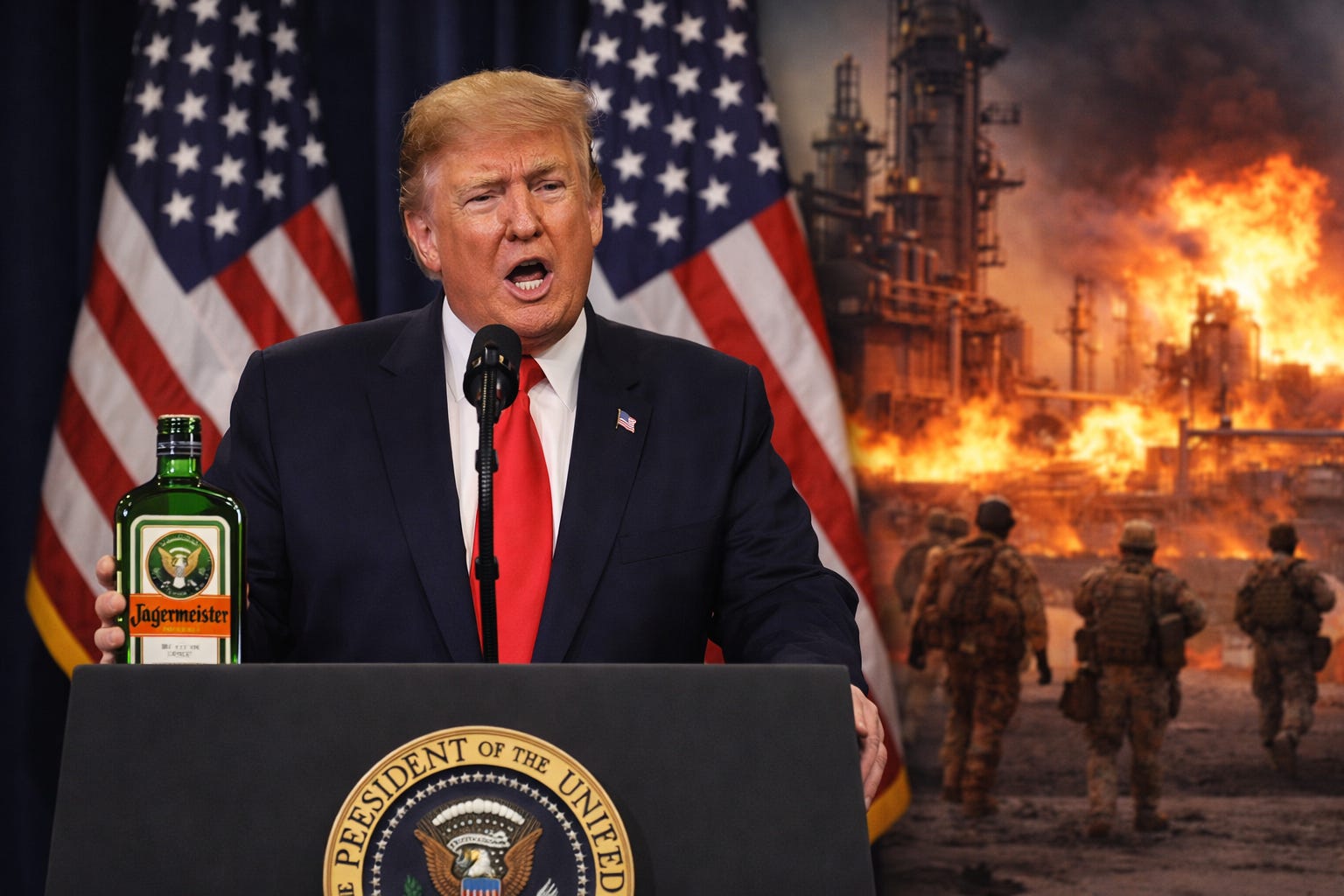
Trump told the nation that the war with Iran was nearing its end. Almost finished.
Almost won.
Almost under control.
The problem was that this supposed endgame came packaged with more weeks of military escalation, no clear exit, no credible political roadmap, and exactly the kind of threat, vagueness, and self-dramatization that markets now seem to read more accurately than many of his supporters do.
The response was immediate. Oil prices surged. Equity markets in the United States, Europe, and Asia fell back. The Associated Press reported on April 2 that U.S. crude had jumped by more than 10 percent while Wall Street posted significant losses. Other outlets described the same basic mechanism: hopes of de-escalation disappeared, and risk premiums flooded right back in.
That is the first lesson of this presidency: Trump does not speak like a statesman trying to clarify events. He speaks like a salesman trying to package uncertainty and move it off the shelf. A president who describes a war as both nearly over and still in need of further force is not offering strategic clarity. He is manufacturing political fog. Markets hate fog when tankers, trade routes, and energy prices are moving inside it.
That is exactly what made the speech so destabilizing. Trump floated the image of a mission nearly complete while offering no serious explanation of how this ends, what success actually looks like, or what the next phase might cost. He tried to project control while signaling continued escalation. Investors heard what political loyalists often refuse to hear: not strength, but instability.
Trump speaks like a man convinced he already has victory in his pocket, when in fact all he is really managing is haze. He sells escalation as an almost completed success story and the mere appearance of nearing an objective as a discount on blood, risk, and legal overreach.
He sells it the way a carnival barker sells Jagermeister spiced with Tabasco like poison with a grin: loud, sticky, and over-seasoned, designed to hit hard before anyone has time to ask what is actually in it. By the time the aftertaste arrives, it burns. That is what a presidency looks like when it rebrands abuse of power as leadership. Anyone who sees through it can feel the revulsion almost physically. His supporters, by contrast, keep mistaking toxicity for strength and may not realize what they have swallowed until it is far too late.
But the deeper problem is larger than Trump himself. Trump is not the entire design flaw. He is the stress test revealing how abuse-friendly the American presidency has become.
For generations, the United States has sold itself—and the world—the story of a beautifully balanced constitutional order. Congress declares war. The president wages it. The courts check excess. That is the ceremonial version. In practice, the executive has held the structural advantage for decades. It moves faster. It commands the machinery. It sets the narrative. It acts through military force, bureaucratic momentum, and the rhetoric of emergency while Congress debates, courts deliberate, and the public is still catching up to what just happened.
That is why talking about abuse of power here is not alarmist rhetoric. It is a sober institutional question. The modern presidency sits on a dangerous combination of military initiative, emergency logic, administrative reach, and political speed. Add to that the gradual normalization of words like emergency, crisis, threat, and exception, and the threshold does not need to be formally broken every time. It only needs to be psychologically lowered.
That is Trump’s real method. He governs not only through action but through atmosphere. Everything is urgent. Everything is historic. Everything is framed as so immediate that restraint itself begins to look like sabotage.
This is not speculation. The architecture is real. The Brennan Center has long pointed out that more than 130 statutory emergency powers may become available once a president declares a national emergency. That is not a technical footnote. It is an arsenal. Anyone who thinks abuse begins only when a president openly tears up the Constitution has misunderstood how executive power works in modern America. Abuse begins much earlier—when urgency becomes pretext, exception becomes routine, and speed becomes a weapon.
It also fits the way Trump synchronizes foreign confrontation with domestic enemy politics. Iran abroad. Immigration at home. Strength outward. Hardness inward. National purpose on one side, loyalty enforcement on the other. None of this is especially original, but it is highly effective. A president who invokes an external enemy and an internal emergency at the same time creates exactly the kind of double-pressure environment in which criticism can be framed as weakness, oversight as obstruction, and opposition as disloyalty.
That does not instantly produce dictatorship. But it does create the dangerous gray zone in which democratic forms remain intact while executive power keeps pushing forward in practice.
And that is the real point: Trump does not need to stay in office longer than the Constitution allows in order to leave lasting damage behind. The 22nd Amendment is clear. No one can be elected president more than twice. But that fact only reassures people who think institutional damage is measured purely in years on a calendar.
The real damage comes earlier—when a president uses the time he has left to create so many personnel, military, legal, and psychological facts on the ground that later correction becomes partial at best. He does not have to become a king in order to govern in a kingly way. He only has to reshape the executive deeply enough that oversight is reduced to after-the-fact damage assessment.
Anyone pointing to Congress, the courts, or the War Powers Resolution as automatic safeguards is confusing the existence of restraints with their timely effectiveness. Yes, the guardrails exist. Yes, the legal frameworks exist. Yes, political resistance exists. But these brakes often engage late, unevenly, and under conditions in which the president has already set the imagery, made the appointments, triggered the machinery, and altered the terrain.
That is what made this speech more than a war address. It was a demonstration of the American presidency in one of its most abuse-friendly forms: not as a disciplined act of statecraft, but as a fusion of theatrical pathos, salesmanship, pressure tactics, and constitutional stretching. Trump did not offer a strategy. He offered a legitimizing narrative—a story designed to make more force, more ambiguity, and more escalation sound like command.
That is not merely unpleasant. It is dangerous. Because rhetoric like this is not only meant to persuade. It is meant to numb.
In the end, the markets reacted more rationally than the political folklore. They ignored the pose and priced the risk. No clear exit. No visible de-escalation. More force promised. Energy routes still vulnerable. More uncertainty. More volatility. More nerves.
That is the truth of the moment. Stocks did not fall and oil did not rise because Trump projected strength. They moved because his speech sounded exactly like what it was: the public packaging of a governing style that produces uncertainty and then tries to sell that uncertainty as leadership.
America does not officially have an emperor. But it does have a presidency that, in the wrong hands, operates close enough to imperial practice that the distinction starts to matter only after the damage is done.
If you also think America does not need an emperor so long as a president can already govern like this, leave your view in the comments. Share this piece with anyone still mistaking Trump’s performance for leadership. And subscribe if you want analysis that stays closer to the mechanics of power than to the public relations wrapped around it.


