


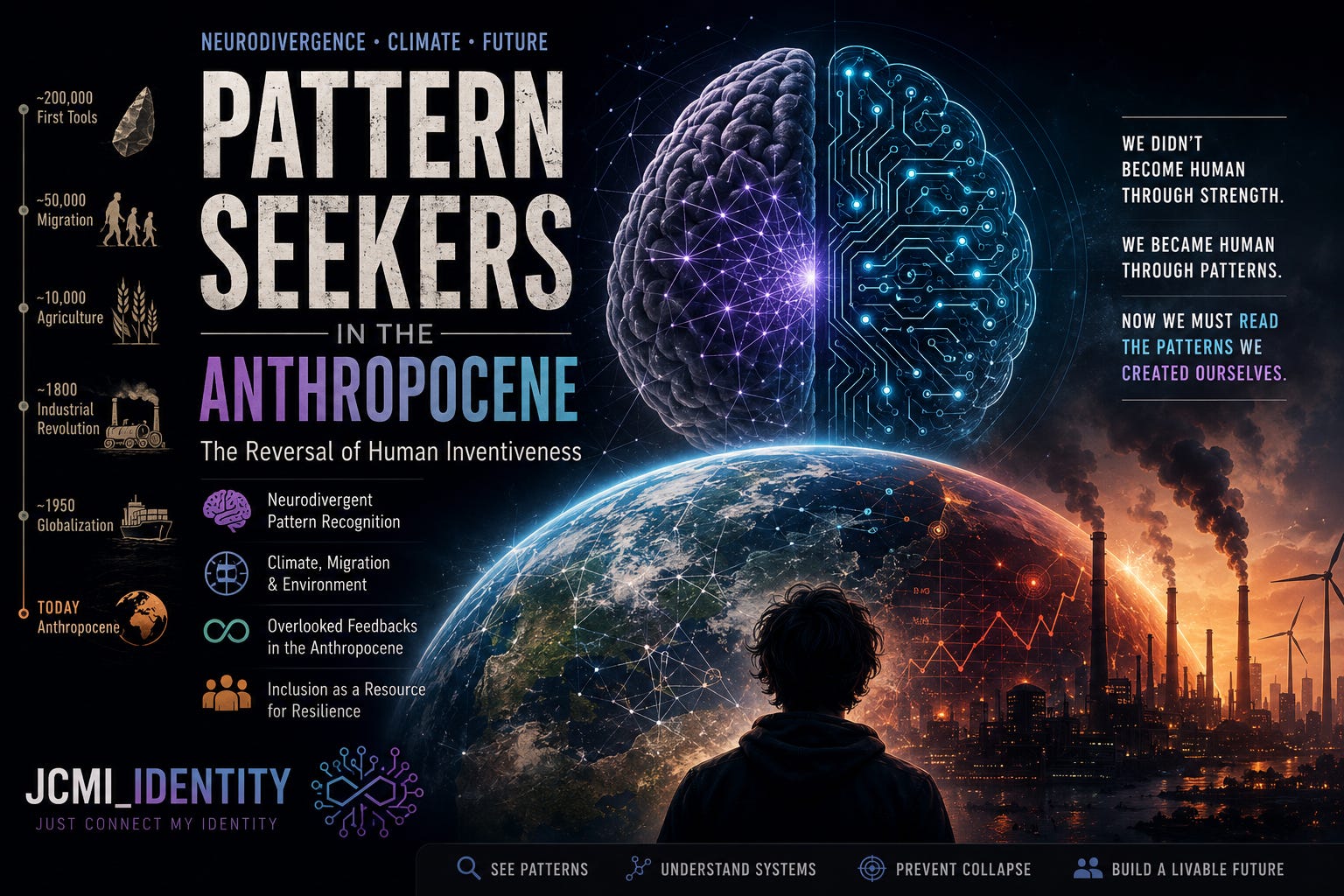
This article is a long-read essay. Use the voiceover like an audiobook. Read the full article text with sources.
1. Not Strength, but Patterns
The human being is not a particularly strong animal. We are not fast, not armed with claws, not especially weatherproof, and not perfectly adapted to one single ecological niche. A wolf smells better, an eagle sees better, a horse runs faster, and a bear has far greater physical strength. Biologically speaking, humans are vulnerable creatures. We get cold, we get hungry, we get injured, we need help, and our children remain dependent for a very long time.
Our true peculiarity lies elsewhere. Humans can recognize patterns, extend them into the future, alter them in imagination, test them in practice, and pass the results on to others. That ability may sound abstract, but it is embedded in nearly everything that makes human culture possible. Someone who infers from a track in the soil where an animal has gone is recognizing a pattern. Someone who reads clouds, wind, and humidity as signs of changing weather is recognizing a pattern. Someone who notices that one kind of stone fractures more sharply than another is recognizing a pattern. Someone who learns from an error and tries a different movement next time is changing a pattern.
From such steps, more than mere experience emerges. Tools emerge, routes emerge, fireplaces, hunting strategies, clothing, shelters, storage techniques, stories, and later machines, science, digital systems, and civilization itself. Humans do not survive because they perfectly inhabit one environment. They survive because they can make environments legible when those environments become difficult.
This is the first key to this essay: human development is not only a story of larger brains, better tools, or growing groups. It is a story of brains that compare states of the world, notice change, simulate possible consequences, and derive action from them. Humans became human not through strength, but through patterns.
2. The If-and-Then Engine
Baron-Cohen’s Pattern-Seeking Thesis
In The Pattern Seekers, Simon Baron-Cohen formulates a thesis that begins precisely here. Human inventiveness, he argues, depends on a systemizing mechanism that identifies and manipulates if-and-then patterns. Not merely: “If this happens, then that follows.” More precisely: “If I change this state, and if I perform this action, then a different result emerges.” In this structure lies the core of technology.
A simple stone is not yet a tool in the full sense. It becomes a tool when a human realizes that it can be used to produce an effect. It becomes a better tool when that human does not merely use what happens to be available, but changes the stone itself. One angle of impact creates a sharper edge than another. One material fractures more predictably. A thin point penetrates better, but breaks more easily. A broader blade lasts longer, but cuts less finely. Even in these seemingly simple observations, technical thought is already present. It is a way of thinking in variables.
Wood is not merely collected. It is bent, hafted, tensioned, burned, hardened. Resin is not merely found. It is heated, combined with fibers, ash, or other substances, and used as an adhesive. A stone point, a wooden shaft, a binding, and a glue form a new system together. The decisive step is not the isolated object, but the connection between things. The human being does not merely recognize a pattern; the human being builds one.
Perception becomes simulation, simulation becomes experiment, and experiment becomes reproducible knowledge [1].
Autism as Systemizing Cognition
Baron-Cohen links this capacity to autism, or more precisely to autistic and autism-adjacent forms of systemizing cognition. His claim does not mean that autism simply equals genius, nor that all inventors are autistic. The stronger idea is more nuanced: autistic people, and people with autism-adjacent cognitive profiles, often show particular strengths in recognizing rule-based systems, details, repetitions, deviations, and cause-and-effect chains. Under certain conditions, such capacities can become culturally and technically valuable [1, 2, 3].
This matters because autism is often described too narrowly in public discourse. The focus is frequently placed on social difficulties, sensory overload, routines, special interests, and differences in communication. All of that can be real, and for many people it is genuinely burdensome. Yet these same traits, seen in another context, can also reveal strengths. A person who does not automatically filter out details may notice deviations. A person who does not experience repetition as boring may stabilize processes. A person who spends long periods immersed in one topic may build knowledge that others would find too laborious to acquire. A person less bound by social convention may sometimes ask questions that others avoid out of habit.
This shifts the perspective on autism. It no longer appears only as a medical deviation from a social norm, but also as part of the neurocognitive diversity from which human culture may have repeatedly drawn its inventive power. This does not mean romanticizing autism. It means refusing to reduce autism to deficits.
3. Where Routines Fail
The Habitable Challenge
Baron-Cohen’s idea needs an ecological extension. The cognitive engine alone does not explain when and why it became evolutionarily powerful. Pattern recognition is not equally valuable in every environment.
In a stable, abundant, and familiar environment, tradition often suffices. If people do what their group has done for generations, they can make it through the year. They know when certain fruits ripen, where water can be found, when animals migrate, and which wood is best for fire. In such a world, deviation is not always an advantage. Too much experimentation may waste energy or create unnecessary risk.
The opposite is also problematic. In a sudden catastrophe, innovation may come too late. If water sources disappear in a short time, food collapses, fires destroy landscapes, or violence and hunger tear apart every form of planning, there may be nothing left but flight, breakdown, or death. Extreme need does not automatically make people inventive. It can narrow thought, divide groups, and destroy the freedom to experiment.
The productive space lies between these extremes. It lies in environments difficult enough to make old routines unreliable, but stable enough for observation, trial, error analysis, and transmission to remain possible. We might call this space a habitable challenge.
It is not paradise that drives development, but an environment attractive enough to remain worth inhabiting, yet demanding enough to make cognitive specialists valuable. Such environments ask questions that habit alone cannot answer. Where is water when the familiar river weakens? Which plants indicate moisture? Which animals move in which rhythm? Which stones fracture into better blades? Which wood stores tension? Which resin only becomes adhesive after heating or mixing with another substance? Which route is dangerous but still possible, and which apparently safe route leads into a dead end?
In such situations, a brain becomes valuable precisely when it does not filter out details too quickly.
Climate, Migration, and Ecological Frontiers
The climate history of Homo sapiens offers exactly such spaces. The dispersal of modern humans was not a single heroic exodus out of Africa. It was a process of openings, retreats, corridors, refuges, humid and dry phases, coastal routes, savanna landscapes, desert margins, and later cold Eurasian frontier zones.
When the Sahara became greener at certain times, new routes opened. When it dried again, groups had to move, retreat, or exploit different resources. When coastlines shifted with sea-level change, food landscapes changed. When animal herds moved differently, humans had to anticipate their movement. Migration was therefore not merely movement from one place to another. It was a chain of decisions under uncertainty.
Research on the ecological niche of Homo sapiens describes our species as remarkably flexible, because humans did not remain confined to one narrow environment. They inhabited forests, savannas, coasts, arid regions, and later cold open landscapes [6, 7]. This flexibility was not merely physical. It was cultural and cognitive. Homo sapiens became a generalist specialist: not specialized for one environment, but specialized in deciphering many environments.
The expression sounds paradoxical, but it captures the point. A generalist specialist is not the best at one single ecological task. Rather, such a being is especially good at analyzing new tasks. It can carry rules from the old world into a new one, but it is not fully bound by them. It sees similarities, but also differences. It does not ask only: “What have we always done?” It also asks: “What is changing here, and what follows from that?”
4. Security Through Competence
The Exploratory Pattern Seeker
This is where neurodivergent pattern recognition becomes evolutionarily interesting. In migrating groups, it was not enough to have people who mediated socially, cared for children, calmed conflicts, or preserved traditions. Groups also needed those who read landscapes differently, noticed small changes, simulated routes in their minds, compared material properties, and tested a solution again and again until it held.
In this context, an autism-adjacent profile would not simply be a social difficulty. It could be a group resource: as a tracker, material tester, tool optimizer, weather observer, route planner, supply thinker, or early warning system.
This challenges a common stereotype of autism. Autism is often associated with rootedness, routine, and resistance to change, but that describes only part of reality. There is also the exploratory pattern seeker: the neurodivergent person who is drawn to adventure, frontier zones, travel, wilderness, and unfamiliar situations not because chaos is pleasant, but because the world there becomes more concrete, more honest, and more systemic.
A difficult landscape may be easier to read than an insincere social situation. Weather, terrain, equipment, energy use, water, route, risk, and retreat form a system that can be analyzed. Security then does not arise from staying still. It arises from competence.
Landscape as a Legible System
Someone who sets out today with a map, GPS, weather forecast, equipment list, and emergency plan is not entirely unlike an early human reading tracks, clouds, plants, animal behavior, and landforms. The tools differ, but the cognitive structure remains similar. One observes, compares, simulates, decides, and checks. One does not merely endure the world, but builds an internal model of it.
For some autistic people, this is precisely what makes travel, hiking, or expeditions attractive. Such experiences are not just “variety.” They are systems of variables that can be prepared for and understood. How much energy do I need? Where is the next safe place? How is the weather changing? What happens if a device fails? Which route is shorter, which is safer, which provides more information? Such questions can be overwhelming, but they can also provide stability because they are concrete.
In an early Homo group, this kind of person could have mattered deeply. Not as a romantic lone hero, but as part of a neurocognitive division of labor. A group does not survive through one single ability, but through a network of abilities. Some people maintain social bonds, others preserve stories, care for the injured, hunt, gather, repair, or recognize patterns in landscape, animal behavior, materials, and weather.
Only when these different forms of cognition are socially embedded does individual observation become cultural knowledge. The pattern seeker may notice that a certain resin binds better after heat. The group turns that observation into a technique by adopting it, remembering it, improving it, and passing it on.
5. When Knowledge No Longer Dies
Cumulative Culture and Critical Density
Here Baron-Cohen’s idea touches research on cumulative culture. Human culture does not merely mean that individuals learn. It means that groups store, vary, and improve knowledge across generations. Research on the origins of cumulative culture emphasizes social learning, group structure, networks, and collective intelligence among hunter-gatherer societies [8].
An invention becomes evolutionarily powerful only when it does not die with the person who made it. One person may discover how a certain adhesive works, but if nobody watches, nobody repeats it, and nobody teaches it to children, it remains a single moment. If the group adopts the procedure, observation becomes technique. If the next generation improves it, technique becomes culture. If several groups exchange similar procedures, an innovation space emerges.
In small, isolated groups, innovation can flare up and disappear. In denser, more connected groups, it can travel, combine, and enable further innovation. This leads to an important point: neurodivergent pattern recognition needs critical density. One systemizing brain can discover an improvement. Several such brains within a group or among neighboring groups can compare variations, reduce errors, specialize knowledge, and stabilize techniques.
From Early Homo Groups to Modern Tech Clusters
This principle may also be visible in modern form: in technology clusters, university environments, engineering regions, AI laboratories, and open-source communities. Such environments attract systemizing people, concentrate them socially and professionally, and make their ways of thinking productive. Baron-Cohen’s research environment has explored this in relation to technology-rich regions such as Eindhoven, where higher reported autism rates among children were found in a strongly technology-oriented region, though the interpretation must remain cautious because diagnosis, education, social selection, and occupational structure all interact [9].
Despite this caution, the analogy is powerful. Certain environments make certain brains more visible and more valuable. An engineering region rewards people who deconstruct systems, optimize them, and reassemble them. An AI lab rewards people who recognize patterns in data, compare models, and search stubbornly for errors. An early frontier landscape rewarded people who could read terrain, animals, materials, and weather as systems. The tools change, but the structure remains related.
6. Archives of Variation
Why Neurodivergent Traits Did Not Become Dominant
This raises the biological question: if autism-adjacent traits could be useful, why did they not simply become dominant? The answer probably lies in costs, thresholds, and intermediate forms.
Evolution does not preserve the diagnosis; it preserves the cognitive building blocks underneath it. Detail focus, systemizing, sensory precision, repetition tolerance, special interests, and causal thinking can be useful in mild to moderate forms, while strong expressions, unfavorable combinations, or additional genetic variants can be associated with isolation, overload, language difficulties, learning disability, or high support needs.
An evolutionarily stable structure would therefore not necessarily preserve the strongest expression, but reproductively viable intermediate forms. This is crucial because it prevents romanticization. Autism-adjacent pattern recognition can be a resource, but severe neurodevelopmental disability is real. Some people need lifelong support. Some cannot live independently. Some suffer intensely from sensory overload, communication demands, or additional intellectual disability. A credible model must see both: the possible cultural benefit and the possible individual cost.
Female Protective Effect, Hormones, and PCOS
This is where the so-called female protective effect enters the picture. Autism is diagnosed more often in boys and men, but this does not mean that autism-related predisposition is simply male. Studies support the idea that, on average, females may carry a higher autism-related genetic load before a clinical diagnosis becomes visible. Siblings of autistic girls or women show an increased likelihood of autism, and mothers may carry more common inherited risk variants than fathers [10].
Females may therefore partially buffer, mask, or differently express autism-related variation. This is a bold hypothesis, not a settled fact; but it opens a view of female bodies not merely as sites of reproduction, but as possible archives of neurocognitive variation.
Baron-Cohen’s research on prenatal sex steroids fits into this picture. Hormones are not simple causes; they are developmental regulators. They influence which genetic programs act more strongly or weakly during particular developmental windows. Baron-Cohen’s research group has studied not only testosterone, but a broader pattern of prenatal sex steroids, including estrogens, and has discussed links between elevated prenatal steroid levels and autistic traits [11].
A visible marker of this axis may be PCOS, polycystic ovary syndrome. PCOS is not relevant because it simply “causes” autism. It is relevant because it connects hormone environment, metabolism, fertility, and female developmental biology to the question of how neurodivergent traits remain present across generations. Baron-Cohen’s team found several notable associations in British health records: autistic women had PCOS more often, women with PCOS had autism more often, and mothers with PCOS had an increased likelihood of having an autistic child [12]. Meta-analyses also support an association between maternal PCOS and an increased likelihood of neurodevelopmental diagnoses in children, though this is not determinism but statistical risk [13].
PCOS also reveals the ambiguity. If a hormonal axis can contribute to neurodivergent development, but in stronger forms can also impair fertility, then biological transmission cannot run primarily through maximal forms. It runs through transitional zones in which neurodivergent cognitive building blocks, social bonding capacity, and reproductive possibility still occur together. Without reproduction there is no biological development; without neurocognitive variation there is no cultural adaptation to new problems. Evolution does not work with purity. It works with tensions.
The Drive for Fit Rather Than the Drive for Reproduction
Partner choice also belongs in this model. Similarity magnetizes. Neurodivergent people often recognize one another not through superficial social codes, but through resonance, depth, directness, special interests, similar perception, or a shared discomfort with social theater.
This does not mean that autistic lines spread through maximum sexual dispersion. On the contrary: many autistic people do not seek as many partners as possible, but rather resonance, reliability, safety, depth, or a very specific form of desire. This narrows the reproductive pathway, but may also concentrate it. In neurodivergent lines, the decisive filter may be less the drive to reproduce than the drive for fit.
That makes the evolutionary dynamic more plausible. Neurodivergent traits do not need to spread massively and indiscriminately in order to persist. It may be enough that they recur in certain families, milieus, and ecological contexts, as long as they remain reproductive in milder or buffered forms and become advantageous in suitable environments.
7. The Reversal
When Climate Shaped Culture
A layered model now emerges. Baron-Cohen describes the cognitive engine of human invention: if-and-then patterns, systemizing, experiment, and repetition. The ecological extension asks about the stage on which this engine was needed: habitable frontier environments, climate fluctuations, migration, new raw materials, new animals, new routes, and new risks. The biological extension asks about the storage mechanism: female protective factors, prenatal hormones, PCOS-related axes, polygenic thresholds, and reproductively viable intermediate forms. The social extension asks about amplification: critical density, cumulative culture, group intelligence, and partner choice through resonance.
In the past, climate changed, and Homo groups had to recognize patterns in order to find new paths, tools, and habitats. The environment asked questions, and human culture developed answers. A river did not dry up because humans had caused it to dry up. It dried because rainfall, temperatures, and landscapes changed. Humans had to respond. They had to read what was happening and find ways to live with that change.
When Culture Shapes Climate
Today, Homo sapiens changes the climate itself, and humanity must recognize patterns in order to stop its own acceleration machine. The climate crisis is not merely an environmental problem. It is a systems problem. It consists of energy, agriculture, transport, industry, capital, law, infrastructure, geopolitical competition, disinformation, psychological denial, and technological inertia. It is a vast if-and-then system whose consequences are already visible, while many societies still behave as though the old routines can continue.
This is the great reversal. In the past, climate shaped culture. Today, culture shapes climate. In the past, humans had to change their tools because the environment changed. Today, humans must change their tools, markets, laws, and infrastructures because they themselves have become a cause of environmental transformation.
8. The Overlooked Metapattern
Local If-and-Then Successes, Global Feedbacks
The problem of the Anthropocene is not that humans cannot recognize patterns. The problem is that humans have perfected local patterns without recognizing their global feedbacks in time.
The early pattern seeker asked: If I strike this stone differently, will I get a better blade? The industrial pattern seeker asked: If I burn coal, will the machine run? The pattern seeker of today must ask: If billions of local if-and-then successes are globally connected, what Earth-system pattern emerges?
This is the modern paradox. Burning coal was a success locally. Steam engines, factories, railways, electrification, steel, chemistry, combustion engines, global supply chains, and digital infrastructure followed the same logic: if we make energy more densely available, we can accelerate work. This logic was not stupid. In a narrow technical sense, it worked. It worked so well that it changed the Earth system itself.
At this point, humanity did not fail because it lacked systemizing. It failed because its systemizing remained too narrow. It mastered the individual if-and-then pattern, but overlooked the metapattern. This is a crucial distinction. A machine can function brilliantly and still be part of a destructive total system. A supply chain can be efficient and still hide ecological costs. A market can grow and still consume the foundations of life. A technology can solve a local problem and produce new problems globally.
The metapattern is the level at which individual successes are interconnected. In everyday life, this level easily becomes invisible. Whoever buys a product does not see the entire supply chain. Whoever uses electricity does not always see the energy source. Whoever drives a car does not see the sum of all emissions. Whoever optimizes a system often optimizes only the segment for which they are paid. The Anthropocene is therefore not only the age of climate change. It is also the age of overlooked feedbacks.
Industrialization as a Threshold
The IPCC now states unmistakably that human activities, primarily greenhouse gas emissions, have caused the warming of atmosphere, ocean, and land, while extreme weather events and risks to food, water, health, infrastructure, and ecosystems increase [14]. Humanity has entered a new evolutionary situation.
The Industrial Revolution marks a threshold in this regard. It did not arise from mere convenience, but from a web of energy demand, resource shifts, urbanization, technology, market integration, and social pressure. Coal played a central role in European industrialization; cities near coalfields grew particularly strongly from the late eighteenth century onward [15]. At the same time, studies of industrial soot and Alpine glaciers show that industrial emissions already interfered with snow and ice processes in the nineteenth century, as black carbon reduced albedo and may have accelerated glacier retreat [16].
Since industrialization, climate no longer only shapes culture. Culture shapes climate. The inventive power that once helped Homo sapiens open up new habitats became powerful enough to alter the planet itself.
This is the tragic symmetry of the Anthropocene. The ability that freed us from ecological narrowness now creates a new kind of global narrowness. We have created tools, markets, machines, algorithms, states, and infrastructures that act faster than our political and emotional correction mechanisms. The pattern seekers of the present therefore face an inverted task. In the past, they had to show how to live with climate change. Today, they must help show how to slow human-made climate change before adaptation alone is no longer enough.
9. Not Saviors, but Early Warning Systems
Neurodivergence as a Resource for Resilience
This is where neurodivergent people may again have a particular role to play, not as saviors and not as morally superior humans, but as system readers. The climate crisis does not reward social smoothness. It rewards the ability to recognize chain reactions, take numbers seriously, dismantle perverse incentives, expose greenwashing, assess technological solutions realistically, and treat the future not as a mood but as a model.
Autistic directness can be uncomfortable when societies want to reassure themselves. Yet precisely that discomfort can become vital. A person who recognizes a collapsing supply chain, a non-resilient city, an overburdened health system, or a political self-deception early fulfills the same function as the pattern reader at the edge of a drying landscape.
This does not mean that autistic people are automatically right. Neurodivergent people, too, can be mistaken, become fixated, focus too narrowly, or underestimate social effects. Yet a society that treats systematic perception of deviation as a disorder by default loses an important early warning system. It hears the warning only when it has already become acceptable to the majority; by then, it is often late.
Why System Analysis Needs Social Translation
Nor does this mean that autistic people alone can save humanity. No minority should be burdened with a civilizational rescue fantasy. Neurodivergent analysis needs social translation, political power, institutional implementation, emotional mediation, and collective action. The pattern seeker may see the pattern, but the group must be willing to take the pattern seriously.
Just as in early Homo groups, survival is not secured by one brain alone, but by embedding different brains in a collective capable of action. One person may recognize the risk. Another can tell the story. A third can organize. A fourth can mediate. An institution can implement. A culture can turn it into a new norm.
This has a political consequence. Inclusion is not only kindness toward people who function differently. Inclusion can also mean that a society expands its own organs of perception. Neurodiversity is then not merely a social issue. It is an issue of resilience.
10. The Pattern Readers of the Future
Perhaps this is the real lesson. A society that treats neurodivergent people only as a problem of adaptation wastes part of its own survival intelligence. It demands social smoothness where it needs systemic clarity. It punishes directness where it needs early warning. It pathologizes detailed perception where it needs error analysis. It ignores those who see patterns before others are emotionally ready to accept them.
If neurodiversity was evolutionarily a response to difficult but habitable challenges, then in the Anthropocene it is not a marginal issue of inclusion. It is a question of civilizational resilience. This is not about glorifying autism or turning autistic people into heroic figures. It is about recognizing an old human resource: the ability to see patterns where habit conceals them.
Humans became human not through strength, but through patterns. They survived by reading environments before those environments overwhelmed them. Now humans must read their own environmental impact before it overtakes them. In this reversal lies the urgency of our time: the pattern readers who once helped open new worlds may now help keep the old world habitable.
Sources
[1] Simon Baron-Cohen: The Pattern Seekers: How Autism Drives Human Invention. Basic Books, New York, 2020. ISBN: 978-1541647145.
[2] Simon Baron-Cohen: Autism: The Empathizing-Systemizing (E-S) Theory. Annals of the New York Academy of Sciences, 2009, 1156(1), pp. 68–80. DOI: 10.1111/j.1749-6632.2009.04467.x.
[3] Simon Baron-Cohen, Sally Wheelwright, Richard Skinner, Joanne Martin, Emma Clubley: The Autism-Spectrum Quotient (AQ): Evidence from Asperger Syndrome/High-Functioning Autism, Males and Females, Scientists and Mathematicians. Journal of Autism and Developmental Disorders, 2001, 31, pp. 5–17. DOI: 10.1023/A:1005653411471.
[4] Simon Baron-Cohen, Sally Wheelwright, Nigel Goldenfeld, Joe Delaney, Debra Fine, Richard Smith, Leonora Weil, Anna Wakabayashi: The Systemizing Quotient: An Investigation of Adults with Asperger Syndrome or High-Functioning Autism, and Normal Sex Differences. Philosophical Transactions of the Royal Society B, 2003, 358(1430), pp. 361–374. DOI: 10.1098/rstb.2002.1206.
[5] Grace Browne: Did invention make us human? Wired, 2021. Article on Baron-Cohen’s pattern-seeking thesis and the debate around human inventiveness.
[6] Patrick Roberts, Brian A. Stewart: Defining the “generalist specialist” niche for Pleistocene Homo sapiens. Nature Human Behaviour, 2018, 2, pp. 542–550. DOI: 10.1038/s41562-018-0394-4.
[7] Eleanor M. L. Scerri et al.: Major expansion in the human niche preceded out of Africa dispersal. Nature, 2025. DOI: 10.1038/s41586-025-09154-0.
[8] Andrea B. Migliano, Lucio Vinicius, Abigail Page, Nikhil Chaudhary, Mark Dyble, Rodolph Schlaepfer, Daniel Smith, Leonora Astete, Jerome Lewis, Ruth Mace: The origins of human cumulative culture: from the foraging niche to collective intelligence. Philosophical Transactions of the Royal Society B, 2022, 377:20200317. DOI: 10.1098/rstb.2020.0317.
[9] Martine T. Roelfsema, Rosa Hoekstra, Carrie Allison, Sarah Wheelwright, Fiona E. Matthews, Carol Brayne, Simon Baron-Cohen: Are Autism Spectrum Conditions More Prevalent in an Information-Technology Region? A School-Based Study of Three Regions in the Netherlands. Journal of Autism and Developmental Disorders, 2012, 42, pp. 734–739. DOI: 10.1007/s10803-011-1302-1.
[10] Emily M. Wigdor et al.: The female protective effect against autism spectrum disorder. Cell Genomics, 2022, 2(9):100134. DOI: 10.1016/j.xgen.2022.100134.
[11] Alexa Pohl, David J. P. Barker, Rupert A. Russell, Bonnie Auyeung, Simon Baron-Cohen et al.: Foetal oestrogens and autism. Molecular Psychiatry, 2019, 25, pp. 2970–2978. DOI: 10.1038/s41380-019-0454-9.
[12] Perrin Cherskov, Carrie Allison, Bonnie Auyeung, Simon Baron-Cohen et al.: Polycystic ovary syndrome and autism: A test of the prenatal sex steroid theory. Translational Psychiatry, 2018, 8:136. DOI: 10.1038/s41398-018-0186-7.
[13] Chen et al.: A systematic review and meta-analysis of the association between maternal polycystic ovary syndrome and neuropsychiatric disorders in children. Translational Psychiatry, 2021, 11:569. DOI: 10.1038/s41398-021-01699-8.
[14] Intergovernmental Panel on Climate Change: Climate Change 2023: Synthesis Report. Summary for Policymakers. IPCC, Geneva, 2023.
[15] Alan Fernihough, Kevin H. O’Rourke: Coal and the European Industrial Revolution. The Economic Journal, 2021, 131(635), pp. 1135–1149. DOI: 10.1093/ej/ueaa117.
[16] Thomas H. Painter et al.: End of the Little Ice Age in the Alps forced by industrial black carbon. Proceedings of the National Academy of Sciences, 2013, 110(38), pp. 15216–15221. DOI: 10.1073/pnas.1302570110.