
European Decision Systems Under Conditions of Structural Delay
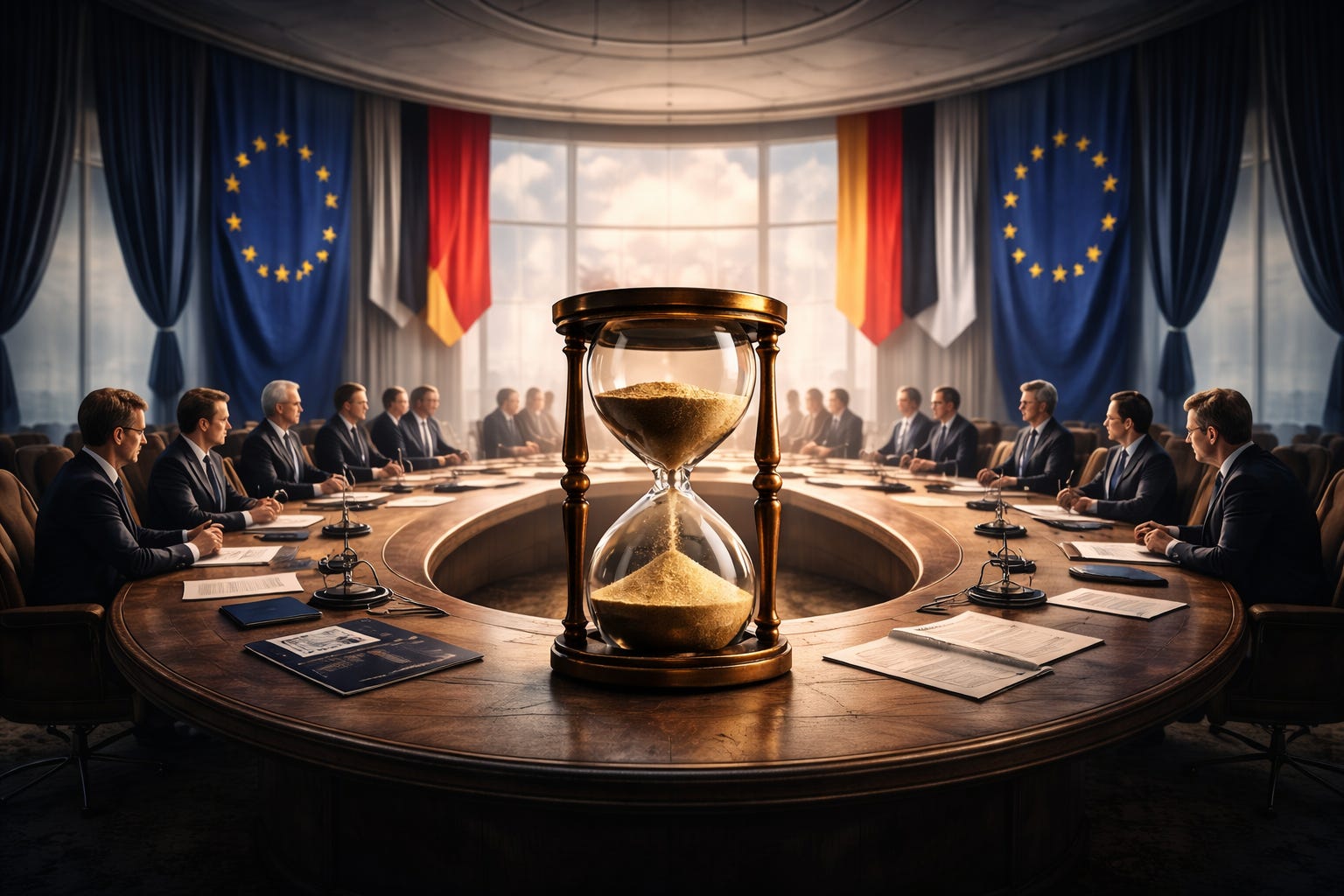
One of the most striking features of current European politics is not ignorance of risk.
It is the paradox of acknowledged danger combined with persistent inaction.
Warnings are issued early.
Threat assessments are comprehensive.
Scenarios are simulated, documented, and repeatedly updated.
And yet, concrete consequences often fail to follow.
This gap is not accidental. It is systemic.
⸻
The Illusion of Rational Delay
European political culture has internalized a deeply rational assumption:
that time is available, and that postponement increases decision quality.
In stable environments, this assumption is correct.
Deliberation reduces error. Consensus increases legitimacy. Gradualism limits unintended effects.
However, this logic presupposes two conditions:
1. That external actors are bound by comparable temporal constraints
2. That the cost of waiting remains lower than the cost of acting early
Both assumptions are increasingly false.
⸻
Consensus as a Structural Time Filter
The European Union is built on a decision architecture designed to prevent domination, conflict escalation, and unilateralism. Unanimity requirements, multi-layered coordination, and extensive consultation processes are not bugs — they are historical safeguards.
But safeguards have side effects.
In high-speed crisis environments, unanimity does not merely slow decisions. It filters them. Only measures that survive the longest internal negotiation processes reach implementation. What disappears along the way are early, preventive, and structurally uncomfortable actions.
As a result, Europe tends to act:
• late rather than early
• reactively rather than anticipatorily
• symbolically rather than structurally
This does not stem from political weakness.
It stems from procedural design optimized for stability, not acceleration.
⸻
Economic Interests as a Secondary Time Constraint
A second, less visible filter operates alongside formal decision rules: economic impact assessment.
European policymaking has long integrated economic stakeholders into its deliberative process. This integration has ensured social peace, industrial continuity, and export strength. It has also created a culture in which short-term economic disruption is treated as a primary political risk.
Under conditions of slow-moving change, this prioritization makes sense.
Under conditions of compressed lead times, it becomes problematic.
Risks that do not yet manifest as immediate economic damage tend to be deprioritized — even if their long-term consequences are severe. Preventive action appears politically costly, while inaction remains economically comfortable — for now.
Thus, many risks are acknowledged, documented, and rhetorically addressed, yet remain politically non-binding.
⸻
The Cultural Weight of Legalism
A further stabilizing — and delaying — factor lies in Europe’s relationship with law.
European political legitimacy is deeply rooted in legal correctness. Decisions are expected to withstand judicial scrutiny, constitutional review, and procedural challenge. This commitment has protected democratic order for decades.
Yet it also creates a specific reflex:
action is often postponed until legal certainty is absolute.
In fast-moving strategic environments, this reflex can invert its purpose. Law becomes a brake rather than a shield. Waiting for definitive rulings, complete frameworks, or final clarifications may ensure formal correctness — but at the cost of strategic relevance.
When action finally occurs, the window for meaningful impact may already have closed.
⸻
Talking as a Substitute for Acting
From the outside, European politics appears highly active.
Meetings, summits, joint statements, coordination rounds, public communication — all signal engagement.
This activity is real. But much of it operates on the level of external visibility, not internal transformation.
The danger lies in mistaking process intensity for effectiveness.
When political systems invest heavily in coordination without parallel implementation capacity, action becomes performative. The system appears busy, responsive, and engaged — while underlying vulnerabilities remain unchanged.
⸻
Why This Pattern Persists
The persistence of this pattern does not indicate failure of individual actors. It reflects a deeper structural mismatch between decision architectures shaped by past stability and a present defined by accelerated disruption.
European systems were designed to prevent sudden shifts, unilateral moves, and unchecked power. They excel at moderation.
They struggle with environments in which:
• others act without consensus
• facts are created faster than they can be processed
• delay itself becomes a strategic liability
⸻
The Core Insight of This Section
Europe does not lack knowledge.
It does not lack values.
It does not lack political effort.
What it increasingly lacks is temporal alignment between risk recognition and effective action.
As long as known risks remain trapped in procedural loops, they remain politically manageable — until they suddenly are not.
The consequence is not immediate collapse.
It is gradual loss of agency.
⸻
Transition to Part 3
If known risks fail to trigger action, the usual response is to emphasize preparedness: plans, strategies, reserves, frameworks.
But preparedness alone does not equal resilience.
Part 3 therefore examines the crucial distinction between being prepared and being able to act in time — and why systems that rely primarily on reactive activation often discover their limits only when it is already too late.


Here is the path forward to part 3: https://open.substack.com/pub/jcmi2025/p/part-3-preparedness-without-initiative?r=6kxrle&utm_medium=ios&shareImageVariant=overlay
Here is the path back to part 1: https://open.substack.com/pub/jcmi2025/p/when-political-effectiveness-requires?r=6kxrle&utm_medium=ios&shareImageVariant=overlay