


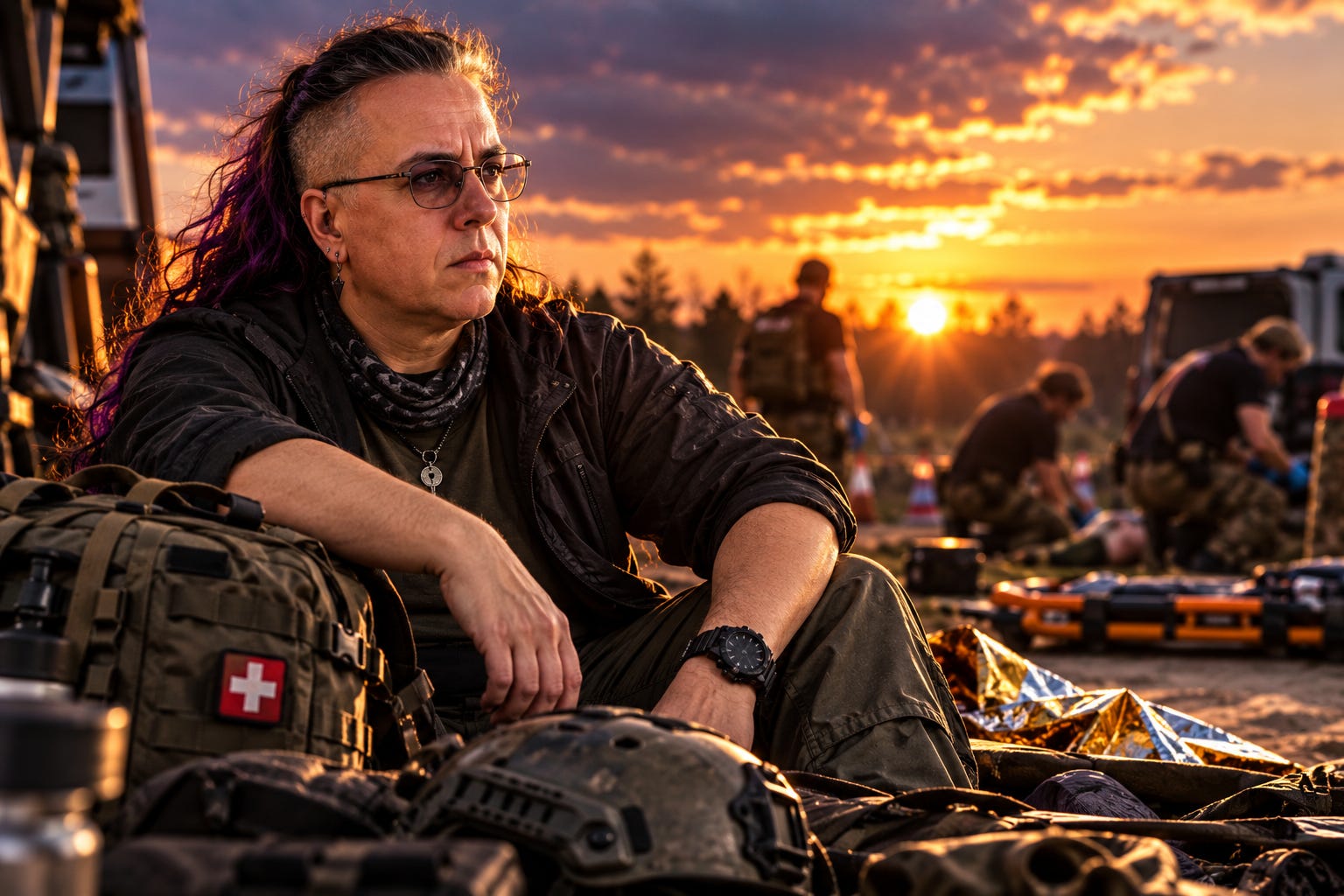
The TECC Provider course pushed me, as expected, right up to — and beyond — my actual limits
A few weeks before the course, after travelling through Romania with my wife in April, I had decided to add a rooftop tent to my travel setup.
The reasons for that are in another article on my Substack.
Getting that rooftop tent onto my Jeep Compass required considerably more physical effort than I had planned. Somewhere in the process, I strained one or more muscles around my hip — something I only properly noticed the following day.
The pain stayed with me for weeks until I finally reached a long-planned appointment with my orthopaedic specialist.
He examined me and, pretty much as part of his usual routine, injected cortisone into the muscle that seemed to be most affected.
Did it help?
For about two days.
He told me it might take another two weeks before the pain disappeared.
Hmm.
Sorry — whaaaat?
I had already been dealing with this for weeks. I carry a lot of body weight, I was badly out of shape, and I had just been trying to manoeuvre roughly 50 kilograms of rooftop tent.
Shortly before the TECC Provider course started, the pain had finally improved enough that I was able to set up the rooftop tent on the Friday before the course with only minor limitations.
Even then, I already suspected what was coming.
This course is going to be brutal.
And my not-quite-healed muscle injury probably wasn’t going to forgive me for it.
It didn’t.
The Course
Interestingly enough, my back held up.
My existing disc problems did not become the main issue, even though I put quite a lot of stress on my spine.
My abdominal-wall hernia also held up — and still does.
But because I had not been able, and in some cases had not been allowed, to properly train my back and abdominal muscles beforehand, many of the movements and loads during the course were genuinely difficult and extremely exhausting.
And I definitely wasn’t the only one sweating like hell.
The instructors deliberately pushed us into significant physical stress.
At one point, my heart rate reached around 170 beats per minute.
That was not an accident.
The whole point was to learn how to perform practical medical tasks while the body and brain were already under pressure — to make the training resemble the conditions we might actually encounter in a real emergency.
At one point, I carried a colleague on my back.
He weighed around 100 kilograms.
At another point, a casualty actor who probably weighed around 50 kilograms had to be lifted and carried to safety by a colleague and me.
Fifty kilograms may not sound too terrible until the person is sweaty, covered in fake blood and suddenly has roughly the handling characteristics of an eel with arms and legs.
And somewhere during all of this, the muscle injury that had not fully healed decided to announce itself again.
More and more.
By the end of the course, I was in so much pain that I could barely move at anything resembling normal speed.
But I had my certificate in my hands.
My TECC Provider patch was attached to the Velcro panel on my sling bag.
I had made it.
Then I Still Had to Drive Home
The drive from Lübeck back to Hamburg was where things became genuinely dangerous.
I had serious difficulty lifting my right leg far enough to move my foot from the accelerator to the brake.
I was exhausted, mentally and physically, and so badly affected by the combination of pain, fatigue and physical overload that I had effectively become a risk in road traffic.
I made it home without damaging either metal or flesh.
But once the ordinary post-course muscle soreness faded after about two days, the real problem remained.
The muscle strain.
The cramping.
And the irritated sciatic nerve.
One week after the course, the pain in my right side was still so severe that walking even ten metres had become difficult.
It barely mattered how I sat or lay down.
It hurt.
At that point, I could not even realistically have driven myself to a doctor.
There were one or two exercises that slowly started helping.
Very, very slowly.
Do I Blame the Instructors?
No.
Quite the opposite.
The instructors actually had a pretty good understanding of where my physical limits were.
They reduced the load where that made medical sense.
When my Garmin Instinct suddenly issued a high-heart-rate warning while I was sitting down, for example, they immediately became concerned and asked whether I was okay.
I told them what my pulse was and said it would come back down again shortly.
At the same time, they still required me to do enough to experience the physical stress that would realistically be expected in the situations the course was preparing us for.
That was, after all, the point.
The objective was not merely to understand the theory or perform comfortable dry drills.
It was to take what we had learned and still be able to apply it under extreme stress.
And it was also about discovering where our actual limits were rather than where we imagined those limits to be.
About going beyond the boundary you had mentally drawn for yourself.
I probably went a little further than I should have.
I had arrived the evening before and slept nearby in my rooftop tent.
That meant I got only around four hours of sleep on each of the two nights.
With my body weight, my poor to practically non-existent fitness, the acute muscle injury and the chronic damage my body already carried, I only just managed to complete the course.
But I did.
And I passed the assessments.
Anyone who has completed a TECC Provider course probably knows what I mean.
If you are neither a good athlete nor someone who already has a solid paramedic or emergency-medical background, this is not an easy course.
The bar is high.
Meine Gesundheit nach dem TECC-Provider Kurs.pdf
Several Months Later
Several months have now passed since that course in the summer.
And for much of that time, my body has been making the decisions for me.
It has essentially ordered me to stop moving.
Not completely, of course.
Real life rarely allows that.
But enough that travelling, carrying equipment and doing many of the things I would normally do became either impossible or a very bad idea.
My muscles needed time to heal, and apparently my body was quite prepared to enforce that recovery period whether I liked it or not.
Unfortunately, everyday life does not care very much about recovery plans.
At one point, I still had to get a portable air-conditioning unit weighing more than 30 kilograms up a flight of stairs.
More recently, I had to do something similar with a 23-kilogram refrigerator.
Both were relatively short bursts of effort.
Both were necessary.
And both set the healing process back again.
That became one of the more frustrating lessons of the months after TECC:
recovery is not linear.
You can spend weeks slowly improving, make one stupidly demanding movement because something simply has to be moved, and suddenly find yourself several steps further back again.
So despite all my plans, despite the Jeep, despite the rooftop tent and despite having built myself a setup that normally gives me an enormous amount of freedom, I have not really been able to travel again since the course.
For months, my body kept me close to home.
And now, just as travelling is slowly beginning to feel physically realistic again, another limitation has taken over.
Fuel prices.
They have gone through the roof.
So even if my body is finally beginning to release me from its involuntary grounding, the cost of actually driving any meaningful distance is now doing almost the same job.
There is a certain irony in that.
First, my body effectively tied me to the house because it needed months to repair itself.
Now that I am slowly becoming physically capable of travelling again, I can look at the prices at the petrol station and discover that, for completely different reasons, I am still effectively tied to the house.
Two entirely different kinds of immobility.
One biological.
One economic.
What the TECC Provider Course Really Taught Me
Above all, the TECC Provider course showed me one thing:
My limits were not smaller than I had thought. They were considerably larger.
But there is an important difference between discovering that you can cross a limit and believing that crossing it comes without consequences.
It doesn’t.
I paid for that lesson with muscle injuries, sciatic pain and months in which my body repeatedly reminded me that surviving a physical challenge and recovering from it are two very different things.
For a while, even walking ten metres was a challenge.
Months later, I am still dealing with the consequences.
Do I regret taking the course?
Not for a second.
Would I take the TECC Provider course again?
Absolutely.
But next time I would approach it differently.
Better physical preparation.
More muscular training where medically possible.
More sleep beforehand.
And considerably more respect for the cumulative load.
Because the most important lesson was not that my body was incapable of doing it.
Quite the opposite.
My body proved that it could do far more than I had expected.
The lesson was that every reserve you use eventually has to be replenished.
And sometimes the bill arrives later.
So, After All This Talking, I Still Have Two Questions
A: Does anyone know a genuinely competent orthopaedic specialist in or around Hamburg who does more than tell patients that everything will probably be fine in another two weeks, that one cortisone injection should sort it out, and that they should simply avoid physical strain?
B: What exercises are actually suitable for people weighing more than 130 kilograms who cannot simply get down onto the floor and back up again, and which can realistically help despite existing disc damage and an abdominal-wall hernia?
I would genuinely appreciate useful experiences and recommendations in the comments.