
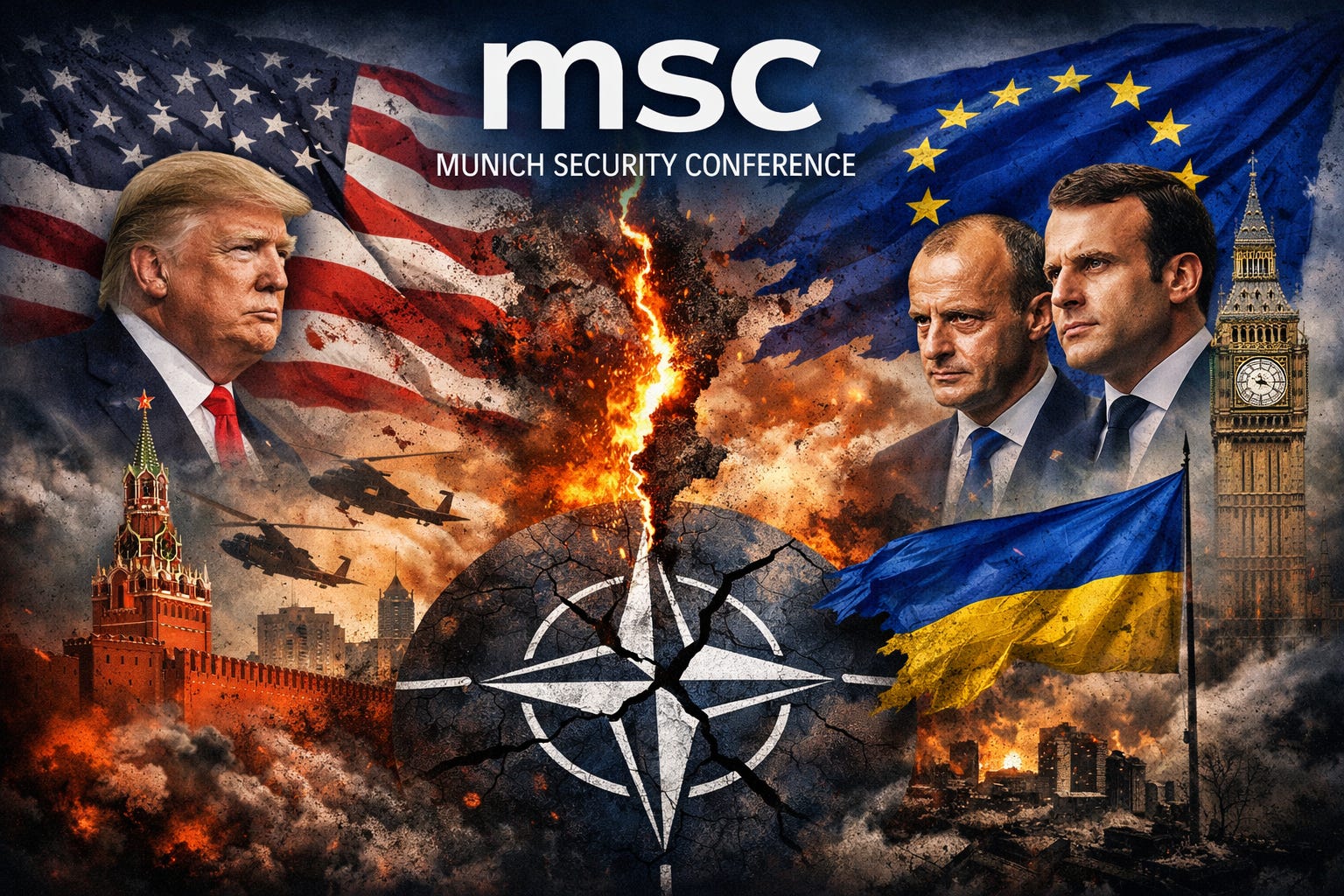
MSC 2026 – Is the Rift Between Europe and the United States Deepening? Is the EU or NATO Breaking?
The Munich Security Conference 2026 was not a scandal, it was not a dramatic rupture.
It was something more consequential: a moment of disclosure.
What had long been hidden behind diplomatic language was articulated more openly this year. The transatlantic structure is shifting. Not loudly. Not explosively. But structurally.
The key question is therefore not:
“Is the West breaking apart?”
It is:
In which direction is its power architecture evolving?
1. The West No Longer Thinks in Identical Terms
U.S. Secretary of State Marco Rubio framed the shift with unusual clarity: national interests must no longer be subordinated to global order.
This is not a withdrawal from NATO, it is a reprioritization.
For decades, institutions legitimized power.
Now, power increasingly defines institutions.
The United States is not abandoning Europe — but it is redefining the conditions of engagement. Europe is expected to assume primary responsibility for its own conventional defense. Rapidly. Substantially. Permanently.
This demand is not merely fiscal. It is strategic.
Washington’s long-term focus is shifting toward Asia. Europe is becoming a secondary theater.
2. Europe Responds – But Not Uniformly
German Chancellor Friedrich Merz openly accepts the return of power politics. His approach is clear: strengthen Europe within NATO, reinforce the alliance, maintain the United States as anchor.
French President Emmanuel Macron moves further. For him, strategic autonomy is not a complement to NATO, but an insurance policy against potential U.S. unpredictability.
UK Prime Minister Keir Starmer positions Britain as a military integrator: hard power is “the currency of our time,” higher defense spending is inevitable, nuclear coordination with France should deepen, and post-Brexit economic rapprochement with the EU is back on the table.
European Commission President Ursula von der Leyen goes even further structurally: €800 billion mobilization capacity, €90 billion Ukraine financing, investment in strategic enablers such as space and intelligence, dual-use industrial integration, qualified majority decision-making instead of unanimity.
This is not crisis management, it is structural transformation.
3. Is NATO Breaking?
No.
But it is becoming more European.
The United States remains indispensable in critical areas:
Satellite intelligence
Strategic airlift and logistics
Missile defense
Nuclear deterrence
Europe cannot replicate these capacities in the short term.
What is changing is not the alliance’s existence, but the automaticity of U.S. leadership.
NATO is shifting toward a more explicit division of labor:
Europe assumes the primary conventional burden in its eastern theater.
The United States provides the strategic umbrella.
This is not dissolution, it is recalibration.
4. Is the European Union Fracturing?
Again: no.
But it is undergoing securitization.
Defense is becoming industrial policy.
Security is becoming economic strategy.
Dual-use technology links civilian and military value chains.
Trade, energy, raw materials, digital infrastructure, financial flows — all are increasingly framed through a security lens.
This represents a quiet revolution.
The strain is not institutional collapse, but structural pressure:
Rising defense expenditure
Increased public debt
Industrial restructuring
Political polarization
The central question is therefore economic and societal:
Can European societies sustain the speed and scale of this transformation?
5. Ukraine as Catalyst
Ukraine is not the core of this transformation — it is the accelerator.
The United States increasingly operates within domestic political time horizons.
Europe thinks in long-term security horizons.
If Washington seeks faster conflict resolution while Europe prioritizes sustained deterrence, friction emerges — not necessarily from betrayal, but from divergent priorities.
The decisive variable is straightforward:
Can Europe credibly compensate for any reduction in U.S. operational support?
If not, structural vulnerability increases.
6. Geoeconomic Consequences
The systemic implications are already visible:
Defense spending will remain structurally elevated.
European defense and high-tech industries will consolidate.
Supply chains will regionalize further.
Energy and raw materials policy will remain strategic assets.
Capital markets will increasingly price in long-term security expenditure.
For Germany, this is particularly consequential:
The federal budget will remain structurally burdened.
Automotive, machinery, and aerospace sectors will integrate deeper into dual-use supply chains.
Infrastructure will become security-critical.
Political polarization over defense spending will intensify.
Germany is not peripheral to this transformation, it is central to it.
7. Most Probable Outlook (2026–2028)
The baseline scenario:
NATO remains intact but more European in operational weight.
The EU expands defense capabilities substantially.
Transatlantic relations remain functional but less ideologically aligned.
Ukraine continues receiving support under growing fiscal and political pressure.
Defense and industrial policy merge structurally across Europe.
No abrupt rupture.
But a long-term redistribution of responsibility.
8. The Core Assessment
MSC 2026 was not a moment of collapse.
It was a moment of clarity.
The West remains allied, but no longer by default.
Europe is being compelled to assume responsibility — militarily, economically, technologically.
Whether this leads to stabilization or overstretch will not be decided in conference halls, but in budgets, industrial capacity, and political consent.
The rift is not yet a fracture.
But the stress test has begun and it will not end quickly!


