
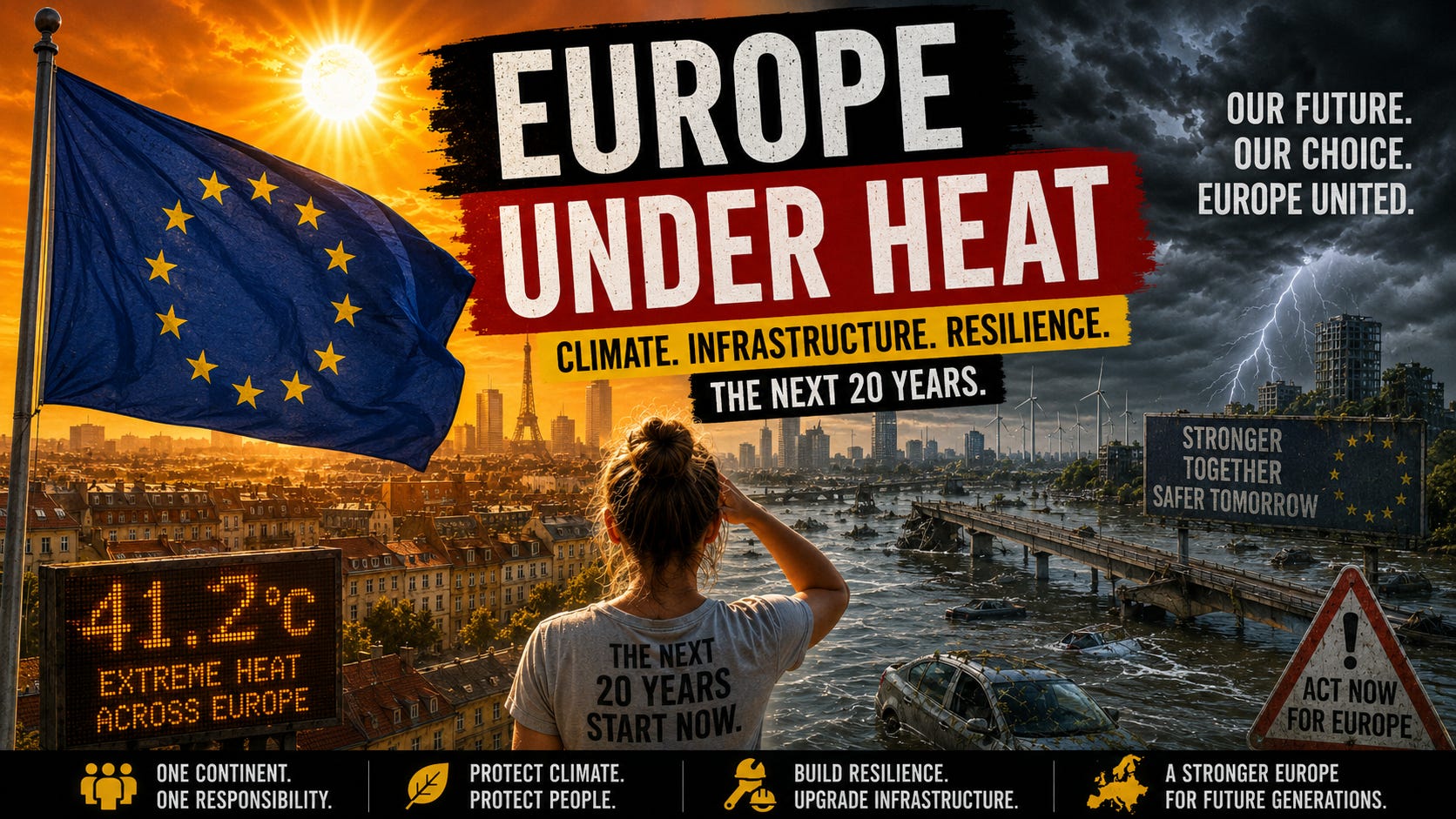
Heat! - A Civil Protection Service Against the Climate Crisis
Climate - Infrastructure - Resilience
Why Europe should not only talk about armies, borders and defence — but about one year of service for heat, water, energy, infrastructure and social resilience
In an overheated attic flat, climate politics sounds very different than it does in an air-conditioned conference room.
There, the climate crisis is not a chart, not a party programme, not a dispute about heat pumps or emissions targets. There, it is a sleepless night. A child with a headache. An elderly woman who can no longer cool down. A care worker who knows that next summer will not be kinder. A city that stores heat all day and refuses to release it at night.
And a jar of Nutella that, in July, looks less like something to spread and more like something to drink with a straw.
For now, attic flats are still the places where Nutella turns from breakfast spread into a warm beverage. That is funny, as long as you are healthy, young enough, have access to a cold shower and can somehow sleep through the night.
But the joke turns bitter quickly. Anyone who believes this will remain a problem of badly insulated rooms under old roofs has not understood the logic of the coming decades.
Europe is burning. Again. But this time it feels less like an exceptional weather event and more like a glimpse into the operating manual of the next twenty or thirty years.
France is breaking heat records. Spain is pushing past temperatures that once belonged to maps of the Sahara, not to European schoolyards, train platforms and hospital corridors. Germany is scratching at figures that would once have sounded almost unreal. Denmark has seen historic heat. Italy, Switzerland, Czechia, Britain, Belgium and the Balkans all show the same pattern: heat is no longer a southern exception watched from a safe northern distance.
Heat is here. It arrives earlier. It stays longer. It pushes deeper into cities, hospitals, train stations, care homes, power grids, roads and workplaces.
So the real question is no longer whether the weather is extreme.
The real question is:
Who protects a society when extreme weather becomes normal?
What this essay argues
This essay makes an uncomfortable proposal: if the climate crisis is becoming the central stress test of the next thirty years, Europe needs more than climate targets, emergency alerts, subsidy schemes and solemn speeches after disasters.
Europe needs a Civil Protection Service Against the Climate Crisis.
One year of service for society. Military or civilian. Technical, social, medical, municipal or digital. For heat, water, energy, infrastructure, disaster protection, care, cities, bridges, grids and social resilience.
Not as punishment.
Not as forced labour.
Not as a cheap replacement army for the shortage of skilled workers.
But as a modern social contract:
Anyone who wants to live in Europe in thirty years as more than a managed survivor must be able — and, according to ability, expected — to become part of its resilience.
That sounds hard.
But the climate crisis will not become softer just because we avoid hard sentences.
I. The heat is not the subject. It is the curtain opening.
We still talk about the climate crisis too often as if it were mainly a question of emissions targets, lifestyle choices, party manifestos and moral guilt.
That is too small.
The climate crisis is no longer an environmental debate.
It is a civil protection question.
Because what this heatwave shows is not only meteorologically remarkable. It is politically brutal. It reveals what a country can carry — and what it cannot.
Which homes remain habitable. Which schools can still hold classes. Which hospitals have reserves. Which care homes cool down at night. Which railway lines function. Which motorways can withstand heat. Which cities offer shade. Which people can escape — and which cannot.
The wealthy buy air conditioners, leave the city, work remotely or spend the hottest weeks elsewhere.
Others sit in attic flats, wait at bus stops without shade, work on construction sites, in kitchens, in care homes, cleaning services, logistics, agriculture and public transport. They do not experience heat as a headline. They carry it in their bodies.
That is the social core of the climate crisis:
It does not hit everyone equally. But it demands an answer from everyone.
Of course, we can wait.
We can wait until heat, illness, water shortages, crop failures and collapsing infrastructure solve the demographic question in their own way.
That would be climate adaptation at pre-industrial level.
One can do that.
One should just not call it civilisation.
Because if Europe refuses organised adaptation, adaptation will still happen — only not politically, socially and technically, but biologically. Through heat deaths, disease, water stress, crop failure and earlier mortality. That is no longer policy. That is the retreat of modernity with a weather forecast.
The alternative to organised transformation is not freedom.
The alternative is unplanned brutality.
II. The uncomfortable sentence: voluntary action alone will not be enough
Europe is once again discussing defence. Soldiers, ammunition, air defence, reserves, conscription, borders, deterrence. That is understandable. Russia is a real military threat. Ukraine shows every day that freedom must sometimes be defended with weapons.
But Ukraine also shows something else:
A country does not hold because its army fights alone.
It holds because its society carries.
Without civilian self-organisation, repair capacity, volunteers, medics, logistics, drone workshops, evacuation networks, donations, local administrations, energy improvisation and neighbourhood resilience, Ukraine would very likely be a very different country today. Perhaps not a free one.
Defence is not only a property of barracks.
Defence is the ability of a society to keep functioning under pressure.
That lesson is still missing from the European climate debate.
When heat, drought, floods, wildfires, water shortages and infrastructure fatigue become permanent threats, climate policy can no longer be treated as one policy field among others. Europe needs a civil protection mandate.
A service not directed against people, but against the crumbling of the common foundation.
We need a:
Civil Protection Service Against the Climate Crisis
Not everyone has to fight.
But nobody should remain merely a spectator when the foundations begin to crack.
Of course, the word “service” will immediately trigger resistance. Service. Obligation. Civil protection. Climate crisis. In some European countries, two of those words in one sentence are enough to send television panels into full emergency mode.
So let us be precise.
This service must not be punitive. It must not become an instrument to discipline the unemployed or to use migrants as a cheap labour reserve. It must not undermine regular wages. It must not create second-class people. It must be paid, insured, limited, accountable and dignified.
But it must also not be so soft that it becomes yet another voluntary programme for those who already volunteer.
Because voluntary action alone will not carry the coming burden.
The sun does not wait for planning approval.
The flood does not ask whether the grant application has been processed.
The heat does not care whether national governments, regions and municipalities are still clarifying which level of administration is responsible.
And asphalt will buckle even if the European working group on “Resilient Transport Infrastructure 2040” has not yet published its accessibility-compliant final report.
Of course, such a service would be legally difficult. A general civil duty cannot simply be introduced across Europe by rhetorical force. Each country has its own constitution, labour law, migration law, welfare system and political memory. Any model would have to be democratic, proportional, rights-based and full of exceptions.
Precisely for that reason, the debate must begin now.
Whether the result is a binding civil protection year, a guaranteed society year with strong incentives, a step-by-step model, or a combination of duty, choice and qualification is a legal design question.
The political core question is this:
Can European societies under permanent climate stress continue to leave millions of people in waiting rooms while infrastructure, care, disaster protection, energy transition and urban adaptation are all desperately short of people?
The answer is no.
III. The tasks are already in front of us
A Civil Protection Service Against the Climate Crisis would not be abstract.
It would not have to begin by putting every citizen in a helmet, reflective vest and shovel parade.
Although, to be fair, some administrative processes in Europe would benefit from a shovel.
The tasks are visible.
Cities must be shaded. Schoolyards must be unsealed. Care homes must be cooled. Drinking-water points must be installed. Bridges must be monitored. Railway lines must be made more resilient. Car parks must be covered with solar roofs. Bus stops must become protection points. Roofs must be greened or solarised. Emergency power points must be set up. Radio and communication networks must be secured. Rainwater must be retained instead of flushed away.
Heat plans must not merely exist in municipal folders. They must work in neighbourhoods.
This sounds like infrastructure.
In truth, it is protection policy.
Because the climate crisis does not attack like an army. It wears no uniform. It has no capital, no flag, no front line.
But it is the central long-term stress on Europe’s infrastructure, health systems, economies, food supply, water security and political stability over the next thirty years.
Russia is an adversary on the military flank.
The climate crisis is the stress test in the foundation.
And a foundation is not defended only with weapons. It is defended with bridges, grids, water pipes, shade, cooling, care, electricity, communication, tools, training and people who know what to do when things become serious.
IV. One year for resilience
Such a service would have to be broad.
Not everyone can do the same thing. Not everyone should do the same thing. Not everyone can be burdened in the same way.
But everyone could contribute according to ability, health, age and life situation.
One year for the resilience of Europe could have several paths:
Military, for external security.
Civil, for disaster protection and infrastructure.
Technical, for energy, water, heating, cooling, solar power, grids, bridges, rail and digital systems.
Social, for care, heat protection, neighbourhood support, evacuation and help for vulnerable people.
Municipal, for cities, schools, districts, green spaces, drinking-water points, unsealing and crisis communication.
Digital, for AI-supported administration, translation, deployment planning, documentation, maintenance plans, risk maps and public information.
Someone physically strong can contribute differently from someone with chronic illness. Someone caring for relatives needs different rules. Someone raising children cannot be deployed like a healthy twenty-year-old. Someone traumatised needs protection. Someone highly qualified might plan, teach or coordinate. Someone newly arrived in Europe can grow into the system through language, training and practice.
A modern obligation needs modern exceptions.
But exceptions are not an argument against organisation.
They are an argument for good organisation.
The formula would be:
Right to qualification. Duty to contribute. Protection from exploitation. A path to advancement.
That would be demanding.
But it would not be antisocial.
Antisocial is leaving people in passivity while cities overheat.
Antisocial is making billions available for infrastructure without training the people who will build, maintain and operate that infrastructure.
Antisocial is leaving climate adaptation to those who can afford it, while everyone else receives fans, emergency numbers and advice to drink water.
Antisocial is telling care homes, schools and attic flats to hope for a milder summer.
Anyone who wants to live in Europe in thirty years as more than someone merely carried through crisis at the minimum must be able to become part of shared resilience.
And a fair society must create the paths for that.
V. Do not merely manage migration. Enable people.
This is the second major point.
Europe has both a severe skills shortage and a vast reserve of unused human potential.
Millions of people live in waiting rooms: unemployed, underqualified, misqualified, with qualifications that are not recognised, with language barriers, uncertain residence status or broken biographies.
At the same time, Europe lacks electricians, cooling and air-conditioning technicians, construction workers, care workers, planners, administrative specialists, energy advisers, grid technicians, solar installers, paramedics, IT specialists and simply people who can work on site.
That is not a law of nature.
It is an organisational failure.
A Civil Protection Service Against the Climate Crisis would therefore also have to be a qualification service.
With language. With occupational safety. With paid training. With certificates. With advancement routes. With recognition of foreign qualifications. With social protection. With real follow-up employment.
The point is not to treat people as cheap hands.
The point is to turn waiting rooms into paths of construction.
Migration must be rethought for this.
Not as a problem to be managed. Not as a reserve for unpleasant work. But as potential for a European rebuilding project.
Many migrants bring languages, experience, endurance, technical skills or simply the will to build a future. Multilingualism would not be an integration deficit. It would be a scaling factor.
Someone who speaks Arabic, Ukrainian, Turkish, French, English, Polish, Romanian, Spanish or Portuguese could tomorrow not only be trained — but train others.
In Germany. France. Spain. Italy. Poland. Greece. Portugal. The Netherlands. Romania. Croatia.
Europe could create mobile resilience teams that go where heat, floods, grid expansion, solar power, cooling, water stress or reconstruction are most urgent.
Not an army of cheap migrant labour.
But a European reconstruction corps: paid, protected, qualified, mobile and recognised.
A European Resilience Corps would not be a romantic idea. It would be the civilian equivalent of a world in which crises no longer stay neatly inside national borders.
The heatwave does not stop at borders.
Wildfires do not.
Floods do not.
Supply chains do not.
Energy prices do not.
Migration does not.
Why should our response remain small, national and fragmented?
VI. Money does not build a bridge
Governments have begun to recognise the financial problem. Billions are being announced or approved for infrastructure, climate adaptation, defence, grids, transport and modernisation.
That is good.
But money alone does not build a bridge.
And even if you place it on the concrete for a very long time, it will not become an engineer.
Money does not install a cooling system. Money does not check on an elderly woman in an attic flat when the night stays at 28 degrees. Money does not sort a permit. Money does not pull cables. Money does not create shade. Money does not document cracks in concrete. Money does not repair a democracy that tells its citizens only to somehow endure.
For that, Europe needs people.
Training.
Organisation.
Administration that does not suffocate in paperwork.
And yes: also AI.
But AI must not stand in this debate as a shiny magic word placed next to climate, migration and infrastructure simply to make everything sound modern.
In such a service, AI would not be the punchline.
It would be the operating system.
A Civil Protection Service Against the Climate Crisis would have to be digital and AI-supported from the start: training modules, translation, deployment planning, documentation, permit preparation, maintenance plans, bridge monitoring, heat maps, material logistics, public communication, multilingual warning systems, sensor data analysis and prioritisation of critical infrastructure.
Digital resilience units could help municipalities turn scattered files, aerial images, sensor data, budget lists, building plans and climate maps into an operational picture.
Because many administrations do not know too little because nobody knows anything.
They know too little because their knowledge is buried in PDFs, email attachments, legacy software, paper folders, jurisdictions and incompatible spreadsheets.
Europe will probably take the climate crisis seriously only once it has a three-part form, an intergovernmental task force and a spreadsheet that no neighbouring authority can open.
AI could help even with that.
Not as a replacement for people.
But as leverage for people who already have too little time.
AI does not build a bridge. AI does not carry a heat pump. AI does not replace a nurse.
But AI can prevent skilled workers from burning out in the fog of forms.
VII. Freedom without resilience becomes a luxury
The strongest argument against a civil protection service is this: obligation is unfree.
That is true.
Obligation interferes with freedom. It must never be introduced lightly.
But the climate crisis also interferes with freedom.
Only more unequally.
An overheated attic flat is not free. An elderly woman who can no longer leave her home in summer is not free. A child whose school becomes an oven at 38 degrees is not free. A commuter whose railway line fails because of heat, floods or decaying infrastructure is not free. A care home without a cooling concept is not free. A municipality that only pays for damage after every flood is not free.
Freedom needs conditions.
Drinking water. Shade. Healthcare. Mobility. Electricity. Safety. Housing. Functioning administration. Trust.
When these conditions crumble, freedom remains as a word — but not as everyday life.
That is why a Civil Protection Service is not an idea against freedom.
It is an idea for the conditions of freedom.
The question is not:
How do we force people into climate service?
The better question is:
How do we organise a society that can remain free under climate pressure?
VIII. The service must not kick downwards
For this idea not to turn toxic, it needs hard boundaries.
A Civil Protection Service Against the Climate Crisis must not become a special duty for the weak. Not for the unemployed alone. Not for migrants alone. Not for people without a lobby. Not for those already most burdened by bureaucracy, income, language, status and housing conditions.
It must apply broadly — according to ability, health and life situation.
And it must give something back.
Pay.
Social insurance.
Recognised certificates.
Credit toward training, study or pensions.
Language support.
Occupational safety.
Advancement routes.
Trade union oversight.
Clear duration.
Clear exceptions.
No wage dumping.
No displacement of regular employment.
No privatisation as a cheap labour model.
No parade-ground pathos.
No romantic belief that enough participation workshops will somehow install a cooling system.
This service would have to be professional.
Otherwise it would not be social.
It would merely be coercion with a green brochure.
IX. The real imposition is doing nothing
So the big question is no longer:
Can we afford such a Civil Protection Service?
The better question is:
Can we afford not to organise it?
Because the climate crisis will not begin someday. It is already here.
It is not only in temperature curves. It is on softened roads, in overheated care homes, in dried-out rivers, in overcrowded emergency rooms, in overloaded power grids, in dying urban trees, in flats that no longer cool down at night.
The most dangerous illusion is that normality will return once this heatwave is over.
Something else is more likely:
We will get used to damaged normality.
More heat. More disruption. More costs. More failures. More social inequality. More political irritability. More repairs after the fact.
That would be surrender.
Not the great surrender with a white flag.
But the small European surrender in administrative language:
“Due to the current situation, we ask for your understanding.”
A Civil Protection Service Against the Climate Crisis would not be a miracle cure. But it would be a signal that this society has understood what is at stake: not green symbolism, not sermons about individual virtue, not party rituals, but the organised defence of living conditions.
X. One year for a Europe that wants to be more than an emergency operation
The climate crisis is not an enemy with a flag, an army and a capital city.
But it is the great stress test of this century.
It tests whether our cities remain habitable. Whether our grids hold. Whether our hospitals function. Whether our administrations can act. Whether our bridges carry. Whether our care homes remain safe places in August. Whether we have enough people who, in an emergency, are not only affected — but organised to help.
If the climate crisis is the permanent load, resilience is our defence.
And this defence does not begin with fear.
It begins with organisation.
Qualify people. Protect cities. Repair infrastructure. Make energy less dependent. Hold water. Create shade. Plan cooling. Accelerate administration. Use AI. Mobilise Europe.
Not against each other.
Not from above.
Not as punishment.
But as a shared service for a continent that, in thirty years, should be more than a managed emergency operation.
The question is not whether everyone wants to become a soldier.
The question is whether we have enough people willing to keep Europe capable of carrying itself.
Shoulder to shoulder.
Civilian.
Practical.
Paid.
Protected.
Qualifying.
And yes: binding enough so that it does not once again fall only on those who already care.
For now, we can still treat the climate crisis as a political debate.
Soon, it will be stronger than any debate.
Then we will no longer be asked whether we feel like building civil protection.
It will only be visible whether we built it in time.


