
AURORA-CAMP — How the West Can Show Presence Without Breaking the Alliance
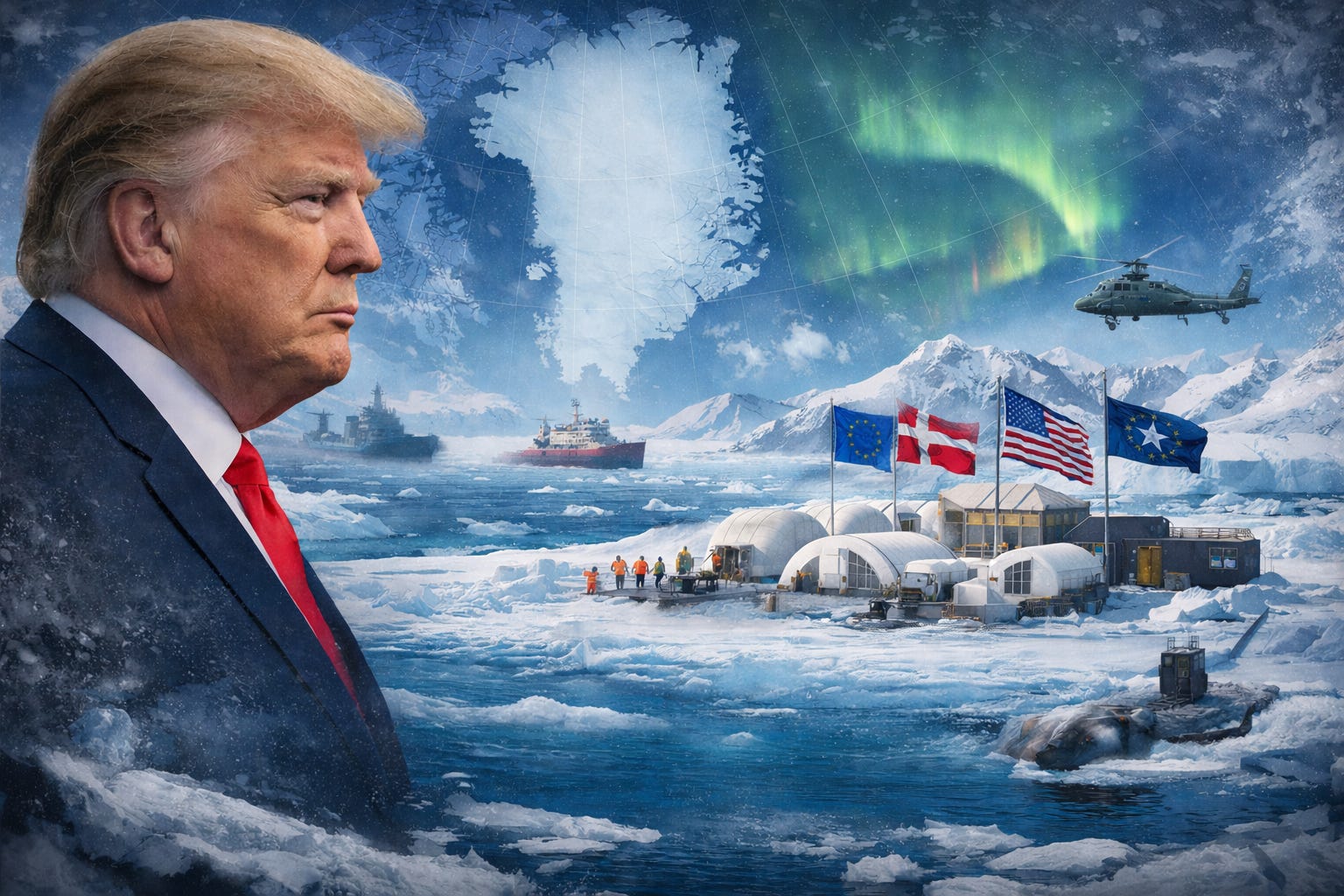
The ice around Greenland is retreating — visibly, measurably, and regardless of political interpretation. As the ice recedes, not only ecosystems are changing, but geopolitical realities as well. New shipping routes are emerging, previously inaccessible regions are becoming operationally reachable, and critical infrastructure is gaining strategic relevance. The Arctic is moving from the periphery to the center of global attention.
Independent of why these changes are occurring, Western states now face a central strategic question: How can presence be established in the Arctic without turning it into a question of ownership — and how can security be organized without damaging alliances?
Greenland has become the test case for this dilemma.
⸻
Control Logic Versus Alliance Logic
The current debate surrounding Greenland reveals less a territorial dispute than a fundamental clash of strategic thinking. On one side is a logic that defines security primarily through control: whoever protects, decides; whoever invests, claims influence. On the other side stands the Western alliance tradition, which understands security as a shared responsibility, embedded in sovereignty, rules, and multilateral coordination.
Greenland sits precisely at this fault line. As an autonomous territory within the Kingdom of Denmark, and at the same time strategically positioned between North America and Europe, the island has become a projection surface for competing models of power. Calls for exclusive control — whether openly articulated or implied — collide with NATO’s self-image as an alliance of equal partners.
⸻
Why Simple Answers Fall Short
Neither European hesitation nor bilateral power arrangements offer a sustainable response.
A logic of acquisition or exclusive control would not only undermine the sovereignty of Greenland and Denmark, but also strike at the foundation of the NATO alliance. It would set a precedent in which alliance members are reduced to objects of strategic convenience rather than partners.
Conversely, symbolic gestures without real presence are insufficient. The Arctic’s strategic relevance is growing in practical terms, not rhetorical ones. Those who wish to remain capable of action must build capabilities, generate situational awareness, and maintain a visible, credible presence on the ground.
The core challenge, therefore, is to organize presence without ownership.
⸻
A Third Option: AURORA Camp
A largely underexplored way out of this deadlock lies in a model that systematically links civilian and security logics: a multinational, modular cooperation camp in Greenland that combines scientific observation with defensive security presence.
Under the working title AURORA Camp (Arctic Unified Observation, Resilience and Action), such a project could be designed as a temporary hub with multiple functions:
• continuous observation of changing Arctic conditions
• scientific assessment of ice retreat, ocean dynamics, and ecological impacts
• monitoring and protection of critical infrastructure
• search and rescue capabilities
• generation of a shared security situational picture
What matters is not scale, but architecture: modular, rotating, transparent, and clearly defensive in nature.
⸻
Science as a Stabilizing Anchor
The integration of international scientific teams would not be a symbolic add-on, but the strategic core of the model. Scientific presence provides legitimacy, continuity, and transparency — while depriving escalation narratives of their foundation.
Crucially, such a framework does not need to be normatively charged. Studying real environmental and ice dynamics is a prerequisite for understanding navigation risks, infrastructure exposure, ecosystem impacts, and security vulnerabilities. Data creates situational awareness without turning the project into an ideological battleground.
This pragmatic approach makes AURORA Camp compatible with very different political cultures — including those that view Arctic transformation primarily through the lens of security, competition, and operational reality rather than climate ideology.
⸻
Why Washington Would Have a Stake
Such a model would not work against U.S. interests. On the contrary, it would allow the United States to:
• gain early access to reliable data on emerging Arctic operational realities
• participate in shared situational awareness and infrastructure monitoring
• maintain influence without asserting formal ownership or control
For political actors who interpret Arctic developments as matters of security, competition, and economic access, AURORA Camp offers a pragmatic entry point: acknowledging reality without ideological pre-commitment.
The distinction between participation and control would be essential. Influence would stem from involvement, not appropriation.
⸻
Governance as the Decisive Factor
The viability of such a model would hinge on clear governance structures:
• Hosts: Greenland and Denmark
• Civilian leadership: an international scientific consortium
• Security framework: NATO or a coalition-based structure
• Participation: open to partners, without ownership or veto rights
This separation preserves sovereignty, limits dominance by any single actor, and creates institutional reliability.
⸻
Risks — and Why They Are Manageable
No such project would be risk-free. Military presence can be misinterpreted, scientific neutrality politicized, and influence operations remain a reality.
Yet these risks are manageable — and significantly lower than the alternatives. A transparent, multinational framework reduces escalation potential far more effectively than exclusive arrangements or strategic vacuums.
⸻
The Core Question
The decisive issue is not whether the Arctic is changing. That change is visible.
The real question is whether Western states shape this new reality together — or allow it to be fragmented by control logic, mistrust, and competition.
Greenland offers a rare opportunity to test a new form of presence: cooperative, data-driven, and alliance-compatible. AURORA Camp would not be a symbol, but a practical experiment in whether the West can still reconcile strategic reality with political principle.


