
Why the latest escalation in the United States is more than political conflict
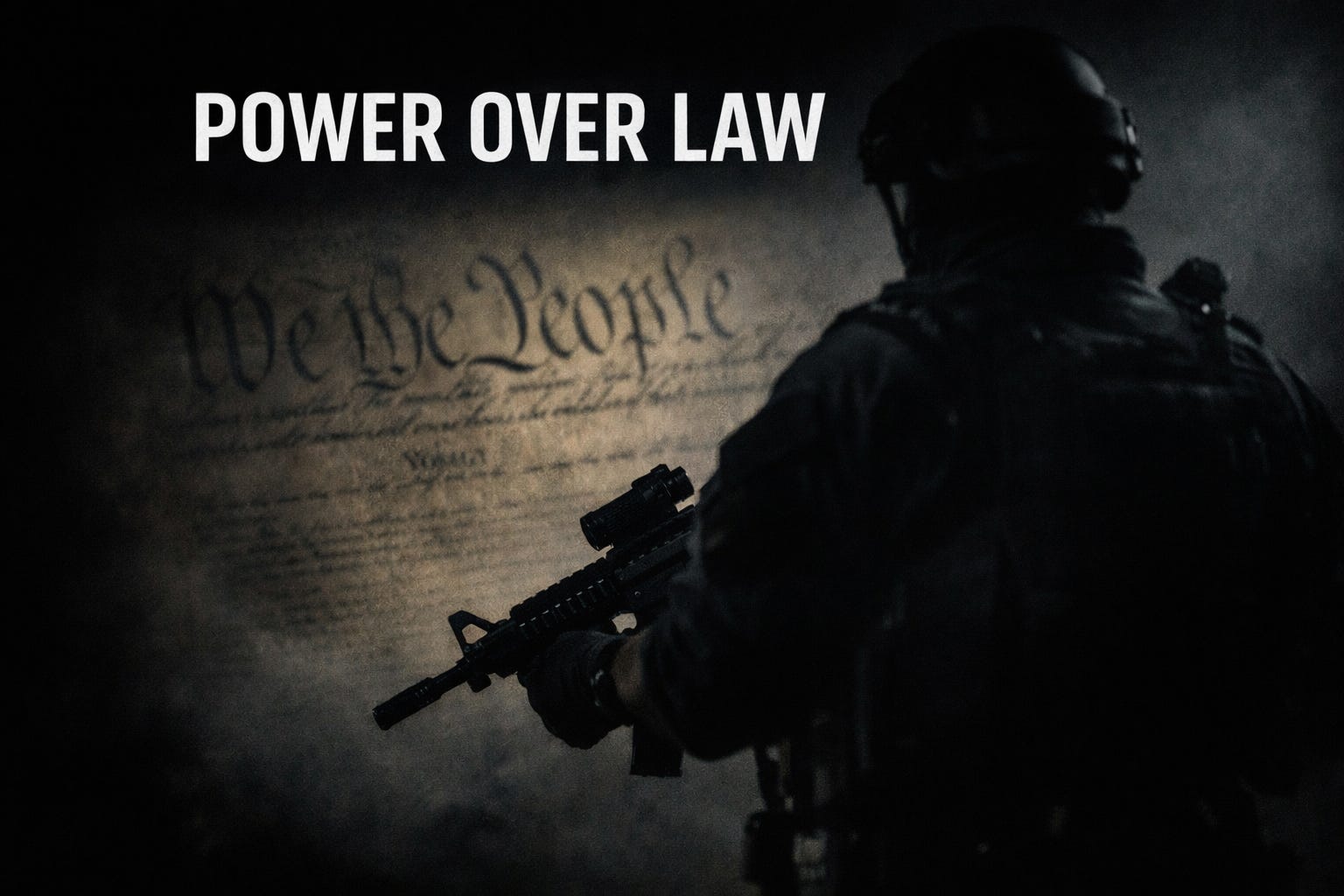
Introduction: When Power Moves Faster Than Law
The decline of democracies rarely begins with their abolition.
It begins with shortcuts.
With the moment when governments argue that extraordinary times require extraordinary measures. That procedures are too slow. That oversight is an obstacle. That security must come before law, jurisdiction, and accountability.
The United States knows this logic from its own history.
From the frontier era, when federal marshals enforced law by discretion rather than due process; through the Civil War; through McCarthyism and COINTELPRO; to the post-9/11 years: whenever state power ceased to be treated as an exception and became a political instrument, the system lost its balance.
The U.S. Constitution was written precisely to prevent this.
Not out of idealism, but out of deep distrust of power.
Not to make governance efficient, but to keep it limited.
Against this historical backdrop, recent domestic developments in the United States must be understood not as partisan conflict, but as a constitutional stress test.
The Core Events: State Violence and Political Response
Over the past months, domestic tensions in the United States have sharply escalated. Federal agencies, particularly those involved in internal security and immigration enforcement, have been implicated in multiple incidents involving lethal force against civilians. At the same time, efforts by individual states to conduct independent investigations have been obstructed or challenged.
Rather than treating these incidents as acts of state power requiring transparency, accountability, and independent review, the federal government responded with political blame-shifting. Senior officials, including the President, framed political opponents—especially Democratic-led states—as responsible for violence carried out by federal authorities.
This marked a critical shift:
state violence was no longer addressed as a matter of state responsibility, but reframed as a partisan conflict.
The Government’s Reaction: Narrative Over Accountability
The communication strategy has followed a consistent pattern:
State violence is defended, not distanced
Oversight is delegitimized when politically inconvenient
Political opponents are portrayed as morally culpable
Security rhetoric replaces legal language
In this framing, the President no longer appears as the integrative head of the constitutional system, but increasingly as a partisan actor, protecting executive action rather than situating it within constitutional limits.
This is not a rhetorical nuance.
It is a structural role change.
The Constitution as the Measure
The U.S. Constitution is not symbolic.
It is an operational framework designed to limit power.
Its foundations are clear:
All state power is bound by law
The use of force must be reviewable and accountable
Power is deliberately divided to prevent abuse
The President swears an oath to the Constitution, not to a party
Neither elections nor majorities legitimize governing against these principles. American democracy functions only through constitutional constraint, not beyond it.
When state violence is explained in partisan terms, when investigations are undermined, and when political opponents are blamed for executive actions, the Constitution is not formally violated—it is functionally ignored.
That is the most dangerous condition a democracy can enter.
What Follows From This
The result is not an immediate dictatorship.
There are no canceled elections. No formal suspension of the Constitution.
Instead, a familiar historical pattern emerges:
Institutions remain in place but lose their effectiveness
Law exists on paper while power decides in practice
Oversight is framed as disloyalty
Democracy survives in form while eroding in substance
What emerges is authoritarian practice under a democratic name.
Conclusion
A democracy can survive mistakes.
It can endure crises, conflict, and even poor leadership.
What it cannot survive is a government that believes it can rule against its own Constitution.
Because once the Constitution is reduced to rhetoric rather than practice, the system retains its name—but not its nature.


