
Friday Update Briefing Pjenga-Effects| 6. March 2026 — When the Energy Stone begins to move the Market Stone
The PJenga Framework by Ike Aaren Hadler
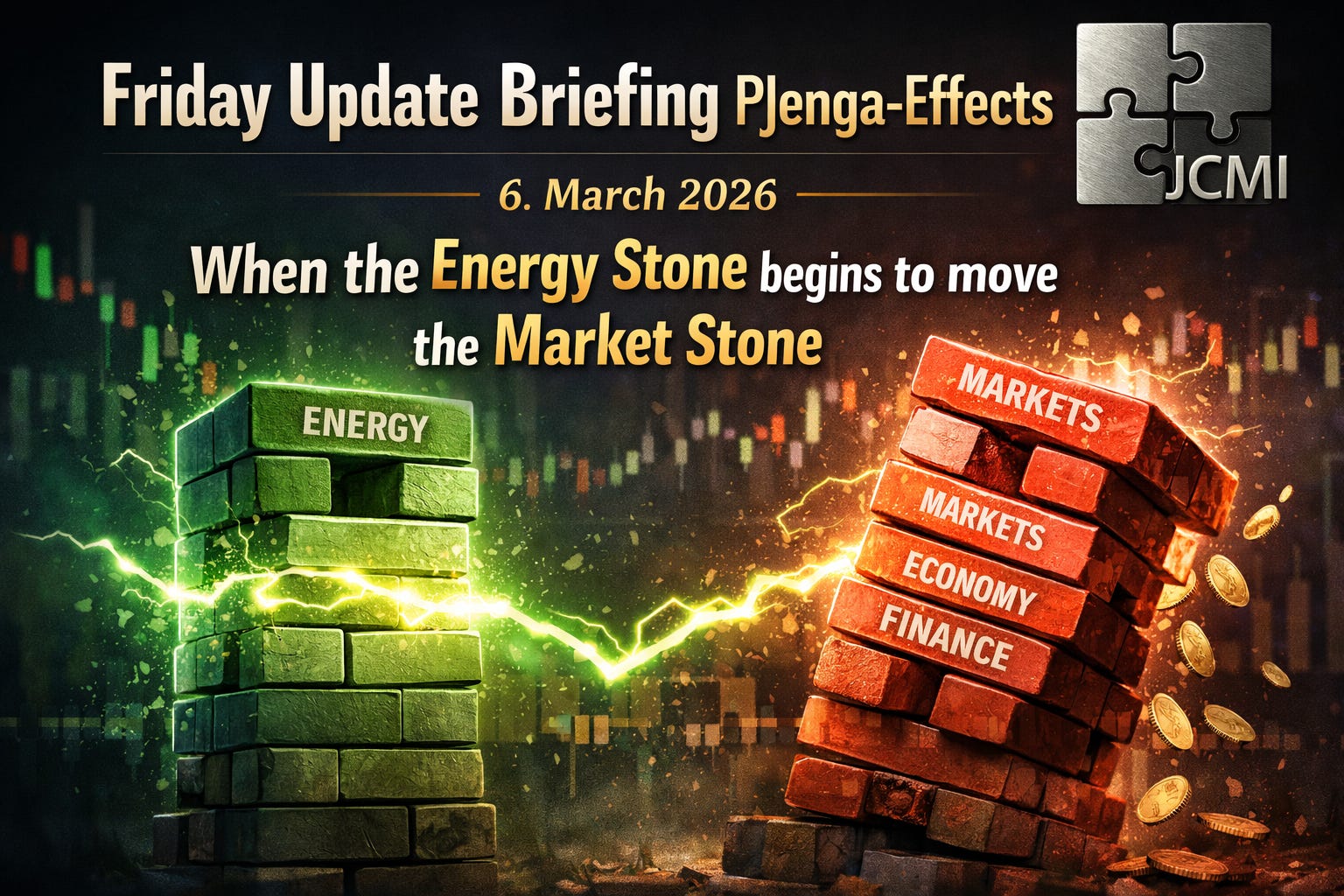
What matters in complex crises is often not the first explosion, but the first visible transfer of load.
That is the real story of this Friday.
Over the past forty-eight hours, the Middle East conflict has not only intensified militarily. It has begun to transmit stress across multiple parts of the wider system. What initially looked like a regional escalation has now become something structurally more significant: a measurable shift inside the PJenga architecture.
The military tower remains the trigger. But today, the most important visible movement is no longer primarily military. It is the coupling of two other stones: the energy stone and the market stone.
The energy system is no longer reacting only in abstract global price language. It is already pushing pressure into transport, consumer costs and industrial expectations. At the same time, the markets are showing that this pressure has not been absorbed. A brief attempt at stabilization was visible in the morning. By the afternoon, that calm had already begun to crack again.
That is why today’s PJenga dashboard does not point in eight directions at once. It points to one central dynamic:
The energy stone is moving, and in doing so it is forcing the market stone into an unstable rebalancing.
What follows are the two core spotlights that matter most today.
⸻
Spotlight I
The Energy Stone
From geopolitical shock to everyday pressure
In the PJenga framework, the energy stone is one of the heaviest structural blocks in the system.
Energy is not simply another sector. It is the operational substrate beneath mobility, production, heating, logistics, digital continuity and political calm. If this stone shifts, many other towers begin to vibrate even before they visibly tilt.
That is exactly what has happened.
The direct military conflict in and around the Gulf has pushed the Strait of Hormuz back into the center of global risk perception. At the same time, the attempted strike vector toward Ras Laffan, the central node of Qatar’s gas economy, showed how quickly the energy tower can move from abstract vulnerability to immediate structural stress. The issue is not only whether infrastructure is physically hit. The issue is that the threat alone is enough to generate a severe risk premium.
That premium is now visible.
Oil and gas markets have already repriced the region as a zone of acute instability. But the more important journalistic observation today is that this is no longer confined to commodity terminals and financial screens. The energy stone has started to transfer load downward into everyday life.
That can be seen at the fuel station.
Even where prices do not move in a simple straight line, they remain clearly elevated and unstable. That volatility matters. A linear price increase is politically easier to process than a jagged pattern of repeated stress. Volatility creates uncertainty, and uncertainty is itself a social cost. Households, commuters, delivery chains and small businesses do not experience “Brent” or “TTF” as abstract market indicators. They experience them as hesitation, recalculation and shrinking margins.
This is where the PJenga perspective becomes useful.
What we are observing is not a single isolated energy event. It is a load transfer.
The stone in Hormuz moves.
That movement reaches oil and LNG risk pricing.
From there it moves into fuel, transport and industrial cost expectations.
From there it begins to press on the economic and political towers.
The system still stands.
But it stands with more internal tension than before.
And that is the important distinction. The energy tower has not collapsed. It has become structurally louder. It is now transmitting pressure.
The human and logistical dimension belongs inside this energy story as well. Stranded travelers, disrupted air corridors and rerouted transport chains are not merely humanitarian side effects. They are part of the same energy architecture. Modern mobility depends on fuel, routing certainty and functioning hub systems. Once Gulf instability enters the aviation and shipping matrix, the energy stone stops being a market story and becomes an infrastructure story.
That is why today’s energy briefing is not really about price alone. It is about the moment when a geopolitical risk begins to acquire social texture.
And that moment has already arrived.
⸻
Spotlight II
The Market Stone
Why the short recovery was not stabilization
If the energy stone was the first visible mover, the market stone is the first place where the system tried to absorb the shock.
And failed.
This morning, parts of the market briefly suggested a return to balance. Several indices opened or traded in green territory. At first glance, that looked like the beginning of normalization: an initial shock, then a technical rebound, then perhaps a slow return to confidence.
By the afternoon, that interpretation had already weakened.
Indices that had looked stable or even positive in the morning turned red again. Broad segments of the German and international market lost ground. Tech weakened. Industrial names came under pressure. Financials softened. At the same time, selected defense-related and protective assets continued to show relative strength, while precious metals rose again.
That pattern is more informative than a simple down day.
It tells us that the market is not processing the crisis in a clean, directional way. It is not saying, “the danger is over.” Nor is it collapsing indiscriminately. Instead, it is doing something more nervous and more revealing: it is re-sorting under stress.
This matters because a re-sorting market is a market that does not trust its own temporary calm.
In PJenga terms, the market stone did not find a new stable resting point today. It entered an unstable adjustment phase. It briefly tried to stabilize, then slipped again as the underlying load remained unresolved.
That underlying load is energy.
What the market is reacting to is not just war in the abstract. It is the possibility that the energy shock will persist long enough to feed through into costs, inflation expectations, margins, rates, transport, consumer behavior and policy response. Once that possibility becomes credible, the market no longer prices the conflict only as a headline event. It prices it as a structural drag.
The sector pattern supports that reading.
The relative strength of defense names and selective safe or strategic assets stands against pressure in cyclical, industrial and energy-sensitive areas. That is not random. It is a map of stress transmission. Capital is looking for shelter, leverage to the new environment, or distance from sectors that depend on calm inputs, predictable logistics and stable energy assumptions.
Even the brief green phase this morning can now be read differently. It was not evidence that the system had regained balance. It was evidence that the market still wanted to believe it could. By the afternoon, that belief looked thinner.
This is why the market stone should not be read separately from the energy stone.
Today’s real dashboard message is not:
first energy, then markets.
It is:
energy and markets are now coupled.
The first stone has already begun to move the second.
Once that happens, every further shock gains more leverage.
Not because the system is collapsing immediately, but because its internal tolerance narrows.
That is the point at which volatility stops being noise and becomes structure.
⸻
Closing Dashboard Note
Today’s Friday PJenga Dashboard Briefing points to a simple but serious conclusion:
The Middle East conflict is no longer acting only as a military escalation. It is now functioning as a cross-tower stress generator.
For this Friday, the two decisive visible stones are:
• the energy stone, which has moved from geopolitical abstraction into real economic and everyday pressure
• the market stone, which has shown that it cannot yet absorb that pressure with confidence
Everything else remains connected: mobility, humanitarian disruption, information overload, political response, strategic distraction.
But today, these two stones tell the clearest story.
The system is not collapsing. It is tightening.
And in PJenga terms, tightening is often the phase that matters most — because it comes before the visible fall.


