
How our world’s complex systems are being pushed into a cascade — and why no single person controls what happens next
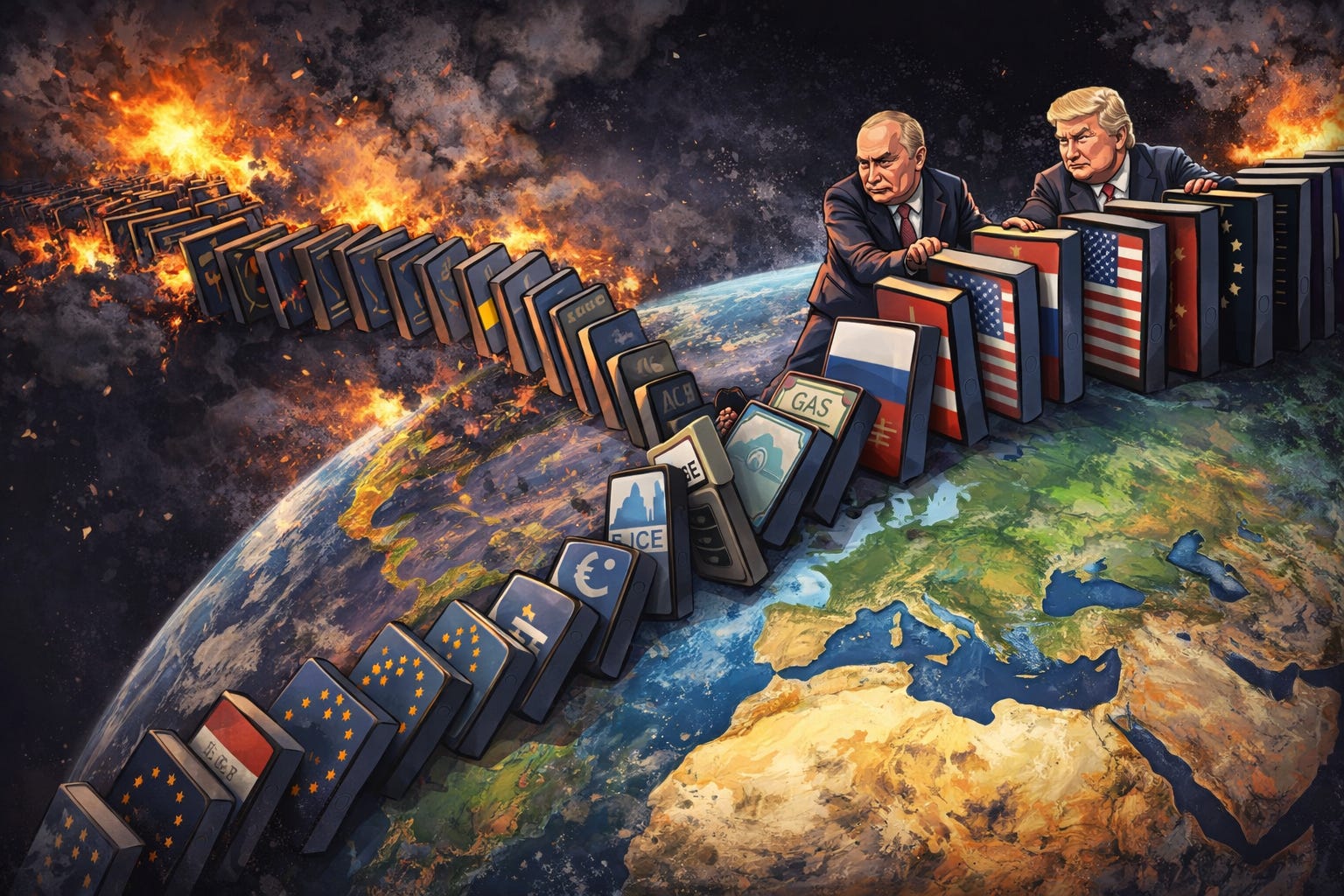
Imagine the world as a giant Domino Day setup.
Not just a few stones on a table, but thousands of them, carefully placed and connected:
energy, food, money, politics, trade, security, trust.
As long as they all stand, the system looks stable.
But domino systems have a simple rule:
👉 You don’t need to push everything. You only need to touch the wrong stones.
That is where we are today.
1. What Domino Day really teaches us
When you watch a real Domino Day, you notice something important:
The stones are prepared in advance.
The distances between them are deliberate.
Once the first stone falls, no one controls the chain reaction anymore.
The push itself is small.
The consequences are huge.
This is exactly how complex global systems behave.
2. The first critical stones: the United States
Many people think global crises begin with war or foreign policy.
But the first domino is often internal.
In the United States, several pressures have been building:
deep political polarization
institutional gridlock
aggressive domestic enforcement (like ICE actions)
declining trust in rules and public institutions
This is not an explosion.
It is an implosion.
👉 A system struggling with itself cannot stabilize others.
The stone does not fall loudly — but it does fall.
3. Trump as an accelerator, not the root cause
Donald Trump is not the sole cause of the instability.
But he acts like someone shaking an already fragile domino setup:
threatening tariffs
questioning alliances
creating permanent uncertainty
In domino terms:
he does not push one stone — he nudges several at once, without caring how the chain unfolds.
Once the motion starts, even he cannot stop it.
4. Putin and the pressure on the energy core
Russia’s role is easier to understand:
Energy is a foundation stone of modern society.
War and geopolitical pressure increase energy uncertainty.
Higher energy costs raise prices, production costs, and social tension.
This is not a side stone.
It is a load-bearing pillar.
When it shakes, many rows start moving at the same time.
5. The European Union: not the cause, but deeply exposed
The European Union is often criticized.
But in the domino picture, it is mainly this:
👉 Highly dependent on how other stones move.
Why?
energy dependency
trade dependency
security dependency
slow decision-making due to unanimity rules
The EU is not pushing the stones.
But it stands directly in the path of the cascade.
When multiple chains start falling at once, “staying calm” is not enough.
6. Why gold and silver suddenly rise
This is where markets tell a clear story.
When people sense that a domino system is becoming unstable, they don’t panic first.
They withdraw quietly.
In financial terms:
Stocks = trust in growth
Money = trust in institutions
Gold and silver = trust in physical reality
When gold and silver rise sharply, it does not mean:
“Everyone is greedy.”
It means:
“Many no longer fully trust the system.”
This is hedging, not hysteria.
7. Why this is not a sudden crash
Many expect a dramatic moment — a single big collapse.
But domino systems rarely work that way:
first: slow movement
then: acceleration
finally: almost impossible to stop
That is why the current moment feels strange.
Daily life still looks normal — and yet everything feels tense.
Both are true.
8. Is this a self-fulfilling prophecy?
Partly — yes.
When enough people expect instability, they behave differently:
they spend less
invest less
protect themselves more
That behavior reinforces the trend.
But this is not panic.
It is rational caution under uncertainty.
9. The most important insight
No one fully controls the domino system anymore.
not the United States
not Russia
not the European Union
not the markets
That does not mean collapse is inevitable.
But it does mean the situation is serious.
Stability now comes from resilience, cooperation, and honesty —
not from slogans or “positive vibes.”
Conclusion
Domino Day is not the end of the world.
But it teaches a crucial lesson:
Complex systems do not fail because of one hit — they fail through cascades.
The real question is not:
“Will everything fall?”
But:
“How many stones can we still keep standing?”


