
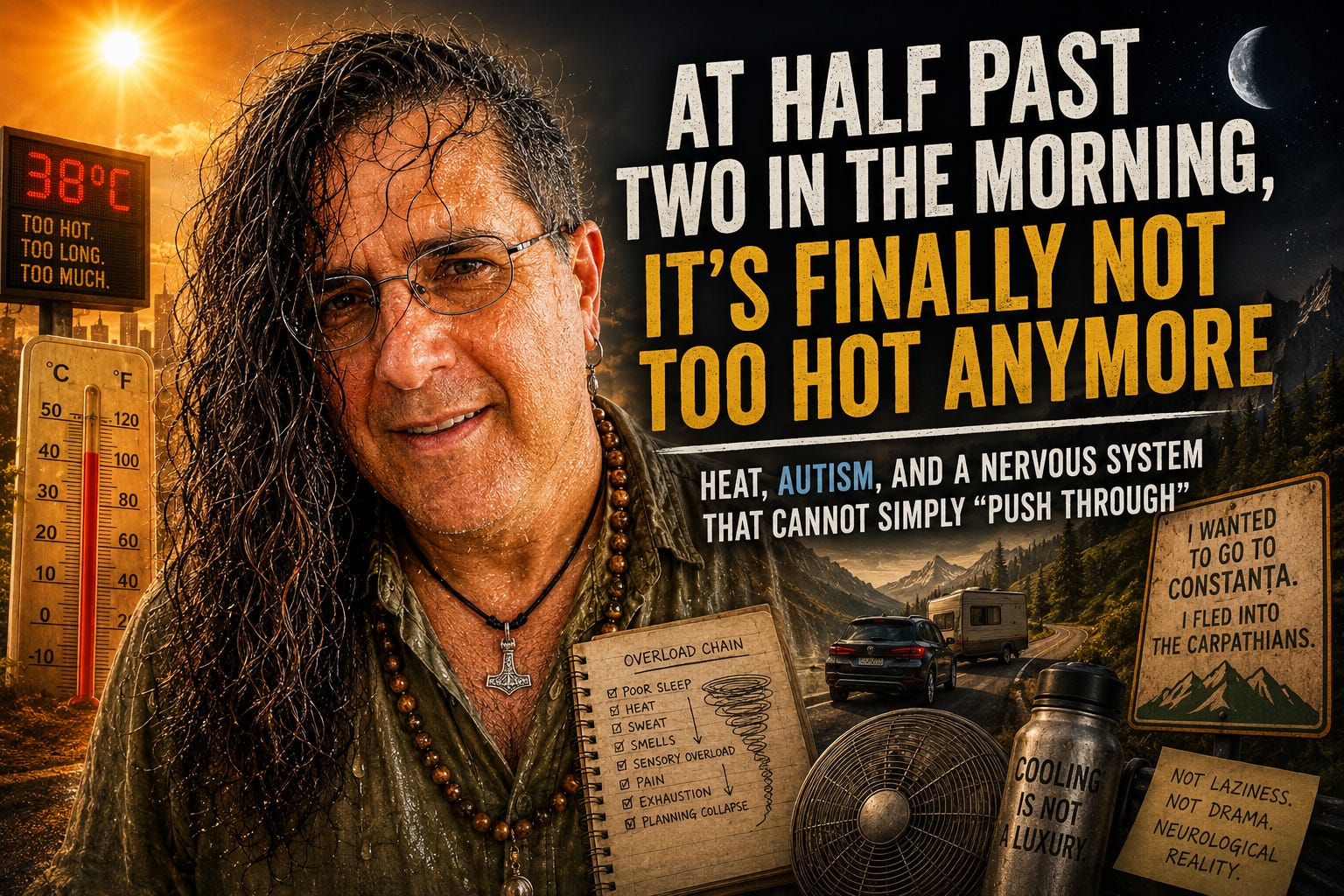
At Half Past Two in the Morning, It’s Finally Not Too Hot Anymore
Heat, autism, and a nervous system that cannot simply “push through”
It was the first truly hot weekend of 2026 across Europe, and only now is it finally cool enough again for me to put these lines into shape.
Only now can I think somewhat clearly again. Before that, I was merely sitting in front of the television, stupidly letting YouTube videos run, streaming random shows on Netflix and Amazon, and waiting for my head to become usable again.
The last spoonful of pasta with parmesan has reached my mouth. Cold, of course. Second nightly meal, or perhaps the first one of this day. Although, technically, it is still night. But Monday has already begun, and cooler temperatures of only around 27 degrees Celsius are expected in and around Hamburg.
Only around 27 degrees.
Which, these days, almost sounds like relief.
Sweet, melodic music fills me with calm and helps me sort my thoughts. So that I disturb neither cat nor wife in the apartment, I use my AirPods. My daily companions. Small private protective capsules for the nervous system, only unfortunately without any cooling function.
Last week was simply too hot to resume the very necessary training I had planned. I wanted to get my heavy body moving a little more again, with the pious wish and hope of becoming somewhat fitter instead of fatter.
But heat very quickly turns good intentions into survival management.
So: What does heat do to my autistic brain and nervous system?
Creatively, I can really function only below roughly 28 degrees Celsius. Above that, my entire system feels as if it shuts down by a good fifty percent in order to avoid overheating. That may sound technical, but that is exactly what it feels like: as if my body starts switching off everything that is not immediately necessary.
Thinking becomes more viscous. Writing becomes harder. Planning becomes more fragile. Decisions become slower. Stimuli become sharper.
Of course, this is not only true for autistic people. People who are not on the autism spectrum also experience heat as exhausting. They, too, sleep worse, become more irritable, more drained, less focused. They, too, are not exactly eager to be highly productive at 35 or 38 degrees Celsius.
But for me it does not simply feel like “too warm.”
It feels as if my entire regulatory system is coming under pressure.
Back in 2017 and 2019 in the United States, in New York City and Boston during high summer, I was still able to cope with heat better. Even then, after an intense day on my feet, I needed a day of rest. After two days at the latest, I was due.
But I could recover. I could continue. I could factor heat into the plan as a burden.
In the summer of 2025 in Romania, that changed.
I had actually intended to see much more of the country. Not only the mountains. Not only the Carpathians. I wanted to go to Constanța and to the Black Sea. I perhaps wanted to travel toward the southeastern and northeastern border with Ukraine. Maybe interview a few people. Maybe collect material. Maybe understand how Europe feels there, where war, border, flight, infrastructure, and everyday life lie closer together than they do in German talk shows.
On the map, all of that looked doable.
Then came the heat.
Driving through the lowlands on the hottest days was brutal. Some stretches could not be avoided. The air conditioning in my Jeep ran continuously at full power. The ventilation was aimed directly at my body. But the sun was roasting through the windshield onto my head and upper body as if someone had pointed a heat lamp at me.
The AC fought.
But it no longer really won.
I was forced to stop at rest areas along the highway and sleep sitting in the car, in the shade. Not as some travel idyll. Not because I enjoy dozing at rest stops. But out of exhaustion. My body could no longer handle the heat.
I could not escape into my camper either. It was attached to the tow hitch behind me, but inside it had heated up like the blast furnace of a steel mill.
Even a short stop at Kaufland pushed me to the edge of what my body was able to endure: out of the air-conditioned supermarket and onto the glowing parking lot, heavy bags in my hands, then into the even hotter camper to stow away supplies.
It did not merely feel as if I were stepping into pure hell.
The camper was the escalation of it.
And in the meantime, the Jeep had been standing in the sun. Half an hour was enough for the interior to become so overheated again that the first thirty minutes of driving onward became a risk in themselves. I was almost dazed by the heat.
Not a little sweaty.
Dazed.
The air conditioning needed roughly that half hour to bring the interior back down to a tolerable level. Until then, my body was driving along in the red zone.
At some point it became clear: Constanța was out. The trip to the Black Sea was out. The border regions were out. Not because I no longer felt like going. Not because the plan was bad. Not because I had suddenly become comfortable.
But because my nervous system had deleted the route before my mind was ready to admit it.
I fled into the Carpathians.
That sounds more romantic than it was. The Carpathians were not an adventure destination in that moment. They were a cooling structure. Elevation. Forest. Shade. Less overheated asphalt. Less lowland heat. Less of the feeling of being inside a giant oven.
I was not looking for postcard Romania.
I was looking for temperature, retreat, and restoration.
Sometimes you do not notice the climate crisis by what happens. You notice it by what you no longer do. Which routes you cancel. Which cities you avoid. Which plans you give up before they officially fail.
But is it typically autistic to suffer this much under extreme heat?
It is not only the heat itself.
The air movement from a fan gives me headaches. That is why, to protect myself from it, I wear a hat almost constantly in the apartment. It sounds absurd from the outside: It is hot, and I am wearing a hat. But the hat does not protect me from the temperature. It protects me from the stimulus of moving air.
And everything that can smell smells faster and more intensely in warmth.
Trash. Food. Sweat. Cleaning products. Perfume. Drugstores. Public transport. People. Clothes. Plastic. Old packaging. Cat food. Drains. Refrigerator. Car. Camper.
But who wants to take out the trash and carry it down to the garbage bins at almost 40 degrees?
At some point, however, it has to be done.
Then people are quick to say: Nobody ever died from a bad smell, so stop making such a fuss.
May I gently point out that certain smells are, for me, very much pain?
Not “unpleasant.”
Not “annoying.”
Pain.
My nervous system receives these stimuli, passes them on, processes them, and my brain turns them into pain. As with a cut. As with scraped skin. Only the trigger is not always a visible injury.
That does not make the pain any less real.
It is similar with certain sounds. Loud, artificial, ugly sounds can have the same effect. Humming. Beeping. Screeching. Shrill fans. Compressors. Cheap speakers. Electrical tones. Sounds that others may find disturbing can trigger pain in me.
And pain does not remain without consequence.
When a nervous system repeatedly experiences intense pain, including from stimuli that other people do not recognize as pain, it learns. It becomes more cautious. More vigilant. Faster to alarm. It begins to store places, smells, sounds, situations, and temperatures not merely as unpleasant, but as danger.
Being exposed to certain smells for too long can echo in me for a long time afterward. Not as poetic exaggeration. But as a nervous trace. As something my body wants to avoid afterward. As a protection program.
And just by the way: If something has a smell, there is a reason. Something is off-gassing. Something is rotting. Something is decomposing. Something is reacting chemically. If you can smell something unpleasant, it is not without reason that your brain treats it as a warning signal. Sulfur compounds, decay, smoke, solvents, spoiled food — smell is not merely the decoration of the world. Smell is information about possible danger.
So yes: People can be harmed by things they smell.
But let us stay with something relatively harmless: garlic.
My wife likes to eat things with garlic. So do I. But we do not always synchronize our meals. We do not always both eat the same thing.
As much as I love my wife: when she has eaten garlic, I sometimes cannot deal with the halo of that smell. Then I keep my distance. Not out of rejection. Not out of lack of love. But because my nervous system cannot simply filter out that smell.
And I do not hold it against her if she keeps her distance from me when I, in turn, give off unpleasant odors. Because both of us react very sensitively to smells.
Even on normal spring or autumn days, I have real trouble entering a drugstore, let alone a perfume shop. The odors there are so extremely intense that they make me scream internally. I have to make an effort not to scream out loud from pain.
And now: What is it like in high summer, when smells are even more intense?
Then I have to avoid entering such stores. Then I consider whether I can postpone the purchase or order the products I need online. What is a quick trip to the drugstore for others becomes, for me, a sensory risk assessment.
Oh yes, and then there are the body odors of people who traditionally like to eat a lot of garlic, onions, or strongly seasoned foods. Their body odors in high summer you might describe as unpleasant.
For me, they are sensory pain.
Pull yourself together, you are just imagining it!
Well, no.
My brain is genuinely wired differently and works with sensory stimuli differently from neurotypical brains. And yes, every person is different. If you know one autistic person, you know exactly one autistic person and not all of us.
But it is indeed typical for many of us that we work with sensory stimuli differently. That our brains perceive them differently, weigh them differently, and process them differently.
Heat therefore does not only hit my body.
It hits my entire sensory system.
I can switch between personal emotional language and scientific lecture language. Even within the same article. Not as a break, but as a tool.
Because my experience alone does not explain enough. And science alone does not feel enough.
Only together does it become visible what this is about: heat, for me, is not merely temperature. It is bodily experience, sensory system, pain, exhaustion, planning collapse — and at the same time a biologically plausible pattern of autistic sensory processing.
What heat does to autistic brains
Scientifically, one has to be careful: there is no such thing as “the autistic brain” and no such thing as “the one” autistic heat sensitivity.
Autistic people are not a homogeneous group. Some react strongly to cold, some strongly to heat, some to both, some seemingly hardly at all. Some notice overheating too late. Others experience even mild warmth as a massive stimulus. Some seek pressure, others cannot tolerate touch. Some need headphones, others can barely tolerate silence.
But precisely this variability is already part of the problem.
Autism today is no longer understood only through communication, social behavior, and routines. Sensory differences are part of the diagnostic core. Many autistic people process sounds, light, touch, smells, taste, pain, temperature, and bodily signals differently.
Not as bad mood.
Not as imagination.
Not as lack of discipline.
But as different neurological processing.
Heat is particularly treacherous because heat does not arrive alone.
Heat brings its whole gang with it.
Temperature on the skin.
Sweat.
Clothes sticking to the body.
Glaring light.
Bad sleep.
Air movement from fans.
More smell.
Less concentration.
Circulatory strain.
Social irritability.
A body that keeps sending signals.
For a nervous system that already has more difficulty reliably filtering stimuli into the background, heat can therefore become an amplifier. It does not simply lie over the day as “warm.” It turns several regulators at once.
Thermoception: temperature is a sense
The perception of temperature is called thermoception. It is part of the somatosensory system and essential for survival.
The body has to notice whether something is becoming too hot or too cold. Whether cooling is necessary. Whether danger is approaching. Whether behavior needs to be adapted.
In autism, the research on thermoception is still smaller and less consistent than the broader research on sensory processing. That is why it would be unserious to say: autistic people always experience heat more strongly.
It is not that simple.
A more accurate way to put it is this: temperature processing in autism can be different, more variable, and more context-dependent. The single stimulus is not always the problem. Sometimes it is the sum. Sometimes it is the unpredictability. Sometimes it is the lack of filtering. Sometimes it is the difficulty of reading one’s own body correctly and in time.
And that matches many autistic everyday experiences very well.
A warm room is not just a warm room. It is a room with bad air, more smell, more body awareness, more fatigue, more skin irritation, more noise from fans or open windows, more social irritability, more internal pressure.
Heat is not a single stimulus.
Heat is a stimulus complex.
Heat also hits interoception
Alongside the perception of external stimuli, there is interoception: the perception of internal bodily signals.
Thirst. Hunger. Exhaustion. Heart pounding. Nausea. Pain. The need to urinate. Overheating. Tension. Circulation. Fatigue.
Many autistic people report that such bodily signals are either too strong, too weak, delayed, or difficult to interpret. In heat, that is dangerous.
Someone who recognizes thirst, exhaustion, or overheating too late does not react in time.
Someone who does feel the signals strongly, but cannot sort them well, experiences them as overwhelming bodily noise.
Then it is not clear: Am I thirsty? Am I tired? Am I hungry? Do I feel sick? Am I overstimulated? Do I need to get out? Do I need to lie down? Do I need to cool myself? Do I need to eat? Do I need to drink? Do I simply need to be left alone?
And while the brain is still sorting, the burden continues to rise.
This is exactly where the sentence “just pull yourself together” becomes biologically wrong.
Because pulling yourself together is not a magical character trait. Pulling yourself together requires cognitive control. Planning. Inhibition. Evaluation. Prioritization. Self-regulation. In short: functions that depend strongly on the prefrontal cortex.
And precisely these functions suffer under heat, sleep deprivation, pain, and stress.
So people demand more self-control at exactly the moment when the biological basis for self-control is less available.
It is like telling an overheated computer that it should now please render especially cleanly.
Pain is real even when others do not feel it
Sensory hypersensitivity is not only about “annoying.”
A sound, a smell, light, airflow, touch, or heat can be processed as pain. Pain is not identical with visible injury. Pain is a perception of the nervous system.
That is crucial.
If a stimulus triggers pain in me, that pain is real, even if the same stimulus is merely unpleasant for someone else.
The other person is not lying.
Neither am I.
We simply do not have the same processing.
This is the point at which neurological difference often becomes moral judgment. Then the words appear: sensitive, difficult, dramatic, exhausting, rude, spoiled.
But that does not describe the stimulus.
It only describes how little the outside world is willing to take different sensory processing seriously.
What repeated sensory pain can do
A nervous system that repeatedly experiences intense pain or overwhelm learns.
It does not learn abstractly, as from a schoolbook. It learns bodily.
This smell: danger.
This sound: danger.
This heat: danger.
This store: danger.
This parking lot: danger.
This room: danger.
This situation: get out.
This can lead to sensitization. The threshold drops. The reaction becomes stronger. Recovery takes longer. The brain begins to mark certain stimuli as threats more quickly.
From the outside, that may look like avoidance.
From the inside, it is protection logic.
I do not avoid the drugstore because I want to be difficult. I avoid it because my nervous system knows what can happen there.
I do not avoid a hot parking lot because I am putting on a show. I avoid it because my body has learned that this place can put me into a state in which thinking, acting, and regulating become worse.
I do not keep distance from the smell of garlic because love is missing. I keep distance because closeness, in that moment, can mean pain.
This is not romantic.
This is not comfortable.
This is not identity-political luxury.
This is an everyday life made of risk assessment.
What fMRI makes visible
Functional MRI scans do not show “autism” as a glowing spot in the brain. It does not work that simply.
But fMRI studies can show that autistic people may process sensory, emotional, and social stimuli differently in certain networks than neurotypical comparison groups.
That matters.
Because it means sensory overload is not merely an opinion about stimuli. It has measurable bodily and neural correlates.
Research repeatedly shows that, in autism, networks for perception, salience, attention, anxiety, body awareness, and emotion regulation may be involved differently. Not in everyone in the same way. Not as a simple diagnostic stamp. But as a pattern that makes the everyday experience of many autistic people biologically plausible.
fMRI does not prove every single scene of my life.
But it disproves the crude claim that sensory pain is only imagination or lack of toughness.
If my brain filters, weighs, and alarms stimuli differently, then “stop making such a fuss” is not help.
It is a misunderstanding with a moral tone.
Why heat can intensify autistic sensory processing
Heat worsens sleep.
Worse sleep worsens sensory filters.
Worse sensory filters increase stress.
Stress amplifies pain.
Pain consumes self-control.
Less self-control makes everyday life, communication, and planning harder.
That is not a chain of weakness.
It is a chain of burden.
And it explains why a hot day is not just a hot day for me.
It may begin with a bad night. Then comes a body that has not cooled down properly. Then light. Then clothing. Then smell. Then hunger or no hunger. Then thirst that I identify too late. Then a fan that cools but gives me a headache. Then an errand. Then a parking lot. Then people. Then noises. Then a hot car. Then a decision I actually need to make, but can no longer make well.
And somewhere in that chain someone says:
Just pull yourself together.
But that is the point: exactly that pulling together is no longer reliably available.
Not because I do not want to.
But because my system is overloaded.
Heat is therefore a question of participation
When autistic people postpone errands in the heat, avoid rooms, cancel trips, reduce social contacts, perform worse at work, slip more quickly into shutdowns, or have to change their routes, that is not a quirk.
It is participation under temperature pressure.
In Romania, I did not merely change a trip. I experienced how heat changes freedom of movement. How “I am driving to the Black Sea” suddenly becomes “I have to go into the mountains.” How planning becomes adaptation. How adventure becomes regulation.
And that is the larger point.
The climate crisis is not only a question of average temperatures. It is a question of who can still participate.
Who can work?
Who can shop?
Who can travel?
Who can sleep?
Who can go to school?
Who can provide care?
Who can keep appointments?
Who can use public spaces?
Who can still think clearly when the city no longer cools down at night?
Heat protection must therefore not only think of circulation, age, nursing homes, and small children. Of course those groups matter. Very much so.
But heat protection must also think of nervous systems.
Autistic people. ADHDers. People with migraine. People with trauma. People with chronic pain. People with mental illness. People whose body and sensory regulation is more sensitive, slower, more overloaded, or differently organized.
Public cooling spaces must not only be cool.
They must also be usable.
A cool room is of little help if it is loud, glaring, crowded, unpredictable, and socially demanding. A library as a cooling center is nice, but not helpful for everyone if it is still sensorily overwhelming. A fan does not help if moving air triggers headaches. A warning app does not help if it only says: “Drink enough and avoid exertion.”
Many people need more concrete, lower-stimulus, more predictable protective spaces.
Cooling without noise.
Retreat without justification.
Shade without forced consumption.
Drinking water without social barriers.
Information without bureaucratic fog.
Work rules that do not only take effect after people collapse.
Apartments that can cool down again at night.
Cities not built only for healthy, flexible, well-regulated bodies.
A heat-resilient city is not only a city with more trees.
It is a city in which people with different nervous systems do not first have to collapse before their burden is taken seriously.
Not a weather problem
For many people, heat is unpleasant.
For some, it is dangerous.
For some, it is the point at which everyday life starts to derail.
For me, heat is not only temperature. It is bodily experience, sensory amplifier, pain system, sleep killer, planning collapse, and sometimes the reason why a route disappears.
I wanted to go to Constanța in the summer of 2025.
I drove into the Carpathians.
Not because I was looking for adventure.
But because my body had understood earlier than my planning that this summer was no longer a normal summer.
And perhaps that is the actual lesson.
The climate crisis will not always appear first as catastrophe. Not always as a burning forest. Not always as a flooded road. Not always as a breaking-news alert.
Sometimes it begins smaller.
As a night without sleep.
As a supermarket parking lot that becomes too much.
As a camper turning into a blast furnace.
As a smell that triggers pain.
As a fan that helps and hurts at the same time.
As a city that no longer cools down.
As a route you delete.
As a nervous system that says:
This far. No further.


