
The PJenga Framework by
Ike Aaren Hadler -
2026-03-05
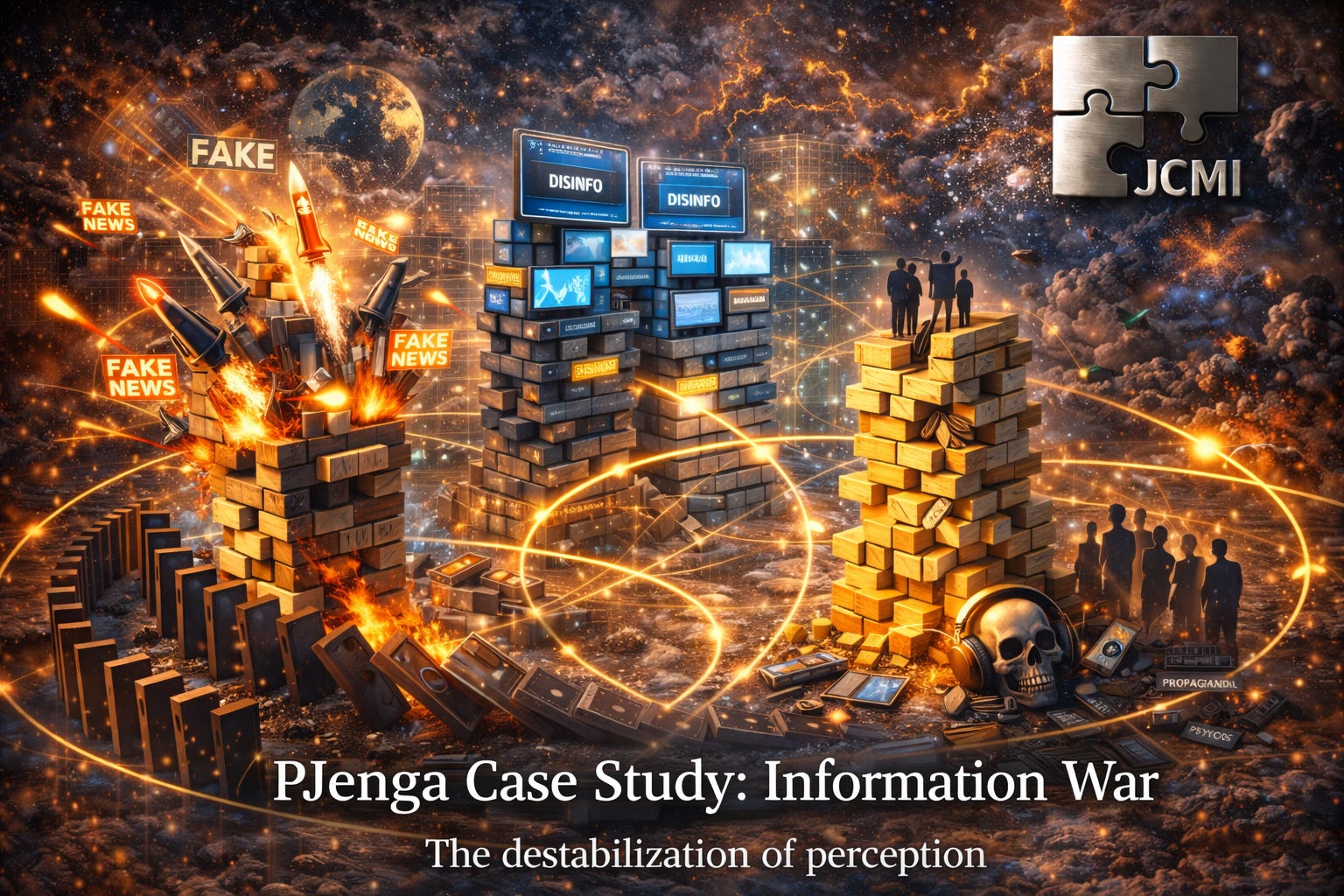
The destabilization of perception
The PJenga Framework treats information systems as a structural tower in their own right.
This reflects a fundamental change in how power operates in the modern world.
In earlier historical periods, military power and economic strength were the dominant instruments of influence.
Today, control over information environments has become equally important.
⸻
The structure of the information tower
The information tower includes:
• news media ecosystems
• social networks
• digital communication platforms
• algorithmic amplification systems
• narrative competition between political actors.
These systems shape how societies interpret events.
They influence public perception, political legitimacy, and institutional trust.
⸻
Information as structural pressure
Information dynamics can create pressure across other towers even without physical disruptions.
Disinformation campaigns may weaken public trust in institutions.
Narrative conflicts can amplify political polarization.
Online rumor dynamics can trigger financial volatility.
In this way, informational instability can generate real-world systemic consequences.
⸻
Acceleration in the digital age
Digital communication networks dramatically accelerate the spread of narratives.
Information moves globally within seconds.
Emotional or polarizing content often spreads faster than verified information.
This creates conditions in which perception may shift faster than institutions can respond.
⸻
Strategic manipulation
State actors, political movements, and non-state groups increasingly attempt to shape information environments intentionally.
Information operations can target:
• electoral systems
• public health policies
• geopolitical conflicts
• economic confidence.
These campaigns aim to shift the balance within the Societal Tower and weaken institutional resilience.
⸻
The PJenga interpretation
Within the PJenga Framework, the information tower functions both as a structural system and as an amplifier.
It does not merely reflect reality.
It shapes how societies interpret and respond to stress within other towers.
In a highly interconnected digital world, the destabilization of perception can become a powerful force in the overall balance of the system.
⸻
Conclusion of the 8 Part PJenga Series
Together, these modules illustrate how the PJenga Framework can be used to analyze complex global dynamics.
Instead of focusing solely on isolated events, the model emphasizes structural stability, systemic tension, and cascading interactions between interconnected systems.
In an era defined by overlapping crises and rapid information flows, understanding these structural dynamics may become increasingly important for interpreting global developments.
If you want to follow future PJenga case studies, subscribe.
Part of the PJenga Framework Series
The PJenga Framework is a systems-analysis model developed by Ike Aaren Hadler.
The following articles explain the structure of the model step by step:
1. Introduction – The PJenga Framework
2. The Seven PJenga Towers – Structural foundations of the system
3. Forces within the PJenga System – Pressure, friction and acceleration
4. The PJenga Dashboard – Monitoring systemic stability
5. Cascades and Domino Effects within the PJenga Framework
6. PJenga Case Study – Hormus: Energy shock and systemic stress
7. PJenga Case Study – Ukraine: Military conflict and structural strain
8. PJenga Case Study – Information War: The destabilization of perception


Part of the PJenga Framework Series
https://jcmi2025.substack.com/p/1-indroduction
https://jcmi2025.substack.com/p/the-seven-pjenga-towers
https://jcmi2025.substack.com/p/3-forces-within-the-pjenga-system
https://jcmi2025.substack.com/p/4-the-pjenga-dashboard
https://jcmi2025.substack.com/p/5-cascades-and-dominoeffects-within
https://jcmi2025.substack.com/p/6-pjenga-case-study-hormus
https://jcmi2025.substack.com/p/7-pjenga-case-study-ukraine
https://jcmi2025.substack.com/p/8-pjenga-case-study-information-war