
The PJenga Framework by
Ike Aaren Hadler -
2026-03-05
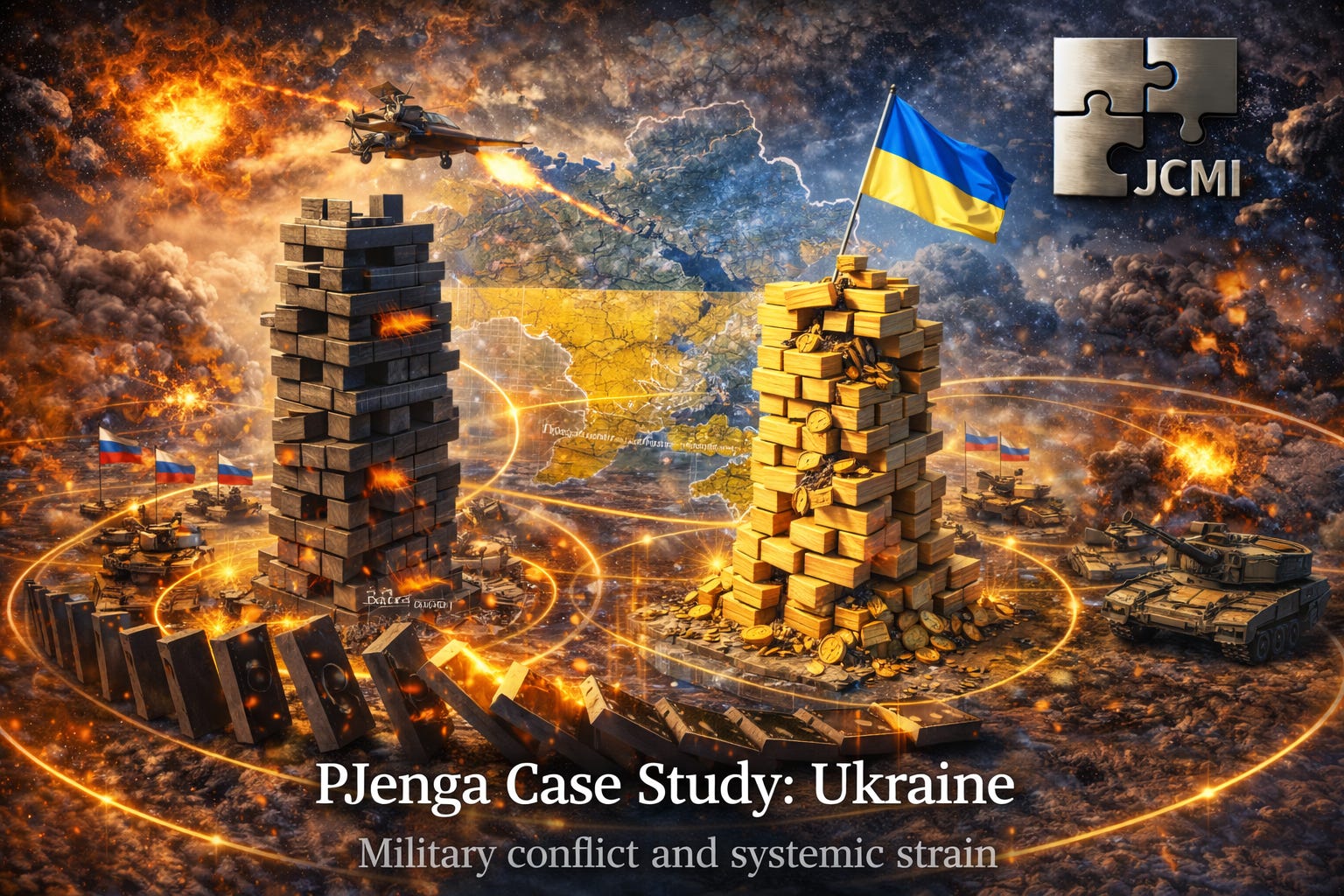
Military conflict and systemic strain
The war in Ukraine provides a clear example of how instability within the security tower can propagate across the entire PJenga system.
When the conflict escalated in 2022, it initially appeared as a regional military crisis.
However, its systemic consequences quickly revealed how deeply interconnected global systems have become.
⸻
Pressure on the security tower
The most immediate effect was a direct increase in geopolitical tension.
Military forces mobilized across Eastern Europe.
NATO defense planning intensified.
Sanctions regimes expanded.
The security architecture of the European continent entered a period of structural stress.
⸻
Energy consequences
Russia has historically been one of the world’s largest exporters of natural gas and oil.
Sanctions, pipeline disruptions, and political confrontation quickly translated into energy market volatility.
European energy systems faced immediate supply uncertainty.
Energy prices surged.
This transferred pressure from the Security Tower into the Energy Tower.
⸻
Economic repercussions
Higher energy prices increased production costs across industries.
Supply chains were disrupted.
Food prices rose due to the importance of Ukraine and Russia in global grain markets.
Financial markets reacted to uncertainty in energy and commodity flows.
This placed additional strain on the Economic Tower.
⸻
Societal and political effects
Economic pressure and inflation translated into domestic political stress within many countries.
Governments faced difficult trade-offs between sanctions, energy security, and economic stability.
Political polarization increased in several regions.
This moved stress into the Societal Tower.
⸻
Information warfare
The conflict also demonstrated the growing importance of the Information Tower.
Narrative competition, propaganda campaigns, and digital information warfare became central elements of the conflict.
Information ecosystems amplified political divisions and shaped global perceptions of the war.
⸻
The PJenga interpretation
The Ukraine conflict illustrates a key principle of the PJenga Framework:
Modern wars rarely remain confined to the battlefield.
They trigger cascading effects across energy systems, economic networks, political institutions, and information environments.
Understanding these interactions is essential for analyzing the broader consequences of geopolitical conflict.
If you want to follow future PJenga case studies, subscribe.
Part of the PJenga Framework Series
The PJenga Framework is a systems-analysis model developed by Ike Aaren Hadler.
The following articles explain the structure of the model step by step:
1. Introduction – The PJenga Framework
2. The Seven PJenga Towers – Structural foundations of the system
3. Forces within the PJenga System – Pressure, friction and acceleration
4. The PJenga Dashboard – Monitoring systemic stability
5. Cascades and Domino Effects within the PJenga Framework
6. PJenga Case Study – Hormus: Energy shock and systemic stress
7. PJenga Case Study – Ukraine: Military conflict and structural strain
8. PJenga Case Study – Information War: The destabilization of perception


Part of the PJenga Framework Series
https://jcmi2025.substack.com/p/1-indroduction
https://jcmi2025.substack.com/p/the-seven-pjenga-towers
https://jcmi2025.substack.com/p/3-forces-within-the-pjenga-system
https://jcmi2025.substack.com/p/4-the-pjenga-dashboard
https://jcmi2025.substack.com/p/5-cascades-and-dominoeffects-within
https://jcmi2025.substack.com/p/6-pjenga-case-study-hormus
https://jcmi2025.substack.com/p/7-pjenga-case-study-ukraine
https://jcmi2025.substack.com/p/8-pjenga-case-study-information-war