
The PJenga Framework by
Ike Aaren Hadler -
2026-03-05
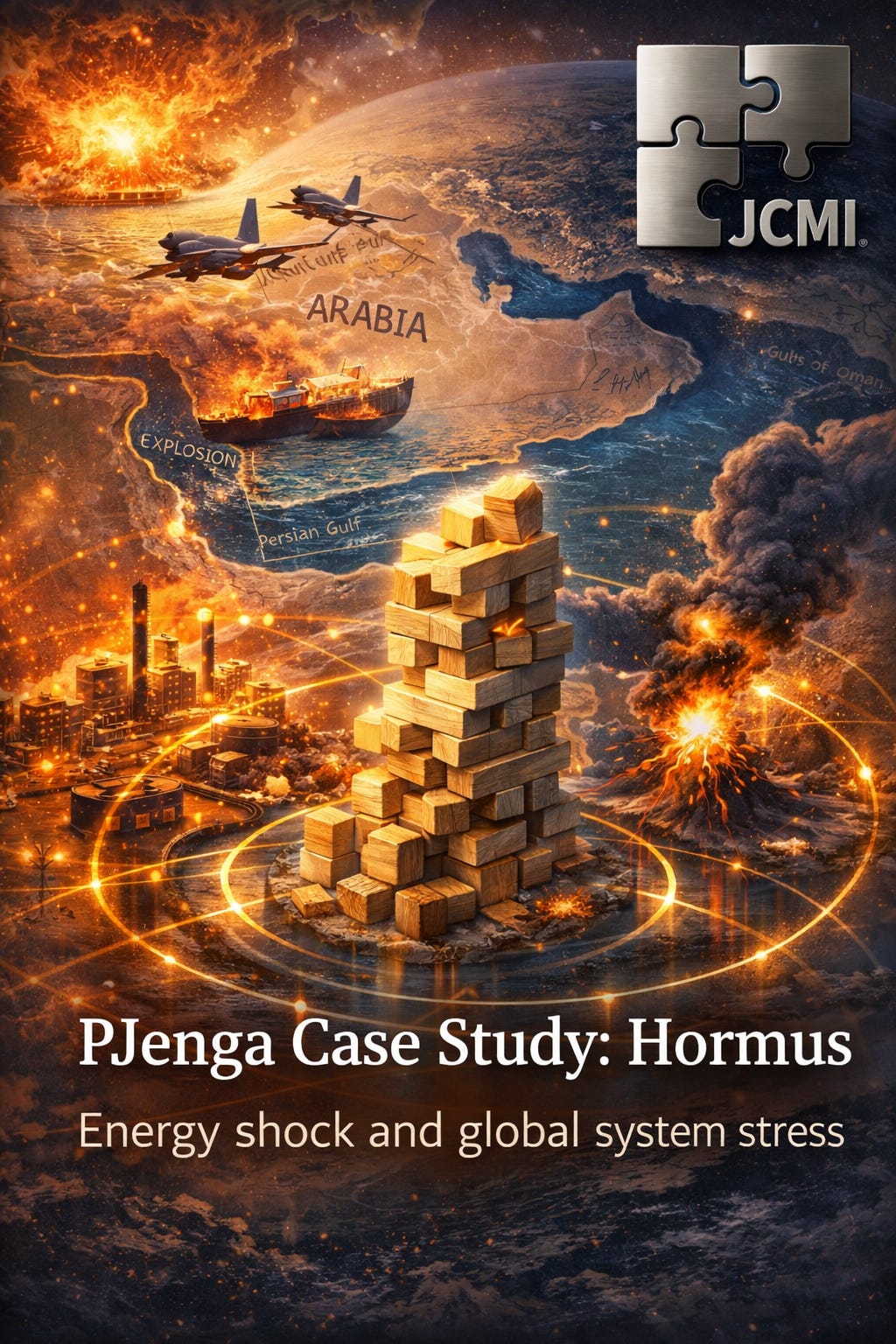
Energy shock and global system stress
Few locations in the world illustrate the PJenga Framework more clearly than the Strait of Hormuz.
This narrow maritime corridor connects the Persian Gulf to the global ocean system.
Through it flows a significant portion of the world’s oil and liquefied natural gas.
Because of this, the Hormuz corridor functions as a critical block within the energy tower.
When tension rises in this region, the effects rarely remain confined to the Middle East.
Instead they propagate rapidly through multiple PJenga towers.
⸻
Pressure on the energy tower
Military escalation, shipping disruptions, or even the perception of risk in Hormuz can immediately influence energy markets.
Insurance premiums for tanker traffic rise.
Shipping routes become more uncertain.
Energy traders begin to price in geopolitical risk.
Oil prices increase even before physical supply disruptions occur.
The first tower under stress is therefore Energy.
⸻
Transmission to the economic tower
Energy prices are directly embedded in nearly every sector of the global economy.
Transport costs increase.
Industrial production becomes more expensive.
Inflationary pressure rises across national economies.
Financial markets react immediately to energy volatility.
This moves the pressure into the Economic Tower.
⸻
Political consequences
Rising inflation and energy costs often trigger political consequences.
Governments face pressure from voters.
Subsidy programs strain national budgets.
Political polarization increases.
This pressure then moves into the Societal and Political Tower.
⸻
Information dynamics
Modern information systems accelerate these cascades.
News coverage amplifies uncertainty.
Social media spreads narratives about shortages, geopolitical escalation, or economic crisis.
Market sentiment and public perception amplify the structural stress already present in the system.
This activates the Information Tower.
⸻
The PJenga interpretation
From the perspective of the PJenga Framework, Hormuz is not simply a regional geopolitical flashpoint.
It is a structural energy block whose instability transmits pressure across multiple towers.
Understanding this interconnectedness explains why events in relatively small geographic regions can produce global economic and political consequences.
If you want to follow future PJenga case studies, subscribe.
Part of the PJenga Framework Series
The PJenga Framework is a systems-analysis model developed by Ike Aaren Hadler.
The following articles explain the structure of the model step by step:
1. Introduction – The PJenga Framework
2. The Seven PJenga Towers – Structural foundations of the system
3. Forces within the PJenga System – Pressure, friction and acceleration
4. The PJenga Dashboard – Monitoring systemic stability
5. Cascades and Domino Effects within the PJenga Framework
6. PJenga Case Study – Hormus: Energy shock and systemic stress
7. PJenga Case Study – Ukraine: Military conflict and structural strain
8. PJenga Case Study – Information War: The destabilization of perception


Part of the PJenga Framework Series
https://jcmi2025.substack.com/p/1-indroduction
https://jcmi2025.substack.com/p/the-seven-pjenga-towers
https://jcmi2025.substack.com/p/3-forces-within-the-pjenga-system
https://jcmi2025.substack.com/p/4-the-pjenga-dashboard
https://jcmi2025.substack.com/p/5-cascades-and-dominoeffects-within
https://jcmi2025.substack.com/p/6-pjenga-case-study-hormus
https://jcmi2025.substack.com/p/7-pjenga-case-study-ukraine
https://jcmi2025.substack.com/p/8-pjenga-case-study-information-war