
The PJenga Framework by
Ike Aaren Hadler -
5. March 2026
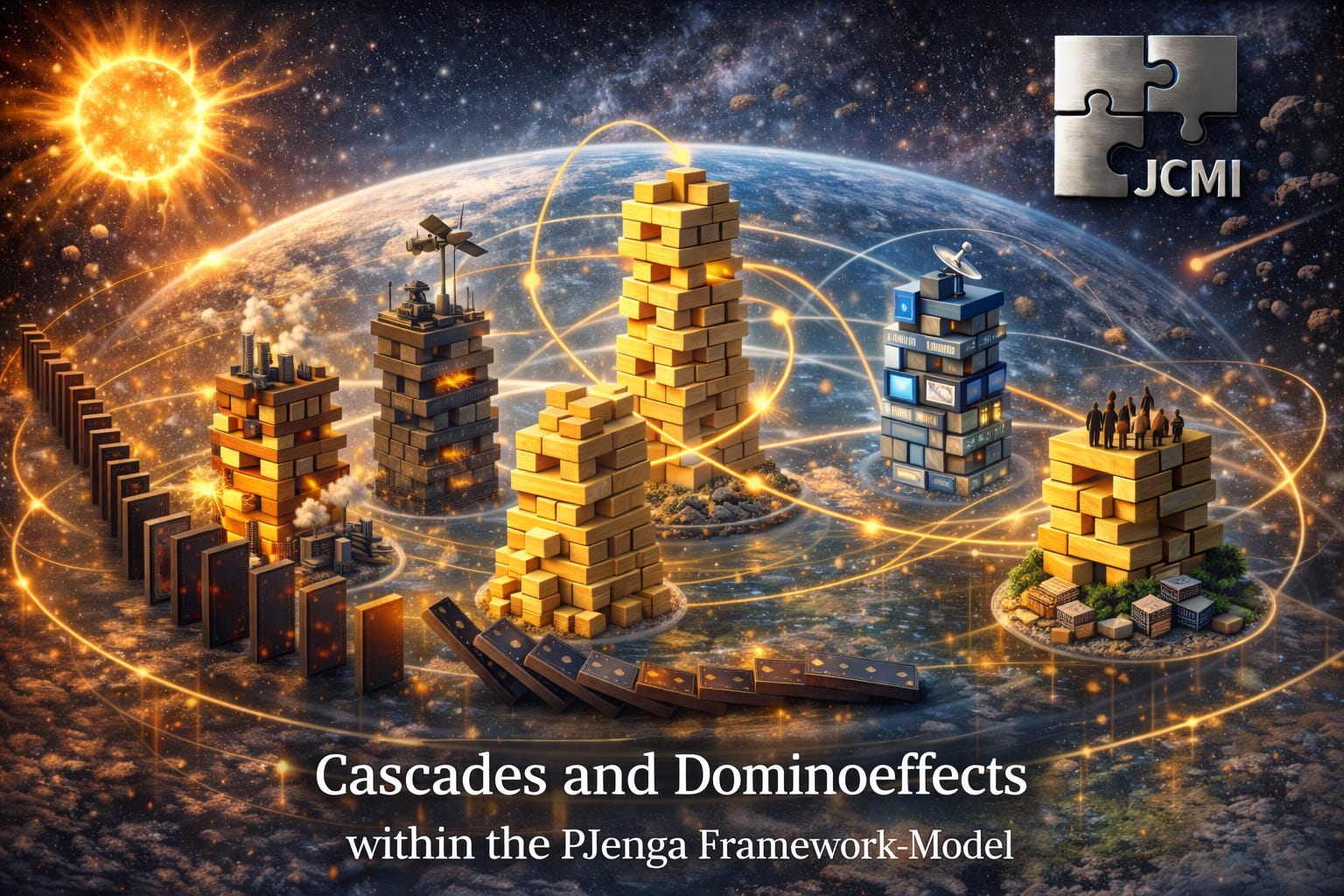
How instability spreads through the PJenga system
In complex systems, collapse rarely begins with a single dramatic event.
More often, instability spreads through cascading interactions between multiple systems.
The PJenga Framework distinguishes between two different dynamics: domino chains and structural cascades.
At first glance they appear similar, but they behave very differently.
Domino chains
A domino chain represents linear causality.
One event directly causes the next.
For example:
• a financial institution collapses
• this triggers bank failures
• which causes a market crash.
The sequence is predictable and directional.
Domino chains are relatively easy to understand.
But they are not how most modern crises unfold.
⸻
Structural cascades
The PJenga system behaves differently.
Instead of a linear chain, it operates like interconnected structures under tension.
When a block moves in one tower, the resulting shift redistributes pressure throughout the system.
Often the consequences appear in entirely different sectors.
For example:
An energy disruption increases transport costs.
Transport costs increase food prices.
Food prices increase political pressure on governments.
Political instability weakens institutions.
Institutional instability increases geopolitical risk.
None of these steps follow a straight line.
They propagate through multiple towers simultaneously.
⸻
Hidden instability
One of the most dangerous features of structural cascades is that the system can appear stable while stress accumulates internally.
A Jenga tower may stand perfectly upright even after several critical blocks have been removed.
Only later does a seemingly minor movement trigger sudden collapse.
Modern global systems behave in a similar way.
Financial markets, political institutions, and supply chains may continue to operate even as their structural resilience erodes.
By the time the crisis becomes visible, the system has already lost much of its ability to absorb shocks.
⸻
Why cascades matter
Understanding cascades is essential for analyzing modern geopolitical and economic risk.
In the PJenga Framework, analysts therefore look not only at events, but at how stress moves between towers.
The key question becomes:
Which systems are currently transmitting instability into others?
When multiple towers begin to transfer pressure simultaneously, the risk of systemic disruption increases dramatically.
Part of the PJenga Framework Series
The PJenga Framework is a systems-analysis model developed by Ike Aaren Hadler.
The following articles explain the structure of the model step by step:
1. Introduction – The PJenga Framework
2. The Seven PJenga Towers – Structural foundations of the system
3. Forces within the PJenga System – Pressure, friction and acceleration
4. The PJenga Dashboard – Monitoring systemic stability
5. Cascades and Domino Effects within the PJenga Framework
6. PJenga Case Study – Hormus: Energy shock and systemic stress
7. PJenga Case Study – Ukraine: Military conflict and structural strain
8. PJenga Case Study – Information War: The destabilization of perception


Part of the PJenga Framework Series
https://jcmi2025.substack.com/p/1-indroduction
https://jcmi2025.substack.com/p/the-seven-pjenga-towers
https://jcmi2025.substack.com/p/3-forces-within-the-pjenga-system
https://jcmi2025.substack.com/p/4-the-pjenga-dashboard
https://jcmi2025.substack.com/p/5-cascades-and-dominoeffects-within
https://jcmi2025.substack.com/p/6-pjenga-case-study-hormus
https://jcmi2025.substack.com/p/7-pjenga-case-study-ukraine
https://jcmi2025.substack.com/p/8-pjenga-case-study-information-war