
The PJenga Framework by
Ike Aaren Hadler -
5. March 2026
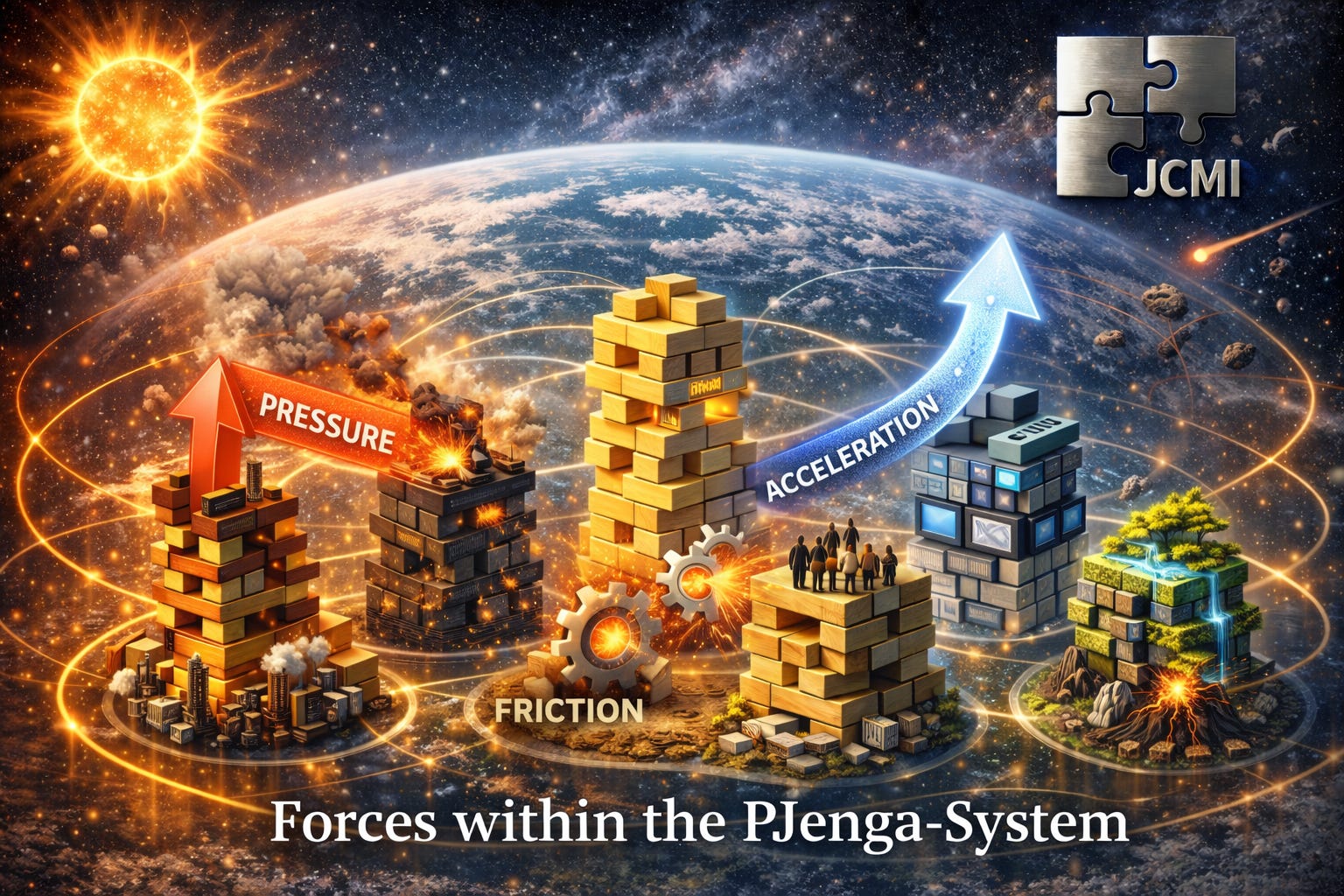
Pressure, friction, and acceleration
In the PJenga Framework, structural towers are not static.
They are constantly influenced by forces that move blocks within the system.
Three fundamental dynamics shape these movements.
Pressure
Pressure represents external or internal shocks that stress a system.
Examples include:
• military conflict
• economic crises
• supply chain disruptions
• environmental disasters
• financial instability.
Pressure increases the load on specific structural blocks. When the pressure exceeds the resilience of those blocks, they shift.
⸻
Friction
Friction represents resistance to change.
Institutions, regulations, bureaucracies, and political processes all introduce friction into systems.
Friction can have two different effects.
In some situations, it stabilizes systems by slowing rapid changes.
In other situations, excessive friction prevents necessary adjustments, allowing tension to accumulate until a larger breakdown occurs.
⸻
Acceleration
Acceleration describes mechanisms that amplify and propagate system changes.
Financial markets, digital communication networks, and algorithmic trading systems can transmit shocks across global systems within minutes.
In earlier historical periods, crises often unfolded slowly.
Today, information and economic signals move at digital speed.
Acceleration therefore increases the likelihood that stress in one tower quickly spreads to others.
⸻
The interaction between pressure, friction, and acceleration determines how the PJenga system evolves.
A small disturbance under low pressure may have little effect.
But the same disturbance under high pressure and rapid acceleration can produce cascading instability.
Part of the PJenga Framework Series
The PJenga Framework is a systems-analysis model developed by Ike Aaren Hadler.
The following articles explain the structure of the model step by step:
1. Introduction – The PJenga Framework
2. The Seven PJenga Towers – Structural foundations of the system
3. Forces within the PJenga System – Pressure, friction and acceleration
4. The PJenga Dashboard – Monitoring systemic stability
5. Cascades and Domino Effects within the PJenga Framework
6. PJenga Case Study – Hormus: Energy shock and systemic stress
7. PJenga Case Study – Ukraine: Military conflict and structural strain
8. PJenga Case Study – Information War: The destabilization of perception


Part of the PJenga Framework Series
https://jcmi2025.substack.com/p/1-indroduction
https://jcmi2025.substack.com/p/the-seven-pjenga-towers
https://jcmi2025.substack.com/p/3-forces-within-the-pjenga-system
https://jcmi2025.substack.com/p/4-the-pjenga-dashboard
https://jcmi2025.substack.com/p/5-cascades-and-dominoeffects-within
https://jcmi2025.substack.com/p/6-pjenga-case-study-hormus
https://jcmi2025.substack.com/p/7-pjenga-case-study-ukraine
https://jcmi2025.substack.com/p/8-pjenga-case-study-information-war