
The PJenga Framework by
Ike Aaren Hadler -
2026-03-05
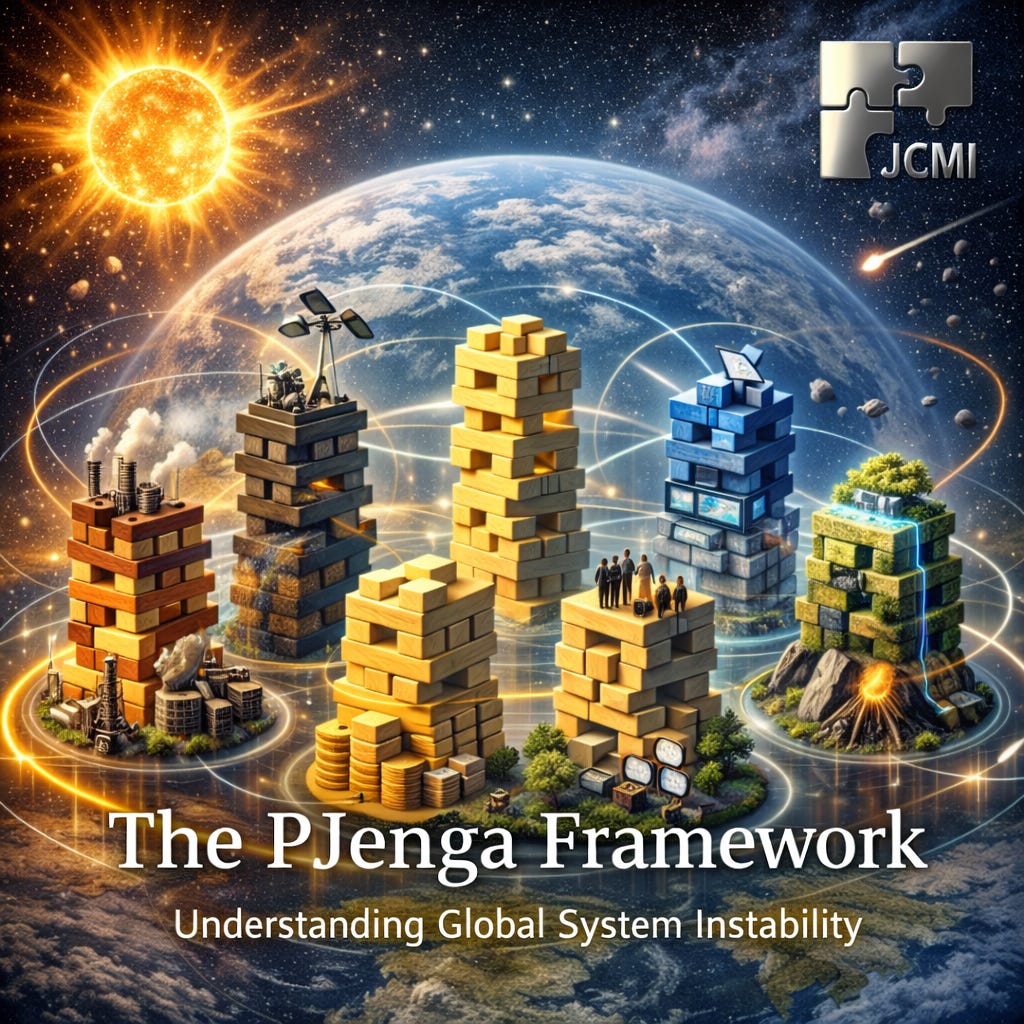
A model for understanding global system instability
The world rarely collapses in a single moment.
Most systems fail slowly.
From the outside everything still looks stable. Institutions continue to function. Markets open in the morning. Governments issue statements. Ships still move through global trade routes.
But internally something has already changed.
The structure has lost integrity.
The PJenga Framework is an attempt to describe this process.
It starts with a simple metaphor: imagine the global system not as a row of dominoes, but as a series of interconnected Jenga towers.
In a domino model, causality is linear. When one tile falls, the next must follow.
But real-world systems do not behave like domino chains.
They behave more like Jenga towers.
A block can be removed and the structure may appear stable for a long time. Yet every removed block shifts weight and tension through the system. Stress accumulates silently until a seemingly small change triggers sudden instability.
This is what makes modern crises difficult to understand.
The world is not experiencing one crisis at a time.
Instead we live inside what researchers increasingly describe as a polycrisis: multiple interacting shocks across energy systems, financial markets, geopolitical conflicts, information environments, and ecological systems.
The PJenga Framework attempts to analyze these dynamics as a structural system.
In this model, global stability rests on several interconnected “towers”. Each tower represents a fundamental system on which modern civilization depends.
Inside these towers are structural blocks: institutions, infrastructures, supply chains, social trust, military capacity, demographic stability, and natural resources.
Political actors, economic shocks, technological change, and environmental stress constantly move these blocks.
Most of the time the system absorbs these movements.
But occasionally the internal balance shifts.
When that happens, pressure in one tower propagates into others. Energy shocks affect economic systems. Information warfare destabilizes societies. Demographic changes reshape political institutions.
The PJenga model therefore does not ask only what event happened.
Instead it asks a different question:
Which structural blocks have moved, and how has the tension in the system changed?
Understanding this difference is essential in a world where crises rarely occur in isolation.
Part of the PJenga Framework Series
The PJenga Framework is a systems-analysis model developed by Ike Aaren Hadler.
The following articles explain the structure of the model step by step:
1. Introduction – The PJenga Framework
2. The Seven PJenga Towers – Structural foundations of the system
3. Forces within the PJenga System – Pressure, friction and acceleration
4. The PJenga Dashboard – Monitoring systemic stability
5. Cascades and Domino Effects within the PJenga Framework
6. PJenga Case Study – Hormus: Energy shock and systemic stress
7. PJenga Case Study – Ukraine: Military conflict and structural strain
8. PJenga Case Study – Information War: The destabilization of perception


Part of the PJenga Framework Series
https://jcmi2025.substack.com/p/1-indroduction
https://jcmi2025.substack.com/p/the-seven-pjenga-towers
https://jcmi2025.substack.com/p/3-forces-within-the-pjenga-system
https://jcmi2025.substack.com/p/4-the-pjenga-dashboard
https://jcmi2025.substack.com/p/5-cascades-and-dominoeffects-within
https://jcmi2025.substack.com/p/6-pjenga-case-study-hormus
https://jcmi2025.substack.com/p/7-pjenga-case-study-ukraine
https://jcmi2025.substack.com/p/8-pjenga-case-study-information-war